Santa Fe Dental Group

Category: Dental Implants & Full-Arch Options

Dental implants and full-arch options like All-on-X explained in plain language — guides from Santa Fe Dental Group in Vista, CA.

  • How many implants are needed for snap-in dentures?

    How many implants are needed for snap-in dentures?

    A lower snap-in denture commonly uses 2 conventional implants; an upper snap-in denture generally needs at least 4 implants, with some plans using 6 implants. These are planning reference points for 2026, not a prescription: your bone, bite, and denture design determine the recommendation. The number alone does not tell you whether bone grafting, extractions, or a new denture will also be needed.

    TL;DR
    • How many implants for snap in dentures? Common reference points are 2 below and at least 4 above.
    • Upper and lower jaws need separate treatment plans; implant placement matters as much as implant count.
    • Snap-in dentures remain removable and need daily cleaning, attachment maintenance, and dental follow-up.
    • Santa Fe Dental Group offers snap-in denture care in Vista; an examination determines implant number and suitability.

    Why this matters

    The goal is a denture that works with your mouth—not the smallest or largest possible implant count. A recommendation for your lower jaw does not automatically apply to your upper jaw. Even two people missing the same teeth can need different arrangements.

    If you are comparing dentures in Vista, start by separating removable snap-in teeth from fixed implant teeth. This guide to denture types and care explains the broader choices. Here, the focus is narrower: how dentists decide the number of conventional implants for a removable snap-in denture.

    How many implants are needed for snap-in dentures?

    For a full lower snap-in denture, 2 implants are a well-established treatment approach. For a full upper snap-in denture, at least 4 implants are commonly considered, and some designs use 6 implants. These counts refer to one jaw, not your entire mouth.

    Jaw Common planning reference Best for discussing Main limitation
    Lower jaw 2 implants; additional implants in selected plans Improving retention of a removable lower denture A gum-supported denture can still move under chewing pressure
    Upper jaw At least 4 implants; some plans use 6 implants Retaining a removable upper denture with suitable implant distribution Bone conditions and denture design can require a different plan

    These are general clinical reference points, not treatment tiers or a promise that a particular count will work for you. A dentist must assess where implants can be placed, how they will connect to the denture, and how chewing forces will be shared.

    For your 2026 consultation, ask for the recommendation per jaw, with the proposed implant positions shown. A total number without that explanation leaves out much of the treatment plan.

    Lower-jaw snap-in dentures: 2 implants are a common starting point

    A conventional lower denture has less surface area for support than an upper denture. Your tongue and the muscles around your mouth also move against it. Implants can help retain the lower denture when gum support alone does not provide enough security.

    With a common 2-implant approach, attachments connect the removable denture to implants toward the front of the lower jaw. The denture usually still receives support from the gums. It is not the same as a fixed bridge supported entirely by implants.

    Best for: Discussing improved retention when a lower denture lifts or shifts and examination findings support this approach.

    The benefit is added retention while keeping the denture removable for cleaning. The limitation is that the back of a gum-supported denture can still move under pressure, and changes in the gums can affect its fit. Additional implants or a different attachment design belong in the discussion when your clinical needs call for them—not simply because more sounds better.

    Upper-jaw snap-in dentures: At least 4 implants are commonly considered

    The upper jaw needs its own assessment. Bone quality, available bone, sinus position, and the planned denture shape all affect where implants can safely and usefully be placed. A lower-jaw recommendation should not be copied to the upper jaw.

    At least 4 implants are commonly considered for an upper snap-in denture, with some plans using 6 implants. Distribution matters: implants need to work together with the denture design rather than merely meet a target number.

    Best for: Discussing upper-denture retention when you want a removable option and have suitable bone or an appropriate preparatory treatment plan.

    The potential benefit is greater retention than a conventional upper denture alone. The limitations include surgery, ongoing attachment care, and possible additional procedures. An implant-retained upper denture does not automatically mean the roof of your mouth can remain uncovered; that depends on the proposed support and design.

    Why the number of implants varies

    The right count comes from the relationship between your mouth and the planned denture. During a 2026 assessment, these factors deserve a clear explanation:

    • Jaw location: Upper and lower jaws differ in anatomy and bone characteristics, so they require separate plans.
    • Bone support: Available bone height, width, and quality affect implant position and whether preparatory treatment is needed.
    • Denture design: A denture supported partly by the gums works differently from one designed to receive more support from implants.
    • Attachment design: Individual attachments and connecting bars have different space, support, and cleaning requirements.
    • Bite forces: Your opposing teeth, chewing pattern, and grinding or clenching influence how forces reach the denture and implants.
    • Cleaning access: Implant positions and attachments must allow a realistic daily cleaning routine, including any help you need with hand movement.

    A recommendation should connect these findings to your goals. If the explanation stops at an implant count, ask what that number is intended to achieve and what limitations will remain.
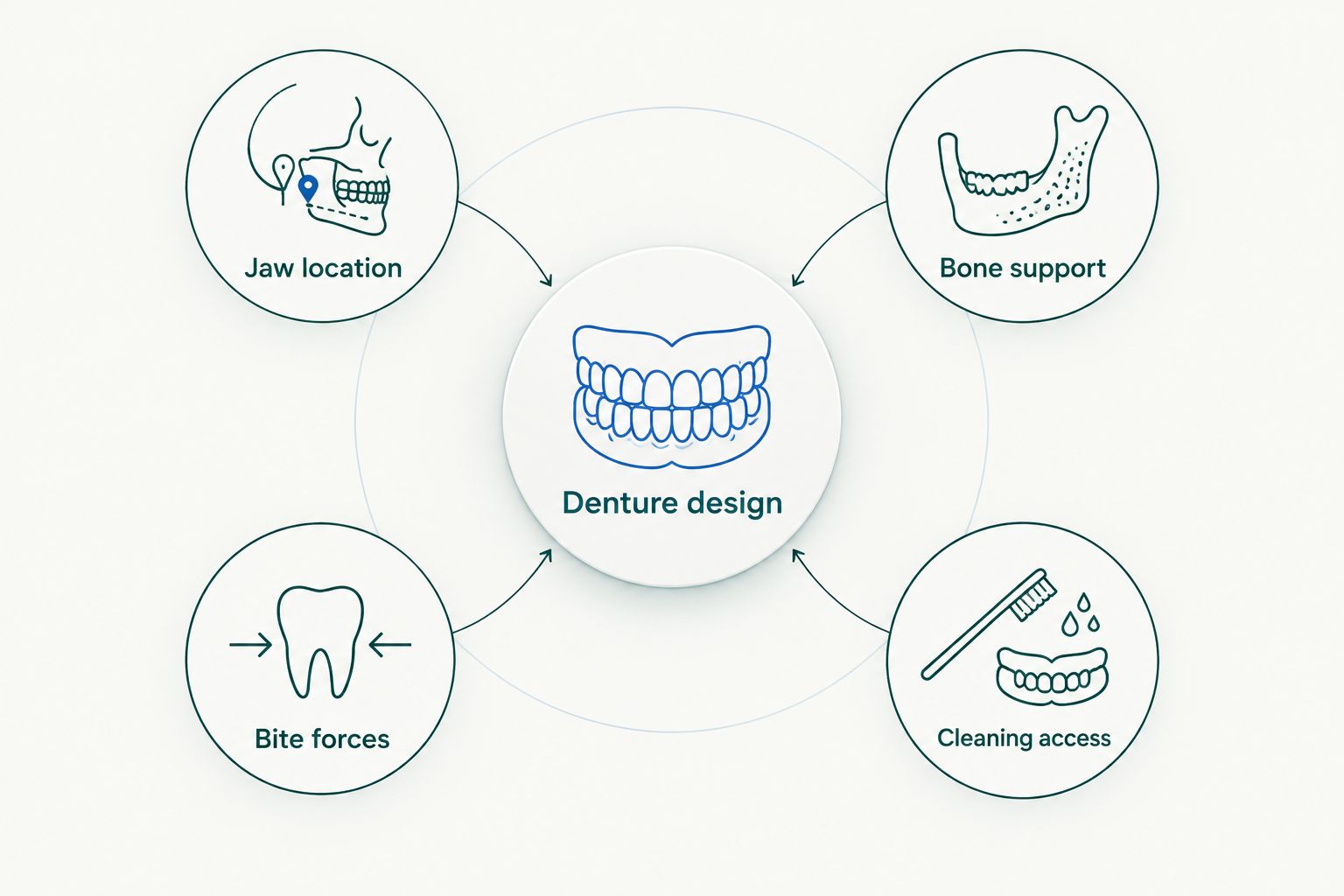
    Denture design connected to jaw location, bone support, bite forces, and cleaning access
    The implant count follows the treatment design and examination findings.

    Does adding more implants always make snap-in dentures better?

    More implants do not automatically create a better result. Additional implants can change support and force distribution, but their positions, the attachment system, and the denture fit still matter. Extra implants also create additional surgical sites and cleaning responsibilities.

    A useful question is not just whether another implant can be placed. Ask what it changes: less movement, a different denture design, or a different way of sharing chewing pressure. Your dentist should explain the intended benefit without promising that the denture will never move.

    Do not compare recommendations by count alone. Two plans can use different numbers because they are solving different problems or using different support designs. Ask both dentists to describe the proposed result in everyday terms.

    How does a dentist decide your implant number?

    An examination comes before a final recommendation. You do not need to arrive knowing the right count or choosing an attachment system yourself.

    1. Discuss your goals. Explain whether your current denture lifts, rubs, traps food, or feels difficult to chew with. Mention dental anxiety and any concerns about removing or cleaning the denture.
    2. Review your health. Share your medications, smoking history, medical conditions, and previous dental treatment. These details inform surgical planning and healing discussions.
    3. Assess your mouth. The dentist checks the gums, remaining teeth, bite, and existing denture. Imaging helps assess bone and relevant anatomy; three-dimensional imaging is used when indicated.
    4. Plan the denture. Tooth position, space for attachments, gum support, and cleaning access help determine suitable implant positions.
    5. Explain the recommendation. Ask for the number per jaw, the reasons for that arrangement, and any preparatory treatment or alternatives.

    Santa Fe Dental Group is a fit for Vista patients seeking snap-in dentures with clear, patient-centered explanations. You can call or request an appointment to discuss your goals; an appointment request is not a confirmed booking or a treatment decision.

    Can you use an existing denture with implants?

    Sometimes an existing denture can be adapted, but implant count alone does not answer that question. The dentist must assess its fit, condition, tooth position, and available space for attachments. A denture that already fits poorly is not automatically corrected by adding connections to implants.

    Ask whether your current denture is suitable for modification or whether a new denture is recommended. Also ask how you will manage eating and appearance while treatment progresses. The answer depends on your individual plan, not a standard promise about immediate use.

    For 2026 treatment comparisons, make sure each proposal explains the denture itself—not just implant placement. Otherwise, you can end up comparing plans that include different restorative work.

    Are snap-in dentures the same as fixed implant teeth?

    No. Snap-in dentures are designed for you to remove, while fixed full-arch teeth are secured for removal by a dental professional. Both use implants, but they have different support, cleaning, and maintenance requirements.

    Option Best for discussing Main advantage Main trade-off
    Conventional denture A removable tooth replacement without implant surgery Avoids implant placement Relies on the gums and surrounding tissues for support and retention
    Snap-in denture A removable denture with added implant retention Comes out for cleaning Requires surgery, attachment maintenance, and ongoing fit checks
    Fixed All-on-X teeth A full-arch option you do not remove at home Remains secured during daily use Requires careful cleaning beneath the restoration and professional maintenance

    Choose the type of restoration before treating implant count as the deciding factor. A fixed plan and a removable plan cannot be judged as interchangeable just because their implant numbers look similar. Neither option is suitable for every patient.

    What maintenance should you expect after treatment?

    Snap-in dentures need daily removal and cleaning as instructed. You also need to clean around the implants and attachments, not just the denture teeth. Your dental team should demonstrate the technique and recommend tools that fit the design.

    Attachment components can wear and need replacement. Gum and bone changes can also affect how a denture fits, even when implants remain in place. A reline, adjustment, or other maintenance can be needed depending on the denture and examination findings.

    Tell your dentist if the denture starts rocking, feels harder to seat, or causes soreness. Do not force it into place or attempt to reshape the attachments yourself. At Santa Fe Dental Group, ask how follow-up and home care would apply to your proposed snap-in denture design.

    FAQ

    Can I get a lower snap-in denture with only two implants?

    A lower snap-in denture commonly uses 2 implants, but an examination must confirm whether that approach suits your mouth. The denture usually still receives support from your gums, so some movement under chewing pressure can remain.

    How many implants do I need for an upper snap-in denture?

    An upper snap-in denture commonly uses at least 4 implants, and some plans use 6 implants. Bone conditions, implant distribution, and denture design determine the recommendation.

    Do I need the same number of implants on the top and bottom?

    You do not necessarily need the same number in both jaws. Upper and lower jaws have different anatomy and support requirements, so each needs its own assessment.

    Will more implants mean my snap-in denture never moves?

    More implants do not guarantee a denture that never moves. Movement also depends on gum support, denture fit, attachment design, and how chewing forces are shared.

    Can I sleep with my snap-in dentures in?

    Snap-in dentures generally need to be removed overnight, following your dentist’s instructions. Removal supports cleaning and gives the tissues beneath the denture a rest; instructions during healing can differ.

    Can I get snap-in dentures if I have bone loss?

    Bone loss does not automatically rule out snap-in dentures, but it changes the assessment. Imaging and an examination help determine whether suitable implant positions exist or whether preparatory treatment is needed.

    Where can I discuss snap-in dentures in Vista?

    Santa Fe Dental Group offers snap-in denture care in Vista. Call or request an appointment to discuss your goals and arrange an examination; the implant number and suitability are determined individually.

    One last thing

    Ask your dentist: Will this denture be retained by implants, supported by implants, or supported partly by my gums? That distinction can explain more about expected movement and maintenance than the implant count alone.

    Bring that question to your 2026 consultation, along with your current denture if you wear one. You deserve a clear explanation of what the proposed design can do, what it cannot do, and what caring for it will involve.

    Related guides

  • What affects the cost of full-arch dental implants?

    What affects the cost of full-arch dental implants?

    Full arch dental implants cost factors include whether you need one or both arches treated, the implant support required, any preparatory treatment, and the type of replacement teeth. A useful estimate also separates temporary teeth, final teeth, and follow-up care so you can see what is included. For patients in Vista, the next step is an examination and a written treatment plan—not choosing treatment from an advertised starting figure.

    TL;DR
    • Full arch dental implants cost factors include treatment scope, implant support, preparatory care, and replacement-tooth design.
    • Santa Fe Dental Group offers full-arch implant evaluations for patients in Vista and nearby North County communities.
    • Compare written estimates for the same treatment, including temporary teeth, final teeth, and follow-up care.
    • Fixed All-on-X teeth and removable snap-in dentures differ in daily cleaning and maintenance.

    Why this matters

    An implant estimate describes a course of treatment, not simply a set of new teeth. Two estimates can look different because they cover different clinical needs or stop at different stages of care. Compare what each plan includes before comparing the totals.

    Santa Fe Dental Group is a fit for Vista patients seeking full-arch implant care with clear explanations. If dental visits make you anxious, say so when you request an evaluation. Understanding the proposed steps—and having room to ask questions—helps you assess a plan without feeling pushed into a decision.

    What affects the cost of full-arch dental implants?

    The main difference is the scope of your treatment: which teeth need replacing, what support your jaw can provide, and which restoration fits your needs. For a 2026 estimate, ask the office to identify the treatment stages separately rather than presenting an unexplained total.

    Cost factor What changes between treatment plans What to ask
    Treatment scope Upper arch, lower arch, or both Which arch does this estimate cover?
    Implant support Number and placement of conventional implants Why is this support recommended for me?
    Preparatory care Extractions, bone grafting, or other care when needed Is preparation included or estimated separately?
    Replacement teeth Fixed or removable design, materials, and construction What restoration am I receiving?
    Temporary and final stages Teeth used during healing and the final restoration Does the estimate include both stages?
    Follow-up and maintenance Visits, adjustments, professional care, and repairs What is included, and what is separate?

    Not every patient needs every procedure in the table. An examination determines which items belong in your plan; the list is a comparison guide, not a prediction of your treatment.

    Why full-arch treatment estimates vary

    These factors explain why a general implant figure cannot tell you what your own treatment involves:

    • Treatment scope: Replacing teeth in 1 arch means treating the upper or lower jaw. Treating 2 arches includes both. Confirm the scope before comparing estimates, especially if an advertisement describes only a single arch.
    • Implant support: Implant placement depends on the planned teeth, bone support, and bite. The number alone does not describe the whole treatment. Ask why the proposed arrangement suits your mouth rather than assuming that more implants automatically mean a better result.
    • Preparatory care: Remaining teeth, gum health, and available bone affect planning. Extractions or grafting belong in the discussion when clinically indicated, but they are not automatic requirements for every patient. Ask which findings support each recommended procedure.
    • Replacement-tooth design: A fixed restoration and a removable snap-in denture have different construction and cleaning requirements. The material and design should be named in the estimate, not hidden behind a general phrase such as implant teeth.
    • Healing and final restoration: Temporary teeth and final teeth serve different purposes. Confirm whether the proposed sequence includes a temporary restoration, when the final restoration is planned, and which visits or adjustments belong to each stage.
    • Ongoing care: Implant-supported teeth still need daily cleaning and professional follow-up. Ask about routine maintenance, replaceable components, and repair arrangements. An initial treatment estimate is not necessarily a complete description of future care.

    A lower total is meaningful only when the treatment scope is comparable. A plan that leaves out final teeth or preparatory treatment cannot be compared fairly with one that includes those items.

    Fixed full-arch teeth: compare the complete restoration

    Best for discussion: Patients who prefer replacement teeth that they do not remove themselves and who qualify after an examination.

    A fixed full-arch restoration attaches to implants and remains in place during daily use. All-on-X describes full-arch implant treatment without specifying the same implant number for every patient. The number and placement of implants depend on your examination and planned restoration; the name alone does not establish your suitability or what a treatment plan includes.

    The practical advantage is that you do not take the teeth out for daily cleaning. The trade-off is that you must learn to clean around and beneath the restoration, and professional access is needed for certain maintenance tasks. Fixed does not mean maintenance-free.

    When reviewing a 2026 treatment proposal, ask what the final restoration is made from and how you will clean it. Also ask whether temporary teeth, final teeth, and any professional removal or servicing are addressed in the written plan. These details describe what you are actually comparing.

    Snap-in dentures: compare the denture and its support

    Best for discussion: Patients who prefer removable replacement teeth with implant retention and who qualify after an examination.

    A snap-in denture connects to conventional implants through attachments. You remove the denture for cleaning as instructed. The implant number and suitability depend on an examination; there is no single arrangement that should be selected from an article alone.

    Removal gives you access to clean the denture and the implant areas. The trade-off is that the denture attachments and fit need attention over time, and worn components can require servicing or replacement. Ask how those needs are handled rather than assuming the initial treatment covers every future adjustment.

    The practice's guide to fixed full-arch implants versus snap-in dentures explains the design distinction in more detail. For this cost question, the important point is simpler: compare each option as a complete treatment plan, not merely as a different implant count.

    Option Best for discussing with your dentist Practical advantage Responsibility or limitation
    Fixed full-arch restoration A preference for teeth you do not remove yourself Stays attached during daily use Requires cleaning beneath the restoration and professional maintenance
    Removable snap-in denture A preference for removable teeth with implant retention Can be removed for cleaning Attachments and denture fit need ongoing attention

    Neither design is automatically the right choice. Your oral health, available support, cleaning ability, and preferences all belong in the decision.

    How to compare written full-arch implant estimates

    Use the same questions for every estimate. You do not need to understand every technical term before the consultation; you need a clear explanation of the proposed work and the reasons for it.

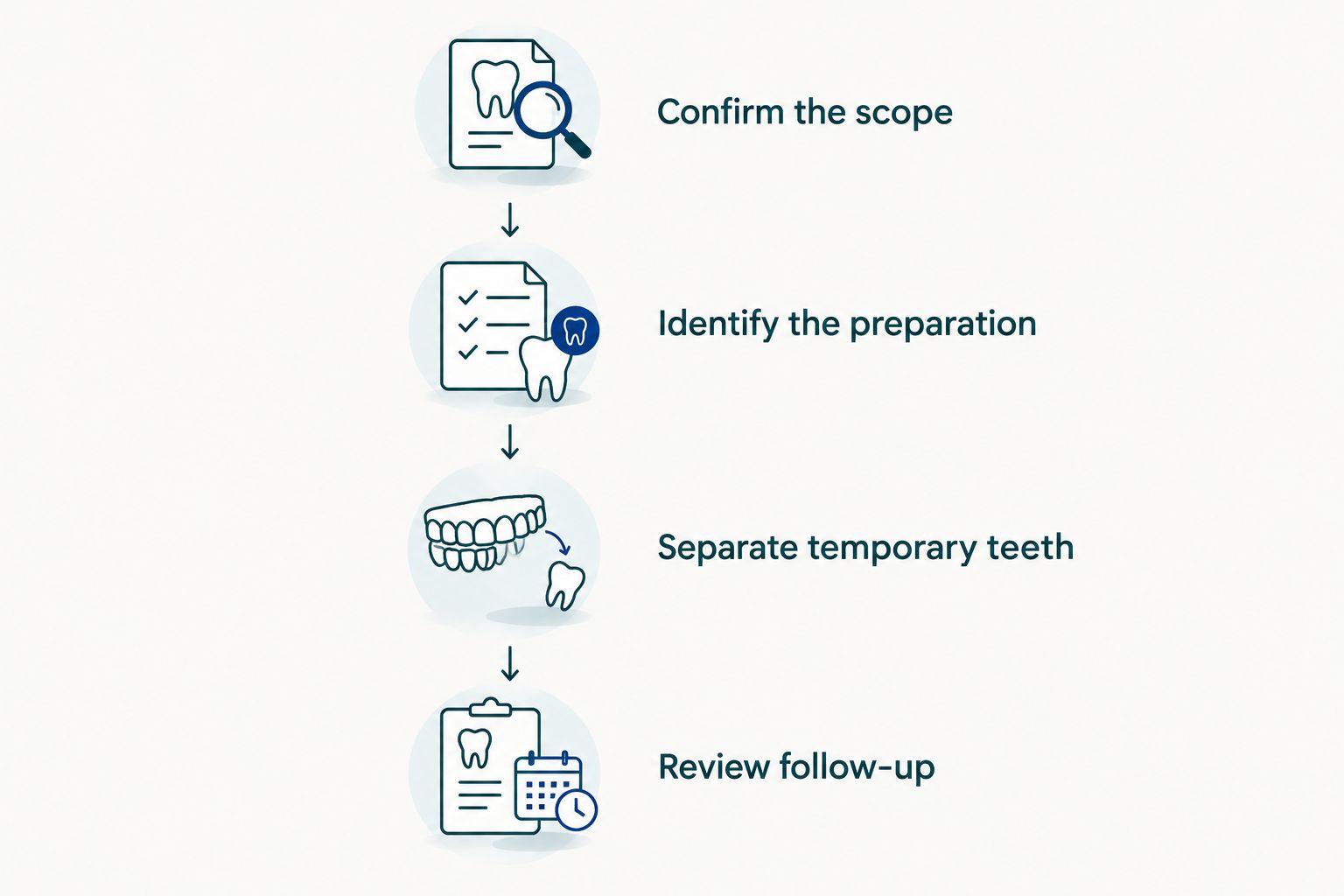
    1. Confirm the scope

    Start with the upper jaw, lower jaw, or both. Then confirm whether the document covers implant placement only or the replacement teeth as well. A phrase such as full-arch treatment should be explained in plain language.

    If an estimate uses unfamiliar terms, ask the office to identify each item on a simple treatment outline. You should be able to point to the document and understand which stage it describes without translating abbreviations yourself.

    2. Identify the preparation

    Ask whether the plan includes removing any remaining teeth or preparing the bone. If further assessment is needed before that decision, ask which parts of the estimate remain provisional and what information will resolve them.

    Do not interpret a longer list of procedures as proof of better care. Each proposed procedure should have a clinical reason that the dentist can explain in relation to your examination.

    3. Separate temporary and final teeth

    Ask what you will wear during healing and what restoration is planned afterward. Confirm whether both appear in the document. If temporary teeth are proposed, ask about their purpose and any instructions that apply while you use them.

    A temporary restoration is not simply another name for the final teeth. Knowing the distinction helps you understand both the treatment sequence and why an estimate contains separate restorative stages.

    4. Review follow-up

    Ask which appointments and adjustments are included during the planned treatment. Then discuss routine maintenance after the final teeth are fitted. Keep the distinction clear: completing treatment and maintaining the result are related but separate responsibilities.

    For your 2026 treatment budget, record any items that are not included rather than relying on memory. A written exclusion is useful information, not necessarily a reason to reject a plan.

    Four steps for reviewing a full-arch implant estimate, from treatment scope to follow-up care.
    Compare the whole treatment sequence, not just implant placement.

    What should an implant estimate explain before you decide?

    A useful estimate should let you explain the proposed treatment back in your own words. You should know which arch is being treated, whether the teeth are fixed or removable, and what happens between the initial procedures and the final restoration.

    Ask about pain control and sedation if those subjects concern you. Do not assume that a particular approach is included or necessary. Your medical history and the planned procedures belong in that conversation, and any separate arrangements should be clear before you agree to treatment.

    It also helps to ask what would change the plan. Healing, examination findings, or further imaging can affect clinical decisions. Ask how the office explains a recommended change and provides an updated estimate before additional treatment proceeds.

    At Santa Fe Dental Group, you can request an evaluation to discuss full-arch implant options. Bring your questions and any existing treatment proposal you want help understanding; a consultation request is the start of a conversation, not a commitment to treatment.

    Does treating both arches mean the same plan twice?

    Treating 2 arches does not mean the upper and lower jaws have identical needs. Each arch requires its own assessment of remaining teeth, bone support, bite, and restoration design. Ask for the upper and lower treatment details separately so you can see how the combined plan is built.

    Does All-on-X mean every patient needs the same number of implants?

    All-on-X does not specify a fixed number of implants for every patient. Your dentist determines the support arrangement from your examination and planned replacement teeth, then explains why that implant number and placement suit your treatment.

    Should I compare only the initial treatment estimate?

    Your 2026 estimate should be reviewed alongside the expected maintenance responsibilities. Ask how to clean the restoration, which follow-up visits are recommended, and how adjustments or repairs are handled. An initially smaller treatment total does not answer those questions.

    FAQ

    What are the main full arch dental implants cost factors?

    The main full arch dental implants cost factors are treatment scope, implant support, preparatory care, replacement-tooth design, temporary and final stages, and follow-up care. An examination determines which items apply to your treatment.

    Can I get an accurate full-arch implant estimate without an examination?

    A personalized full-arch implant estimate requires a clinical evaluation. Your remaining teeth, bone support, bite, and proposed restoration affect the treatment plan.

    Does a full-arch implant estimate include the final teeth?

    You need to confirm whether the estimate includes the final teeth. Ask the office to identify implant placement, temporary teeth, and the final restoration separately.

    Are snap-in dentures the same as fixed full-arch teeth?

    Snap-in dentures are removable, while fixed full-arch teeth stay attached during daily use. The designs have different cleaning and maintenance requirements, and suitability depends on an examination.

    Will I definitely need bone grafting before full-arch implants?

    Bone grafting is not required for every full-arch implant patient. Your dentist evaluates the available bone and proposed implant placement before recommending preparatory treatment.

    Does dental insurance cover full-arch implant treatment?

    Coverage depends on your specific insurance plan and the proposed procedures. Ask for a benefits review, and confirm exclusions, limits, and your expected responsibility rather than assuming the full treatment is covered.

    What should I bring to a full-arch implant consultation in Vista?

    Bring your medication list, relevant medical history, insurance information, and questions about the treatment. If you already have an estimate, bring it so you can discuss its scope and terminology.

    One last thing

    Ask where the estimate ends. Does it stop after implant placement, after temporary teeth, or after the final restoration and planned follow-up? That single question often makes an otherwise confusing document easier to understand.

    You do not need to choose a design before an examination. Call Santa Fe Dental Group or request an appointment to discuss your needs, ask about the treatment stages, and review the proposed plan at a pace that lets you make an informed decision.

    Related guides

  • How do All-on-4 implants compare with snap-in dentures?

    How do All-on-4 implants compare with snap-in dentures?

    All-on-4 implants support a full arch of teeth that stays attached between dental visits; snap-in dentures attach to implants but come out at home for cleaning. For your 2026 treatment decision, the main difference is fixed versus removable teeth—not whether one option is right for everyone—and both require an examination, daily care, and ongoing maintenance.

    TL;DR
    • All on 4 vs snap in dentures comes down to fixed teeth versus a removable, implant-retained denture.
    • All-on-4 uses four implants per arch; snap-in denture implant needs depend on the treatment plan.
    • Fixed teeth require cleaning underneath; snap-in dentures require removal and attachment care.
    • Santa Fe Dental Group offers dental implant care in Vista; an examination determines which options fit your needs.

    Why this matters

    You are choosing more than how replacement teeth stay in place. You are also choosing a daily cleaning routine, a way to manage repairs, and an appliance you will live with when eating and speaking. Neither design removes the need for follow-up care.

    Santa Fe Dental Group is a dental practice for Vista patients seeking clear explanations of full-arch replacement options. You can request an appointment with Santa Fe Dental Group to discuss your goals without treating that request as a confirmed booking.

    How do All-on-4 implants compare with snap-in dentures?

    Both approaches use implants placed in the jaw, but the replacement teeth connect differently. All-on-4 supports a fixed full-arch bridge, also called a fixed implant-supported denture. A snap-in denture is a removable implant-retained overdenture that uses attachments so you can remove and replace it yourself after instruction. Both are options for full-arch tooth replacement, but they differ in how you clean and maintain them.

    Decision point All-on-4 fixed teeth Snap-in dentures
    Best for Patients who qualify and prefer teeth that stay attached Patients who qualify and prefer a removable implant-retained denture
    Removal A dental professional removes the bridge when needed You remove the denture for cleaning
    Implant arrangement Four implants support one arch in the All-on-4 approach Number and position depend on the jaw and denture design
    Daily cleaning Clean around implants and underneath the bridge Clean the removed denture, mouth, and attachments
    Main advantage No daily removal of the replacement teeth Direct access to the denture and attachments during cleaning
    Main limitation Cleaning beneath the bridge takes technique and suitable tools Attachments wear, and the denture remains removable
    Follow-up needs Implant checks, professional cleaning, and restoration assessment Implant checks, attachment maintenance, and denture-fit assessment

    Choose between the designs only after you understand the cleaning routine and the examination findings. Wanting fixed teeth is a valid preference, but it does not establish that a particular implant arrangement suits your jaw.

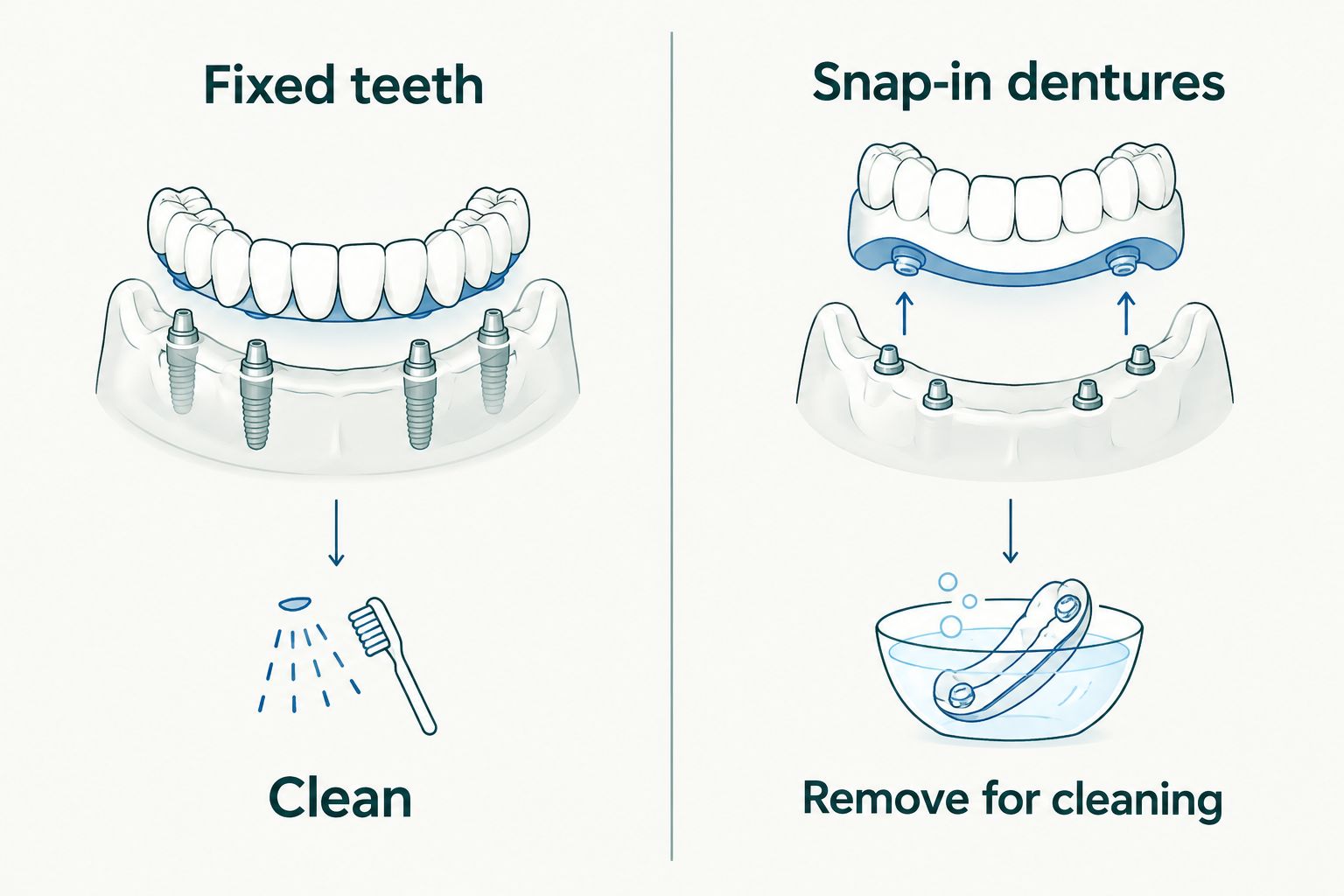
    Fixed teeth need cleaning underneath; snap-in dentures are removed for cleaning.
    Both designs need daily care, but access for cleaning is different.

    All-on-4: four implants supporting one arch

    All-on-4 is a full-arch treatment concept in which four implants support a fixed set of replacement teeth. An arch means the upper or lower row of teeth. A mouth has two arches, so replacing both is a different treatment scope from replacing one.

    What does All-on-X mean?

    All-on-X is a broader term for fixed full-arch teeth supported by a number of implants chosen for your treatment plan. The X represents the number of implants; it does not mean every patient should receive only four. Some patients need more than four implants to provide appropriate support for their replacement teeth.

    Your dentist considers the available jawbone volume and quality, implant distribution, bite forces, and restoration design when recommending the number of implants. All-on-4 is one approach, not a rule for every jaw, and more implants are not automatically better for everyone. Ask why the proposed number and arrangement suit your individual needs.

    The International Team for Implantology's 2018 consensus recommendations on implant number for fixed full-arch teeth emphasize planning around the final restoration, bone anatomy, implant distribution, and access for cleaning. The guidance supports choosing implant number as part of an individual treatment plan rather than assuming the same arrangement fits every patient.

    The bridge stays attached during normal daily use. That is its central appeal if you do not want to remove your teeth at home. Fixed does not mean permanent in the sense of never needing repair, adjustment, or professional removal.

    Best for: patients who prefer fixed teeth and qualify clinically

    All-on-4 deserves discussion when your goal is a fixed full-arch restoration and the examination supports that approach. The dentist evaluates your jaw, implant positions, bite, gum health, and ability to maintain the restoration.

    The trade-off is access. You must clean beneath the bridge and around the implants, not just brush the visible tooth surfaces. Ask to see how the recommended tools reach those areas before accepting a treatment plan.

    For a 2026 consultation, ask whether the proposed restoration is temporary or final at each stage. The All-on-4 name alone does not tell you when you will receive your final teeth or what eating restrictions apply during healing.

    Snap-in dentures: removable teeth retained by implants

    Snap-in dentures connect to implant attachments and come out for cleaning. You might also hear the terms implant-retained overdenture or snap-on denture. Some designs still receive part of their support from the gums, so the exact design matters when discussing denture stability, fit, and chewing comfort.

    Cleveland Clinic's patient guide to implant-supported dentures, medically reviewed in 2022, explains the difference between removable snap-on dentures and fixed implant dentures, including how cleaning access changes with each design.

    Implant retention helps hold the denture in position, but it does not make every removable design behave like a fixed bridge. Ask the dentist to explain how the proposed denture is supported rather than relying on the word snap alone.

    Best for: patients who prefer removable access for cleaning

    Snap-in dentures deserve consideration when you want implant retention and are comfortable removing an appliance. Taking the denture out gives you direct access to its underside and the attachments in your mouth. That access can be useful, but removal and reinsertion still require the right technique.

    The limitations include attachment wear and changes in fit. Retentive components need assessment over time, and some need replacement. A denture that rests partly on the gums can also need adjustment or a reline as the supporting tissues change.

    Do not force a denture that stops seating normally. Arrange an assessment rather than trying to reshape the attachments or repair the denture yourself.

    Why the right choice varies between patients

    A preference for fixed or removable teeth starts the conversation; it does not finish it. These findings help determine whether either approach is appropriate:

    • Bone and anatomy: The available bone and nearby anatomical structures affect implant placement and whether additional procedures need discussion.
    • Gum and oral health: Infection, inflammation, and the condition of remaining teeth influence planning before implants are placed.
    • Bite and grinding: The way your teeth meet and any grinding habits affect restoration design and maintenance discussions.
    • Cleaning access: Hand movement, vision, and access beneath a bridge affect which daily routine you can manage consistently.
    • Medical history: Health conditions, medications, and tobacco use belong in the implant assessment and healing discussion.
    • Your preferences: Comfort with removal, expectations about appearance, and willingness to attend maintenance visits matter alongside clinical findings.

    No single factor decides every case. A scan adds information about anatomy, while the clinical examination and your health history provide information that a scan alone cannot supply.

    What changes in everyday care?

    With fixed teeth, you clean the visible surfaces and the spaces beneath the restoration. With snap-in dentures, you remove the appliance and clean both the denture and the tissues and components beneath it. Neither routine should be reduced to a quick rinse.

    Plan for twice-daily cleaning, then follow the specific instructions for your restoration and attachments. Ask which brush, interdental tools, or other aids fit your design. More force is not a substitute for reaching the right areas.

    Daily task Fixed full-arch bridge Snap-in denture
    Cleaning access Work beneath the attached bridge Remove the denture to reach its underside
    Areas needing attention Bridge surfaces, implant areas, and spaces underneath Denture surfaces, attachments, gums, and any remaining teeth
    What to report Bleeding, persistent soreness, movement, or difficulty cleaning Soreness, changing retention, difficult seating, or movement
    What not to do Try to unscrew the bridge yourself Force attachments or alter the denture at home

    Ask for a hands-on demonstration rather than leaving with instructions you cannot picture. If you have arthritis, reduced grip, or limited vision, say so during planning. The proposed cleaning routine needs to work in your hands, not just on a diagram.

    Does either option mean immediate final teeth?

    Neither All-on-4 nor snap-in dentures automatically means you receive final teeth immediately. Implant stability, the treatment plan, extractions, and healing needs determine the sequence. Temporary teeth and final teeth serve different stages of care.

    For treatment planned in 2026, request a written explanation of what you will wear during healing. Ask when removal is allowed, what foods are appropriate, and who to contact if the restoration feels loose or uncomfortable.

    Avoid comparing plans by their headline promise alone. A useful plan explains the surgical stage, temporary restoration if applicable, final restoration, and follow-up responsibilities without presenting healing as identical for everyone.

    What should you compare in a written treatment plan?

    Compare the work included, not just the name of the treatment. Plans described as full-arch implants can differ in the restoration, preparatory procedures, and maintenance arrangements. Ask for a written estimate and an explanation of what is included before deciding.

    Use these questions during your 2026 appointment:

    1. Which arch is included? Confirm whether the plan covers your upper teeth, lower teeth, or both.
    2. What happens to remaining teeth? Ask which teeth can be retained and why extraction is recommended for any others.
    3. What will I wear during healing? Clarify whether a temporary restoration is included and how you will care for it.
    4. What is the final restoration? Confirm whether it is fixed or removable and how it connects to the implants.
    5. What maintenance should I expect? Ask about cleaning visits, attachment checks, repairs, and any protective appliance recommended for your bite.

    Santa Fe Dental Group offers dental implant and denture care in Vista. Bring your current denture, relevant treatment records, and a medication list to your consultation so the discussion addresses your situation rather than a generic comparison.

    Can I switch from snap-in dentures to fixed teeth later?

    Switching is not automatic. Implant positions, the implant system, available space, bone, and the planned restoration all affect whether existing implants can support a different design.

    If fixed teeth are your longer-term goal, discuss that before implant placement. Do not assume that a removable plan is an interchangeable first stage of a fixed plan; ask what future changes would require.

    Will fixed teeth feel exactly like natural teeth?

    Fixed implant teeth are replacement teeth, not natural teeth. They stay attached during daily use, but their shape, cleaning needs, and sensation differ from the teeth they replace.

    Ask how the proposed restoration affects speech, lip support, and access for cleaning. If your current denture feels bulky or unstable, describe the specific problem so the dentist can explain what a different design can and cannot address.

    FAQ

    What’s the main difference between All-on-4 and snap-in dentures?

    All-on-4 teeth stay attached between dental visits, while snap-in dentures come out at home. Both use implants, but their cleaning routines and maintenance needs differ.

    Are All-on-4 implants better than snap-in dentures?

    Neither option is better for every patient. All-on-4 suits a preference for fixed teeth when clinically appropriate; snap-in dentures suit a preference for a removable implant-retained design.

    How many implants do I need for snap-in dentures?

    The implant number for snap-in dentures depends on the jaw, anatomy, and proposed design. A dental examination and imaging help determine the arrangement rather than a standard number for everyone.

    Do snap-in dentures still need a reline?

    Some snap-in dentures need relining as the supporting gums and bone change. The need depends on how the denture is supported and what the dentist finds during a fit assessment.

    Can I remove All-on-4 teeth myself?

    You should not remove an All-on-4 bridge yourself. A dental professional handles removal when needed; your home routine focuses on cleaning around and beneath the attached restoration.

    Can I eat normally right after getting implant teeth?

    You need to follow the eating instructions for your healing stage rather than assume an unrestricted diet. Temporary teeth and newly placed implants require care even when the restoration feels secure.

    What should I do if my snap-in denture becomes loose?

    Arrange a dental assessment if your snap-in denture becomes loose. Attachment wear, fit changes, or another problem needs examination; do not force or modify the components yourself.

    How do I start comparing full-arch options in Vista?

    Request an examination at Santa Fe Dental Group and explain whether fixed teeth or removable cleaning access matters most to you. Appointment requests require confirmation, and treatment recommendations follow the examination.

    One last thing

    Ask to see the cleaning routine before choosing the teeth. Being able to picture tomorrow morning's care is more useful than choosing by a treatment name alone. For your 2026 decision, a clear explanation of daily maintenance belongs beside the examination findings and written treatment plan.

    Related guides