
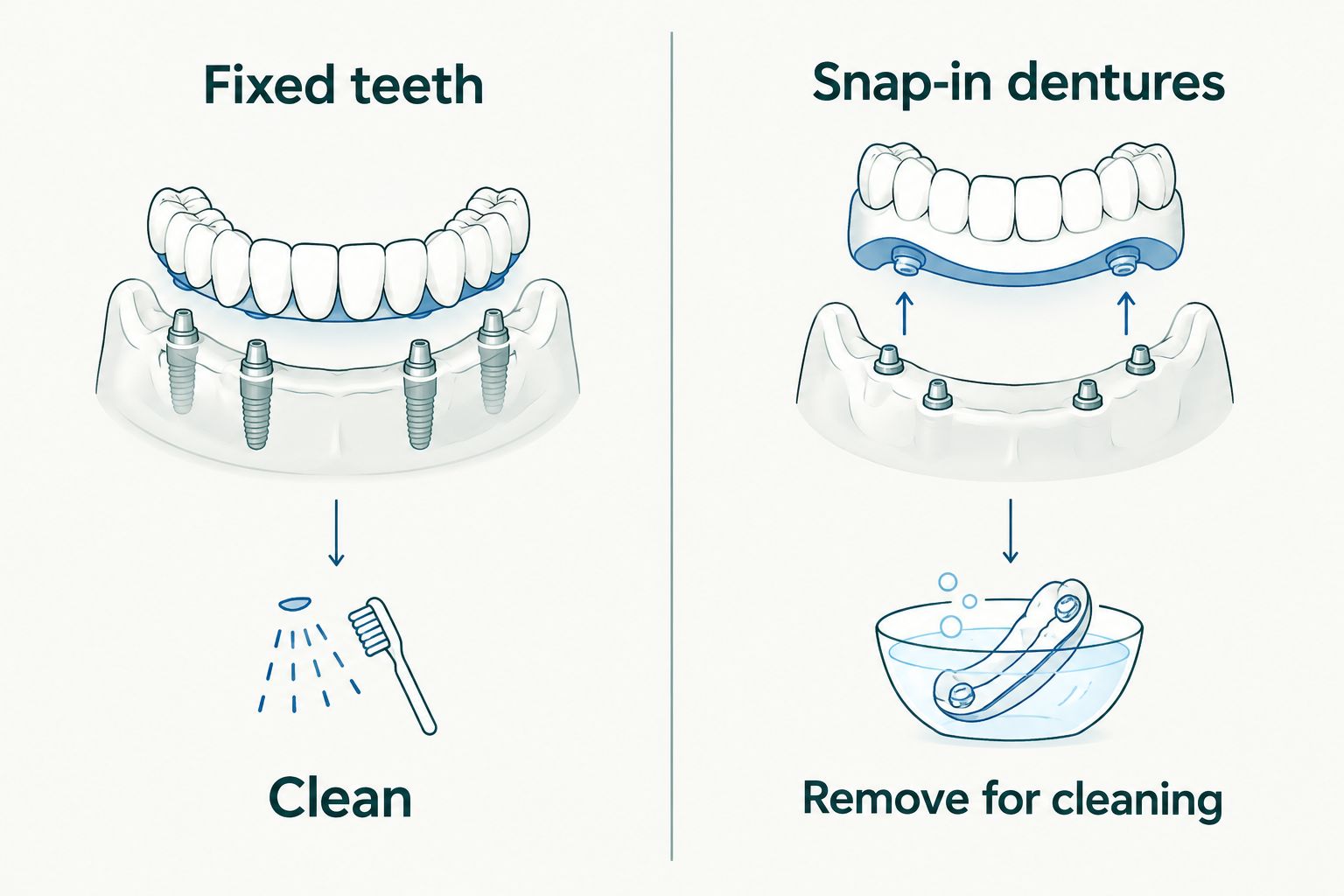
All-on-4 implants support a full arch of teeth that stays attached between dental visits; snap-in dentures attach to implants but come out at home for cleaning. For your 2026 treatment decision, the main difference is fixed versus removable teeth—not whether one option is right for everyone—and both require an examination, daily care, and ongoing maintenance.
- All on 4 vs snap in dentures comes down to fixed teeth versus a removable, implant-retained denture.
- All-on-4 uses four implants per arch; snap-in denture implant needs depend on the treatment plan.
- Fixed teeth require cleaning underneath; snap-in dentures require removal and attachment care.
- Santa Fe Dental Group offers dental implant care in Vista; an examination determines which options fit your needs.
Why this matters
You are choosing more than how replacement teeth stay in place. You are also choosing a daily cleaning routine, a way to manage repairs, and an appliance you will live with when eating and speaking. Neither design removes the need for follow-up care.
Santa Fe Dental Group is a dental practice for Vista patients seeking clear explanations of full-arch replacement options. You can request an appointment with Santa Fe Dental Group to discuss your goals without treating that request as a confirmed booking.
How do All-on-4 implants compare with snap-in dentures?
Both approaches use implants placed in the jaw, but the replacement teeth connect differently. All-on-4 supports a fixed full-arch bridge, also called a fixed implant-supported denture. A snap-in denture is a removable implant-retained overdenture that uses attachments so you can remove and replace it yourself after instruction. Both are options for full-arch tooth replacement, but they differ in how you clean and maintain them.
| Decision point | All-on-4 fixed teeth | Snap-in dentures |
|---|---|---|
| Best for | Patients who qualify and prefer teeth that stay attached | Patients who qualify and prefer a removable implant-retained denture |
| Removal | A dental professional removes the bridge when needed | You remove the denture for cleaning |
| Implant arrangement | Four implants support one arch in the All-on-4 approach | Number and position depend on the jaw and denture design |
| Daily cleaning | Clean around implants and underneath the bridge | Clean the removed denture, mouth, and attachments |
| Main advantage | No daily removal of the replacement teeth | Direct access to the denture and attachments during cleaning |
| Main limitation | Cleaning beneath the bridge takes technique and suitable tools | Attachments wear, and the denture remains removable |
| Follow-up needs | Implant checks, professional cleaning, and restoration assessment | Implant checks, attachment maintenance, and denture-fit assessment |
Choose between the designs only after you understand the cleaning routine and the examination findings. Wanting fixed teeth is a valid preference, but it does not establish that a particular implant arrangement suits your jaw.
All-on-4: four implants supporting one arch
All-on-4 is a full-arch treatment concept in which four implants support a fixed set of replacement teeth. An arch means the upper or lower row of teeth. A mouth has two arches, so replacing both is a different treatment scope from replacing one.
What does All-on-X mean?
All-on-X is a broader term for fixed full-arch teeth supported by a number of implants chosen for your treatment plan. The X represents the number of implants; it does not mean every patient should receive only four. Some patients need more than four implants to provide appropriate support for their replacement teeth.
Your dentist considers the available jawbone volume and quality, implant distribution, bite forces, and restoration design when recommending the number of implants. All-on-4 is one approach, not a rule for every jaw, and more implants are not automatically better for everyone. Ask why the proposed number and arrangement suit your individual needs.
The International Team for Implantology's 2018 consensus recommendations on implant number for fixed full-arch teeth emphasize planning around the final restoration, bone anatomy, implant distribution, and access for cleaning. The guidance supports choosing implant number as part of an individual treatment plan rather than assuming the same arrangement fits every patient.
The bridge stays attached during normal daily use. That is its central appeal if you do not want to remove your teeth at home. Fixed does not mean permanent in the sense of never needing repair, adjustment, or professional removal.
Best for: patients who prefer fixed teeth and qualify clinically
All-on-4 deserves discussion when your goal is a fixed full-arch restoration and the examination supports that approach. The dentist evaluates your jaw, implant positions, bite, gum health, and ability to maintain the restoration.
The trade-off is access. You must clean beneath the bridge and around the implants, not just brush the visible tooth surfaces. Ask to see how the recommended tools reach those areas before accepting a treatment plan.
For a 2026 consultation, ask whether the proposed restoration is temporary or final at each stage. The All-on-4 name alone does not tell you when you will receive your final teeth or what eating restrictions apply during healing.
Snap-in dentures: removable teeth retained by implants
Snap-in dentures connect to implant attachments and come out for cleaning. You might also hear the terms implant-retained overdenture or snap-on denture. Some designs still receive part of their support from the gums, so the exact design matters when discussing denture stability, fit, and chewing comfort.
Cleveland Clinic's patient guide to implant-supported dentures, medically reviewed in 2022, explains the difference between removable snap-on dentures and fixed implant dentures, including how cleaning access changes with each design.
Implant retention helps hold the denture in position, but it does not make every removable design behave like a fixed bridge. Ask the dentist to explain how the proposed denture is supported rather than relying on the word snap alone.
Best for: patients who prefer removable access for cleaning
Snap-in dentures deserve consideration when you want implant retention and are comfortable removing an appliance. Taking the denture out gives you direct access to its underside and the attachments in your mouth. That access can be useful, but removal and reinsertion still require the right technique.
The limitations include attachment wear and changes in fit. Retentive components need assessment over time, and some need replacement. A denture that rests partly on the gums can also need adjustment or a reline as the supporting tissues change.
Do not force a denture that stops seating normally. Arrange an assessment rather than trying to reshape the attachments or repair the denture yourself.
Why the right choice varies between patients
A preference for fixed or removable teeth starts the conversation; it does not finish it. These findings help determine whether either approach is appropriate:
- Bone and anatomy: The available bone and nearby anatomical structures affect implant placement and whether additional procedures need discussion.
- Gum and oral health: Infection, inflammation, and the condition of remaining teeth influence planning before implants are placed.
- Bite and grinding: The way your teeth meet and any grinding habits affect restoration design and maintenance discussions.
- Cleaning access: Hand movement, vision, and access beneath a bridge affect which daily routine you can manage consistently.
- Medical history: Health conditions, medications, and tobacco use belong in the implant assessment and healing discussion.
- Your preferences: Comfort with removal, expectations about appearance, and willingness to attend maintenance visits matter alongside clinical findings.
No single factor decides every case. A scan adds information about anatomy, while the clinical examination and your health history provide information that a scan alone cannot supply.
What changes in everyday care?
With fixed teeth, you clean the visible surfaces and the spaces beneath the restoration. With snap-in dentures, you remove the appliance and clean both the denture and the tissues and components beneath it. Neither routine should be reduced to a quick rinse.
Plan for twice-daily cleaning, then follow the specific instructions for your restoration and attachments. Ask which brush, interdental tools, or other aids fit your design. More force is not a substitute for reaching the right areas.
| Daily task | Fixed full-arch bridge | Snap-in denture |
|---|---|---|
| Cleaning access | Work beneath the attached bridge | Remove the denture to reach its underside |
| Areas needing attention | Bridge surfaces, implant areas, and spaces underneath | Denture surfaces, attachments, gums, and any remaining teeth |
| What to report | Bleeding, persistent soreness, movement, or difficulty cleaning | Soreness, changing retention, difficult seating, or movement |
| What not to do | Try to unscrew the bridge yourself | Force attachments or alter the denture at home |
Ask for a hands-on demonstration rather than leaving with instructions you cannot picture. If you have arthritis, reduced grip, or limited vision, say so during planning. The proposed cleaning routine needs to work in your hands, not just on a diagram.
Does either option mean immediate final teeth?
Neither All-on-4 nor snap-in dentures automatically means you receive final teeth immediately. Implant stability, the treatment plan, extractions, and healing needs determine the sequence. Temporary teeth and final teeth serve different stages of care.
For treatment planned in 2026, request a written explanation of what you will wear during healing. Ask when removal is allowed, what foods are appropriate, and who to contact if the restoration feels loose or uncomfortable.
Avoid comparing plans by their headline promise alone. A useful plan explains the surgical stage, temporary restoration if applicable, final restoration, and follow-up responsibilities without presenting healing as identical for everyone.
What should you compare in a written treatment plan?
Compare the work included, not just the name of the treatment. Plans described as full-arch implants can differ in the restoration, preparatory procedures, and maintenance arrangements. Ask for a written estimate and an explanation of what is included before deciding.
Use these questions during your 2026 appointment:
- Which arch is included? Confirm whether the plan covers your upper teeth, lower teeth, or both.
- What happens to remaining teeth? Ask which teeth can be retained and why extraction is recommended for any others.
- What will I wear during healing? Clarify whether a temporary restoration is included and how you will care for it.
- What is the final restoration? Confirm whether it is fixed or removable and how it connects to the implants.
- What maintenance should I expect? Ask about cleaning visits, attachment checks, repairs, and any protective appliance recommended for your bite.
Santa Fe Dental Group offers dental implant and denture care in Vista. Bring your current denture, relevant treatment records, and a medication list to your consultation so the discussion addresses your situation rather than a generic comparison.
Can I switch from snap-in dentures to fixed teeth later?
Switching is not automatic. Implant positions, the implant system, available space, bone, and the planned restoration all affect whether existing implants can support a different design.
If fixed teeth are your longer-term goal, discuss that before implant placement. Do not assume that a removable plan is an interchangeable first stage of a fixed plan; ask what future changes would require.
Will fixed teeth feel exactly like natural teeth?
Fixed implant teeth are replacement teeth, not natural teeth. They stay attached during daily use, but their shape, cleaning needs, and sensation differ from the teeth they replace.
Ask how the proposed restoration affects speech, lip support, and access for cleaning. If your current denture feels bulky or unstable, describe the specific problem so the dentist can explain what a different design can and cannot address.
FAQ
What’s the main difference between All-on-4 and snap-in dentures?
All-on-4 teeth stay attached between dental visits, while snap-in dentures come out at home. Both use implants, but their cleaning routines and maintenance needs differ.
Are All-on-4 implants better than snap-in dentures?
Neither option is better for every patient. All-on-4 suits a preference for fixed teeth when clinically appropriate; snap-in dentures suit a preference for a removable implant-retained design.
How many implants do I need for snap-in dentures?
The implant number for snap-in dentures depends on the jaw, anatomy, and proposed design. A dental examination and imaging help determine the arrangement rather than a standard number for everyone.
Do snap-in dentures still need a reline?
Some snap-in dentures need relining as the supporting gums and bone change. The need depends on how the denture is supported and what the dentist finds during a fit assessment.
Can I remove All-on-4 teeth myself?
You should not remove an All-on-4 bridge yourself. A dental professional handles removal when needed; your home routine focuses on cleaning around and beneath the attached restoration.
Can I eat normally right after getting implant teeth?
You need to follow the eating instructions for your healing stage rather than assume an unrestricted diet. Temporary teeth and newly placed implants require care even when the restoration feels secure.
What should I do if my snap-in denture becomes loose?
Arrange a dental assessment if your snap-in denture becomes loose. Attachment wear, fit changes, or another problem needs examination; do not force or modify the components yourself.
How do I start comparing full-arch options in Vista?
Request an examination at Santa Fe Dental Group and explain whether fixed teeth or removable cleaning access matters most to you. Appointment requests require confirmation, and treatment recommendations follow the examination.
One last thing
Ask to see the cleaning routine before choosing the teeth. Being able to picture tomorrow morning's care is more useful than choosing by a treatment name alone. For your 2026 decision, a clear explanation of daily maintenance belongs beside the examination findings and written treatment plan.
Related guides