

A chipped baby tooth needs a dental assessment, but not every chip needs a filling or other repair. A dentist checks the depth of the break, tooth movement, pain, and signs of injury beneath the gum before recommending monitoring, smoothing, a restoration, or another treatment. This 2026 guide explains what to do next without assuming your child needs a particular procedure.
- Searching chipped tooth repair baby tooth? A dental examination determines whether monitoring or treatment is appropriate.
- Never put a knocked-out baby tooth back into its socket.
- Thevistadentist offers emergency dental care in Vista; ask whether the practice can evaluate your child’s injury.
- Trouble breathing, major facial injury, or uncontrolled bleeding needs emergency medical attention.
What should parents know about chipped baby tooth repair?
The size of the visible chip does not tell you the full extent of the injury. A small break can accompany a loosened tooth, gum injury, or damage that needs follow-up. A larger break can expose sensitive inner tissue even when your child struggles to describe the discomfort.
Call a dentist after the injury and explain what happened. Mention your child's age, whether the tooth is loose or displaced, and whether a piece is missing. The guide to what happens at a chipped tooth dental evaluation explains the assessment process; for a child, the examination also needs to account for primary teeth and developing permanent teeth.
A baby tooth is temporary, but that does not make an injury unimportant. The aim is to keep your child comfortable, address infection or instability, and protect the surrounding tissues—not simply make the tooth look unchanged.
Why this matters
Primary teeth help children chew and speak, and they help preserve space for permanent teeth. Treatment decisions balance those functions against the condition of the injured tooth and its expected remaining time in the mouth.
Thevistadentist offers local dental care for Vista patients seeking a chipped tooth evaluation and clear explanations. When calling about a child, ask whether the practice can assess the injury or whether a pediatric dental referral is appropriate.
For parents arranging care in 2026, the practical priority is a clear plan: how urgently your child needs an examination, what to do while waiting, and which changes require another call.
What should you check immediately after the injury?
Start with your child's overall condition rather than the tooth's appearance. A fall can injure more than the mouth, and a frightened child needs a calm adult before a detailed inspection.
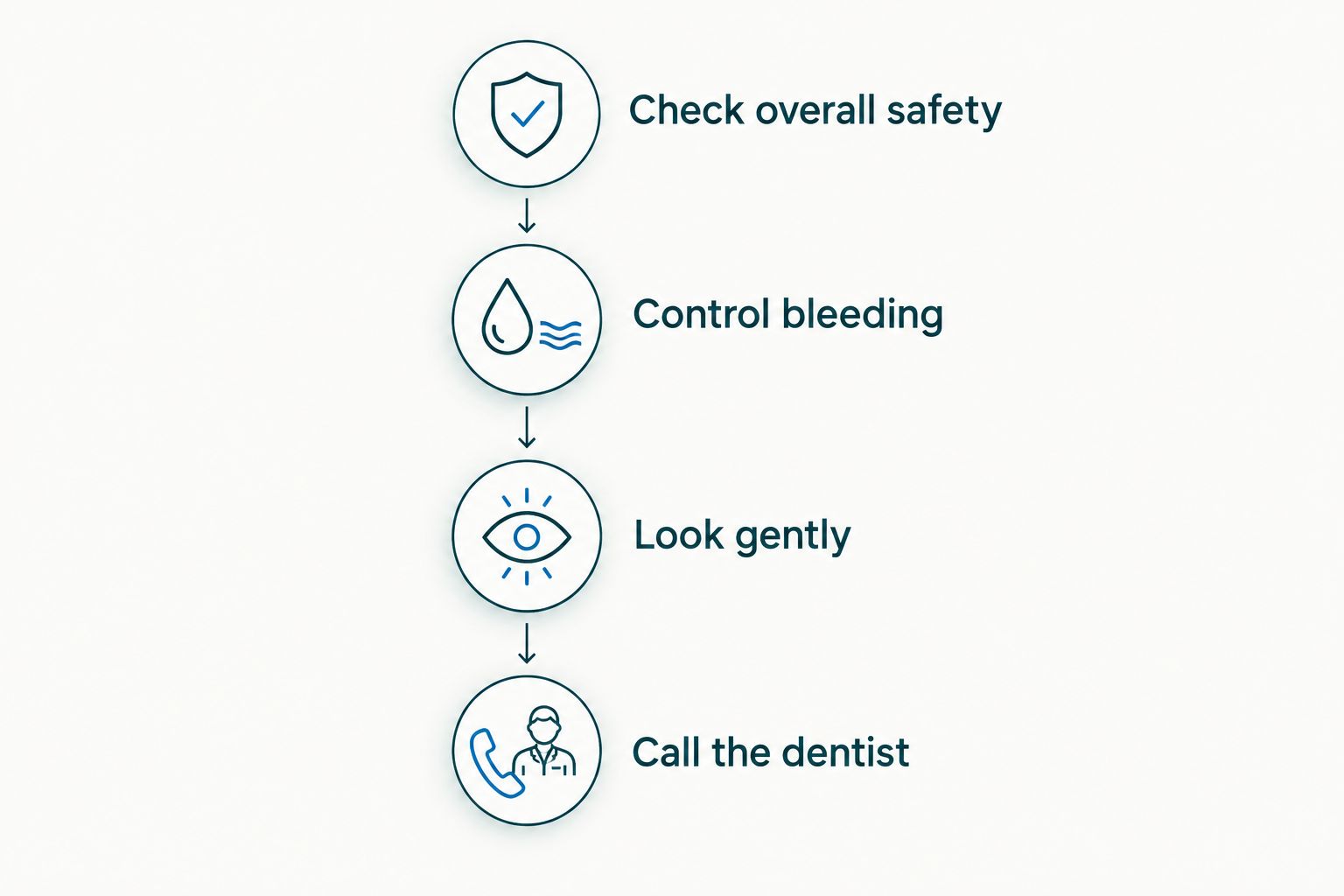
- Check overall safety. Trouble breathing, loss of consciousness, repeated vomiting after a head injury, or a major facial injury requires emergency medical attention.
- Control bleeding. Apply gentle pressure with clean gauze for about 10 minutes if your child can cooperate safely. Get urgent help for heavy bleeding that does not stop.
- Look gently. Note whether the tooth is chipped, loose, pushed out of position, or missing. Do not wiggle it to test its stability.
- Call the dentist. Describe the injury and symptoms, including any missing fragment. Ask where and how soon your child should be evaluated.
If you find a tooth fragment, save it in a clean container and bring it to the appointment. Tell the dentist if you cannot find the fragment, especially if your child has coughing or breathing symptoms. Do not reach blindly into the mouth or throat.
Which treatments can a chipped baby tooth need?
There is no single repair for every primary tooth injury. The dentist considers the fracture, the tooth's stability, your child's symptoms, and whether the tooth can be restored safely.
The following comparison explains possible approaches, not a treatment recommendation for your child. An examination comes first.
| Approach | Best suited to | Main benefit | Limitation or trade-off |
|---|---|---|---|
| Monitoring | Selected minor injuries without findings that require immediate repair | Avoids unnecessary treatment | Needs follow-up and attention to new symptoms |
| Smoothing | A small, sharp enamel edge when smoothing is appropriate | Removes an irritating edge | Does not replace missing tooth structure |
| Filling or bonding | A restorable chip needing replacement of lost structure | Restores shape and covers the damaged area | Requires suitable remaining tooth structure and cooperation |
| Crown | Selected primary teeth needing more extensive coverage | Covers more of the damaged tooth | Involves more treatment than smoothing or a small filling |
| Pulp treatment or extraction | Selected deep injuries, infection, or teeth that cannot be retained safely | Addresses damage beyond the outer tooth layers | Requires a separate discussion of benefits, risks, and follow-up |
Monitoring or smoothing for a small chip
A minor enamel chip does not automatically need a filling. If the tooth is stable and the examination shows no reason for more treatment, the dentist can recommend observation or smoothing a sharp edge.
The advantage is avoiding a procedure that offers little benefit. The limitation is that observation still requires a plan: what to watch for, when to return, and whether further assessment is needed.
Filling or bonding to replace missing structure
A filling or bonding material can replace part of a chipped tooth when the remaining tooth supports a repair. The dentist checks the bite and the damaged surface before deciding whether this approach fits.
A restoration can improve shape and comfort, but it does not make an injured tooth immune to future problems. It can chip or loosen, and deeper injury can still become apparent later.
A crown when broader coverage is needed
A crown covers more tooth structure than a small filling. It is an option for selected damaged primary teeth, not an automatic response to a visible chip.
The benefit is broader coverage where a smaller restoration is unsuitable. The trade-off is a more involved procedure; ask why coverage is needed and how the dentist will help your child manage treatment.
Pulp treatment or extraction for deeper injury
The pulp is the tissue inside a tooth containing nerves and blood vessels. A deep fracture or infection can require treatment beyond replacing the missing corner.
In selected cases, a dentist can treat the pulp and restore the tooth. In others, removing the tooth is appropriate. Ask what each approach would address, what follow-up involves, and whether early tooth loss affects space for the permanent tooth.
Why does chipped baby tooth treatment vary?
Treatment depends on the injury, not on a standard repair chosen from a photograph. These factors explain why children with similar-looking chips can receive different recommendations:
- Depth of the break: Enamel-only damage differs from a fracture reaching sensitive dentin or pulp.
- Tooth position and movement: A displaced or unusually loose tooth needs assessment beyond the chipped surface.
- Symptoms and tissue health: Pain, swelling, tenderness, or signs of infection influence the plan.
- Remaining tooth structure: A repair needs enough suitable tooth structure to support it.
- Stage of dental development: The dentist considers the primary tooth and the developing permanent tooth beneath it.
- Your child's ability to manage care: Age, anxiety, and cooperation help shape how treatment is delivered or whether referral is needed.
For a 2026 appointment, bring a clear account of the accident and your child's medical information. Photos taken soon after the injury can help show changes, but they do not replace the examination.
How can you keep your child comfortable while waiting?
Offer soft foods and discourage biting with the injured tooth. Avoid foods or drinks that trigger discomfort, and do not let your child repeatedly touch the sharp edge with a finger or tongue.
Use a cold compress against the outside of the cheek for comfort, with a cloth between the cold source and skin. If your child needs pain relief, ask a dentist, pediatrician, or pharmacist about an appropriate medicine and dose for your child's age and weight. Never put aspirin directly on the tooth or gum.
With first aid for children's dental emergencies, the goal is to protect the injured area and recognize urgent symptoms—not to complete a repair at home. Do not file the tooth, use household glue, or attach a fragment yourself.
Keep the mouth clean gently. Routine brushing guidance is 2 minutes, twice a day, but avoid scrubbing an injured area or forcing brushing that causes bleeding or pain. Ask the dentist how to clean around the injury until it is assessed.
What should you tell the Vista dental office when you call?
Start with the injury, not a request for a particular treatment. Say that your child chipped a baby tooth, explain when and how it happened, and describe bleeding, discomfort, tooth movement, or swelling.
Tell the team if your child is anxious, has difficulty tolerating dental care, or has medical needs that affect treatment. You can ask for plain-language explanations and time to discuss the plan before agreeing to a procedure.
Thevistadentist usually has same-day emergency evaluations during normal office hours, subject to availability. Ask whether the practice can evaluate your child's injury; an inquiry is not a confirmed booking, and an evaluation does not guarantee same-day treatment or after-hours care.
Before your 2026 visit, ask how payment and insurance questions will be handled. Understanding whether insurance covers chipped tooth repair starts with your plan's benefits and the treatment recommended after examination, not an assumption that every dental injury has the same coverage.
Does a chipped baby tooth need care if it does not hurt?
A chipped baby tooth still needs dental advice even when it does not hurt. Pain alone does not show whether the tooth is stable or whether the surrounding tissues were injured. Call for guidance rather than waiting for discomfort to decide when to act.
Should you put a knocked-out baby tooth back in?
Never put a knocked-out baby tooth back into its socket. Replanting it can harm the developing permanent tooth. If you are unsure whether the missing tooth is primary or permanent, seek immediate dental guidance because the recommended response differs.
What if the baby tooth changes color afterward?
A color change after injury needs dental follow-up, but color alone does not determine treatment. Tell the dentist when the change appeared and whether your child has pain, swelling, increased looseness, or a gum bump. Do not assume a darker tooth automatically needs extraction.
FAQ
Can a chipped baby tooth heal on its own?
Missing enamel does not grow back. A dentist can still recommend monitoring a minor chip when the examination shows that a restoration is unnecessary.
Is a chipped baby tooth always a dental emergency?
Not every chip requires immediate treatment, but every injury deserves dental advice. Significant pain, displacement, swelling, or persistent bleeding makes prompt assessment especially important.
Can a dentist put a filling in a baby tooth?
Yes, a dentist can restore a baby tooth with a filling when the tooth and injury are suitable. The examination determines whether a filling, another treatment, or monitoring fits.
What if my child swallowed the chipped piece?
Tell the dentist that the fragment is missing or was swallowed. Trouble breathing or choking requires emergency medical care; do not assume a missing fragment was swallowed if breathing symptoms are present.
Will a chipped baby tooth damage the adult tooth?
A chipped baby tooth does not automatically mean the permanent tooth is damaged. The type and force of the injury matter, and the dentist assesses whether follow-up of the developing tooth is needed.
Can I wait until the baby tooth falls out?
Do not decide to wait for the tooth to fall out without dental advice. Symptoms, stability, infection risk, and dental development determine whether observation is appropriate.
Can I request a same-day evaluation in Vista in 2026?
You can ask Thevistadentist about a same-day emergency evaluation during normal office hours, subject to availability. Explain your child’s age and injury so the team can advise whether the practice can assess the problem; treatment is not guaranteed that day.
One last thing
Before leaving the appointment, ask for a follow-up plan—not just a repair plan. An injured tooth can change after the first visit, even when the chip looks minor. Know which symptoms require a call and whether the dentist wants another examination.
For your child's 2026 care, keep the instructions somewhere easy to find and tell other caregivers what to watch for. A calm explanation and a clear next step are more useful than repeatedly checking the tooth yourself.
Related guides
- Does a chipped tooth need repair if it does not hurt?
- Can a filling repair a chipped tooth?
- Can you repair a chipped tooth at home?