

A chipped tooth that does not hurt still needs a dental evaluation, but it does not always need a filling or another repair. A dentist checks the chip’s depth, the remaining tooth structure, and your bite before recommending smoothing, restoration, or monitoring. For chipped tooth repair without pain in 2026, the next step is an examination—not waiting for discomfort to tell you whether something is wrong.
- Chipped tooth repair without pain starts with an examination; no pain does not prove the damage is minor.
- A shallow enamel chip may need smoothing, while deeper damage can require a restoration.
- Thevistadentist offers dental evaluations for Vista patients with chipped or broken teeth.
- Swelling, fever, or trouble swallowing changes the urgency; seek prompt help rather than waiting for pain.
Does a chipped tooth need repair if it does not hurt?
A painless chipped tooth needs assessment; whether it needs repair depends on what the examination shows. Enamel, the hard outer covering of a tooth, has no nerves. A chip limited to that layer can feel completely painless even though the tooth’s edge or shape has changed.
A dentist also checks for problems that the visible chip alone cannot explain, including decay, an existing restoration, or a crack. You cannot reliably judge those findings from a mirror or photograph. Read about what happens at a chipped tooth dental evaluation if knowing the steps helps you feel more comfortable.
The options below describe possible findings, not a way to choose your own treatment.
| Option | Best for, after examination | What it addresses | Limitation |
|---|---|---|---|
| Smoothing or polishing | A shallow enamel chip with enough tooth remaining | Rounds an uneven or sharp edge | Does not replace missing tooth structure |
| Dental bonding | A chip suitable for a tooth-colored repair | Rebuilds the missing shape with resin | Can chip or stain and needs ongoing care |
| Veneer | Selected front teeth needing a broader appearance correction | Covers the visible front surface | Often requires enamel removal and is not suitable for every tooth |
| Crown | A tooth that needs more extensive coverage | Covers and restores the remaining tooth | Involves more tooth preparation than a small bonded repair |
| Monitoring | A minor finding the dentist considers safe to observe | Avoids unnecessary treatment | Requires follow-up and attention to changes |
Why this matters
The absence of pain answers only one question: whether you currently feel discomfort. It does not establish how much tooth is missing, whether a crack is present, or how your teeth meet when you bite.
For your 2026 dental care, base the decision on the examination rather than the pain level. That approach avoids both extremes: ignoring a problem that needs care and assuming every small chip needs a major procedure.
If you feel anxious about treatment, say so when you request the appointment. You can ask the dentist to explain the findings and discuss comfort options before any proposed treatment begins.
What should you do before the appointment?
You do not need to decide on a repair before contacting a dentist. Your immediate job is to protect the tooth, note any changes, and describe what happened clearly.
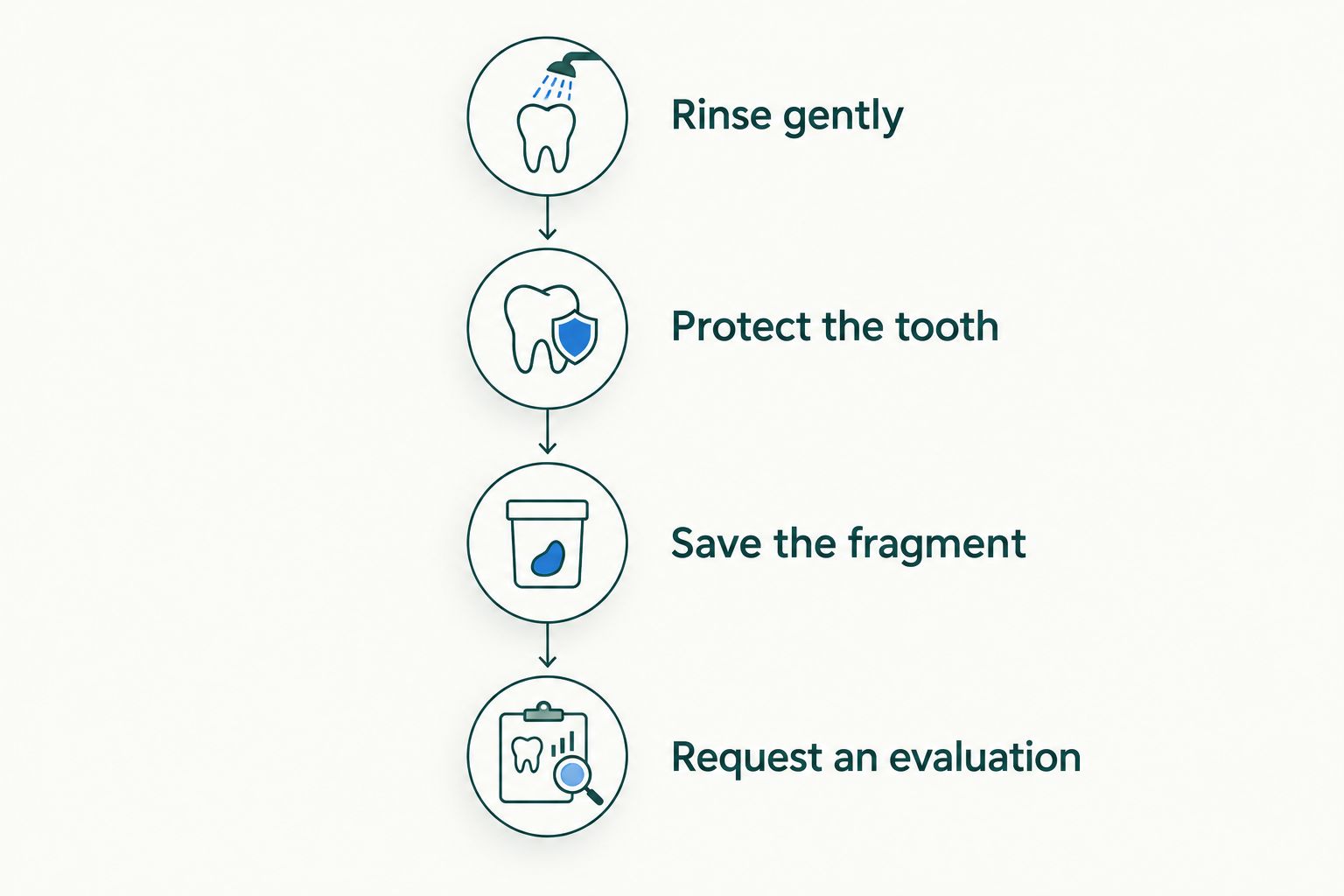
- Rinse gently. Use water to clear loose debris. Avoid repeatedly poking the chipped area with a finger or another object.
- Protect the tooth. Avoid biting hard foods with the affected tooth. Do not keep testing it to see whether it will hurt.
- Save the fragment. If you find the broken piece, keep it moist in milk or saliva in a clean container and bring it along. Reattachment is an option in some cases, but the dentist must assess it.
- Request an evaluation. Explain when the chip happened, which tooth is affected, and whether there was an injury, swelling, sensitivity, or a change in your bite.
These steps protect the area while you arrange care; they do not seal or repair the tooth. Do not file the edge yourself or use household glue.
When does a painless chip need urgent attention?
Call promptly after a dental injury, even when the tooth does not hurt. Tell the dental team if the tooth feels loose, looks displaced, or no longer meets the opposing tooth normally. Those details help the team assess urgency.
Swelling, drainage, a bad taste, or fever also deserve prompt attention. Do not use the absence of toothache as a reason to dismiss those symptoms.
Trouble breathing or swallowing, swelling spreading toward the neck or eye, or a serious facial injury requires emergency medical attention. A knocked-out permanent tooth is also time-sensitive and needs immediate dental help; it is different from a small chip.
Same-day emergency evaluations at the Vista practice are usually available during normal office hours, subject to availability. An evaluation does not guarantee same-day treatment, and an appointment request is not a confirmed booking.
When is smoothing or monitoring enough?
Smoothing can be appropriate when a chip is shallow and the tooth does not need missing structure replaced. The dentist gently reshapes an irregular edge rather than adding material. This is a different goal from rebuilding a visible missing corner.
Monitoring is another possible recommendation after the dentist checks the tooth. Ask what finding makes observation reasonable, what changes to report, and when the tooth should be checked again.
Neither option means the tooth was safe to ignore without an examination. The decision depends on the tooth’s condition, not simply on whether you felt pain.
When is dental bonding an option?
Dental bonding uses tooth-colored resin to restore a missing area. It can be appropriate for a chipped front tooth when the remaining tooth and bite support that kind of repair.
The benefit is a repair shaped to the missing portion rather than automatically covering the whole tooth. The limitation is that bonded material can chip or stain, and it still needs daily cleaning and follow-up.
Ask how the repaired edge will function when you bite. A repair that looks right also needs to fit the way your teeth come together.
When are a veneer or crown considered?
A veneer covers the front surface of a tooth and can address a broader appearance concern. It is not automatically the right choice for a small chip, particularly when a more limited repair meets your needs. Many veneers require removal of enamel, which makes that part of treatment irreversible.
A crown covers more of the tooth and can be considered when the remaining structure needs that support. It involves more preparation than smoothing or a small bonded repair. A dentist should explain why that additional coverage is needed before you agree to it.
If an examination identifies damage or infection involving the pulp inside the tooth, treatment planning changes. Root canal treatment is not determined by the chip’s appearance or by pain alone, and it is not a routine requirement for every broken tooth.
Why chipped tooth repair varies
There is no single repair for every painless chip. These findings explain why two teeth that look similar can receive different recommendations:
- Depth of damage: A chip limited to enamel differs from one exposing the underlying dentin or involving the pulp.
- Remaining tooth structure: The amount and condition of the tooth affect how a restoration can be supported.
- Tooth location: A front edge and a back tooth’s chewing surface experience different biting forces.
- Bite and grinding: Where the teeth contact, and whether you clench or grind, affects repair planning.
- Existing dental work: A chip beside a filling or crown requires assessment of both the restoration and the tooth.
- Decay or cracks: Additional damage can change what is needed beyond restoring the visible edge.
Ask the dentist to connect the recommendation to the finding: what needs protection, what needs rebuilding, and what can safely remain unchanged?
Can I wait until my next routine checkup?
Ask the dental office before deciding to wait for a routine checkup. Describe the chip and any injury or changes, even if your appointment is already scheduled. The team can advise you about arranging an earlier evaluation.
A tooth that remains painless is not necessarily unchanged. Report new sensitivity, swelling, a sharp edge injuring your tongue, or a change in the way you bite.
Will repairing a painless tooth hurt?
A painless tooth does not guarantee a sensation-free repair. What you feel depends on the procedure and the tooth’s condition; the dentist can explain whether local anesthetic or other comfort measures are appropriate.
Tell the team about dental anxiety or a previous difficult experience. Ask how you can signal for a pause so you know what to expect before treatment starts.
How do I choose a dentist in Vista for a painless chip?
Choose a dentist who explains the examination findings before recommending a repair. You should understand the purpose, limitations, and alternatives for the proposed treatment—not just its name.
Thevistadentist is an option for Vista patients seeking chipped tooth evaluation without pain. The practice provides emergency, general, restorative, and cosmetic dental care; the examination determines which type of care fits your tooth.
When arranging care in 2026, use the same practical questions you would for any dental decision:
- What does the examination show beyond the visible chip?
- Is the recommendation intended to protect the tooth, change its appearance, or both?
- Is a more limited repair appropriate, and what are its drawbacks?
- What happens if I choose monitoring instead?
- What should I know about the proposed treatment and financial arrangements before proceeding?
You can visit Thevistadentist to find practice information and request an appointment. Explain that you have a chipped tooth without pain so the team can help you arrange an evaluation.
Request a chipped tooth evaluation
Discuss your chipped tooth and ask about appointment availability at the Vista practice.
FAQ
Does a chipped tooth need repair if it does not hurt?
A chipped tooth needs a dental evaluation even if it does not hurt; repair depends on the findings. A shallow chip may need smoothing or monitoring, while deeper damage can require restoration.
Can a chipped tooth heal by itself?
A missing piece of tooth does not grow back. A dentist can determine whether the area needs smoothing, a restoration, or monitoring.
Is bonding better than a crown for a painless chip?
Neither bonding nor a crown is automatically better for a painless chip. Bonding replaces a limited missing area, while a crown covers more of the tooth; the remaining structure and examination findings guide the choice.
Do I need an X-ray if my chipped tooth does not hurt?
The dentist decides whether an X-ray is needed based on the examination and the history of the chip. X-rays can help assess underlying problems, but they do not show every crack.
Can I eat normally with a chipped tooth?
Avoid biting hard foods with the chipped tooth until a dentist assesses it. Do not repeatedly test the tooth by biting down, even when it feels comfortable.
Can I get a same-day chipped tooth evaluation in Vista in 2026?
Same-day emergency evaluations at Thevistadentist are usually available during normal office hours, subject to availability. Call or request an appointment to ask about scheduling; an inquiry is not a confirmed booking or a guarantee of same-day treatment.
Does no pain mean I will not need root canal treatment?
No pain does not rule out a problem involving the pulp inside a tooth. Root canal treatment is considered only when the examination supports it, not simply because a tooth is chipped.
One last thing
Notice your bite, not just your pain level. Tell the dentist if the chipped tooth feels different when you close your mouth or chew; that information helps explain how the damaged area functions.
If you are putting off an evaluation in 2026 because the tooth feels fine, take the smaller next step: call and describe what changed. You can request an explanation of the findings before making a treatment decision.
Related guides
- How much does chipped tooth repair cost?
- How is a chipped front tooth repaired?
- Cosmetic options for a chipped front tooth in Vista, CA