Santa Fe Dental Group

Category: Chipped Tooth Repair

Learn how our Vista, CA dentists evaluate and repair chipped or broken teeth — from bonding and fillings to crowns — with gentle, unhurried care.

  • What affects the cost of full-arch dental implants?

    What affects the cost of full-arch dental implants?

    Full arch dental implants cost factors include whether you need one or both arches treated, the implant support required, any preparatory treatment, and the type of replacement teeth. A useful estimate also separates temporary teeth, final teeth, and follow-up care so you can see what is included. For patients in Vista, the next step is an examination and a written treatment plan—not choosing treatment from an advertised starting figure.

    TL;DR
    • Full arch dental implants cost factors include treatment scope, implant support, preparatory care, and replacement-tooth design.
    • Santa Fe Dental Group offers full-arch implant evaluations for patients in Vista and nearby North County communities.
    • Compare written estimates for the same treatment, including temporary teeth, final teeth, and follow-up care.
    • Fixed All-on-X teeth and removable snap-in dentures differ in daily cleaning and maintenance.

    Why this matters

    An implant estimate describes a course of treatment, not simply a set of new teeth. Two estimates can look different because they cover different clinical needs or stop at different stages of care. Compare what each plan includes before comparing the totals.

    Santa Fe Dental Group is a fit for Vista patients seeking full-arch implant care with clear explanations. If dental visits make you anxious, say so when you request an evaluation. Understanding the proposed steps—and having room to ask questions—helps you assess a plan without feeling pushed into a decision.

    What affects the cost of full-arch dental implants?

    The main difference is the scope of your treatment: which teeth need replacing, what support your jaw can provide, and which restoration fits your needs. For a 2026 estimate, ask the office to identify the treatment stages separately rather than presenting an unexplained total.

    Cost factor What changes between treatment plans What to ask
    Treatment scope Upper arch, lower arch, or both Which arch does this estimate cover?
    Implant support Number and placement of conventional implants Why is this support recommended for me?
    Preparatory care Extractions, bone grafting, or other care when needed Is preparation included or estimated separately?
    Replacement teeth Fixed or removable design, materials, and construction What restoration am I receiving?
    Temporary and final stages Teeth used during healing and the final restoration Does the estimate include both stages?
    Follow-up and maintenance Visits, adjustments, professional care, and repairs What is included, and what is separate?

    Not every patient needs every procedure in the table. An examination determines which items belong in your plan; the list is a comparison guide, not a prediction of your treatment.

    Why full-arch treatment estimates vary

    These factors explain why a general implant figure cannot tell you what your own treatment involves:

    • Treatment scope: Replacing teeth in 1 arch means treating the upper or lower jaw. Treating 2 arches includes both. Confirm the scope before comparing estimates, especially if an advertisement describes only a single arch.
    • Implant support: Implant placement depends on the planned teeth, bone support, and bite. The number alone does not describe the whole treatment. Ask why the proposed arrangement suits your mouth rather than assuming that more implants automatically mean a better result.
    • Preparatory care: Remaining teeth, gum health, and available bone affect planning. Extractions or grafting belong in the discussion when clinically indicated, but they are not automatic requirements for every patient. Ask which findings support each recommended procedure.
    • Replacement-tooth design: A fixed restoration and a removable snap-in denture have different construction and cleaning requirements. The material and design should be named in the estimate, not hidden behind a general phrase such as implant teeth.
    • Healing and final restoration: Temporary teeth and final teeth serve different purposes. Confirm whether the proposed sequence includes a temporary restoration, when the final restoration is planned, and which visits or adjustments belong to each stage.
    • Ongoing care: Implant-supported teeth still need daily cleaning and professional follow-up. Ask about routine maintenance, replaceable components, and repair arrangements. An initial treatment estimate is not necessarily a complete description of future care.

    A lower total is meaningful only when the treatment scope is comparable. A plan that leaves out final teeth or preparatory treatment cannot be compared fairly with one that includes those items.

    Fixed full-arch teeth: compare the complete restoration

    Best for discussion: Patients who prefer replacement teeth that they do not remove themselves and who qualify after an examination.

    A fixed full-arch restoration attaches to implants and remains in place during daily use. All-on-X describes full-arch implant treatment without specifying the same implant number for every patient. The number and placement of implants depend on your examination and planned restoration; the name alone does not establish your suitability or what a treatment plan includes.

    The practical advantage is that you do not take the teeth out for daily cleaning. The trade-off is that you must learn to clean around and beneath the restoration, and professional access is needed for certain maintenance tasks. Fixed does not mean maintenance-free.

    When reviewing a 2026 treatment proposal, ask what the final restoration is made from and how you will clean it. Also ask whether temporary teeth, final teeth, and any professional removal or servicing are addressed in the written plan. These details describe what you are actually comparing.

    Snap-in dentures: compare the denture and its support

    Best for discussion: Patients who prefer removable replacement teeth with implant retention and who qualify after an examination.

    A snap-in denture connects to conventional implants through attachments. You remove the denture for cleaning as instructed. The implant number and suitability depend on an examination; there is no single arrangement that should be selected from an article alone.

    Removal gives you access to clean the denture and the implant areas. The trade-off is that the denture attachments and fit need attention over time, and worn components can require servicing or replacement. Ask how those needs are handled rather than assuming the initial treatment covers every future adjustment.

    The practice's guide to fixed full-arch implants versus snap-in dentures explains the design distinction in more detail. For this cost question, the important point is simpler: compare each option as a complete treatment plan, not merely as a different implant count.

    Option Best for discussing with your dentist Practical advantage Responsibility or limitation
    Fixed full-arch restoration A preference for teeth you do not remove yourself Stays attached during daily use Requires cleaning beneath the restoration and professional maintenance
    Removable snap-in denture A preference for removable teeth with implant retention Can be removed for cleaning Attachments and denture fit need ongoing attention

    Neither design is automatically the right choice. Your oral health, available support, cleaning ability, and preferences all belong in the decision.

    How to compare written full-arch implant estimates

    Use the same questions for every estimate. You do not need to understand every technical term before the consultation; you need a clear explanation of the proposed work and the reasons for it.

    1. Confirm the scope

    Start with the upper jaw, lower jaw, or both. Then confirm whether the document covers implant placement only or the replacement teeth as well. A phrase such as full-arch treatment should be explained in plain language.

    If an estimate uses unfamiliar terms, ask the office to identify each item on a simple treatment outline. You should be able to point to the document and understand which stage it describes without translating abbreviations yourself.

    2. Identify the preparation

    Ask whether the plan includes removing any remaining teeth or preparing the bone. If further assessment is needed before that decision, ask which parts of the estimate remain provisional and what information will resolve them.

    Do not interpret a longer list of procedures as proof of better care. Each proposed procedure should have a clinical reason that the dentist can explain in relation to your examination.

    3. Separate temporary and final teeth

    Ask what you will wear during healing and what restoration is planned afterward. Confirm whether both appear in the document. If temporary teeth are proposed, ask about their purpose and any instructions that apply while you use them.

    A temporary restoration is not simply another name for the final teeth. Knowing the distinction helps you understand both the treatment sequence and why an estimate contains separate restorative stages.

    4. Review follow-up

    Ask which appointments and adjustments are included during the planned treatment. Then discuss routine maintenance after the final teeth are fitted. Keep the distinction clear: completing treatment and maintaining the result are related but separate responsibilities.

    For your 2026 treatment budget, record any items that are not included rather than relying on memory. A written exclusion is useful information, not necessarily a reason to reject a plan.
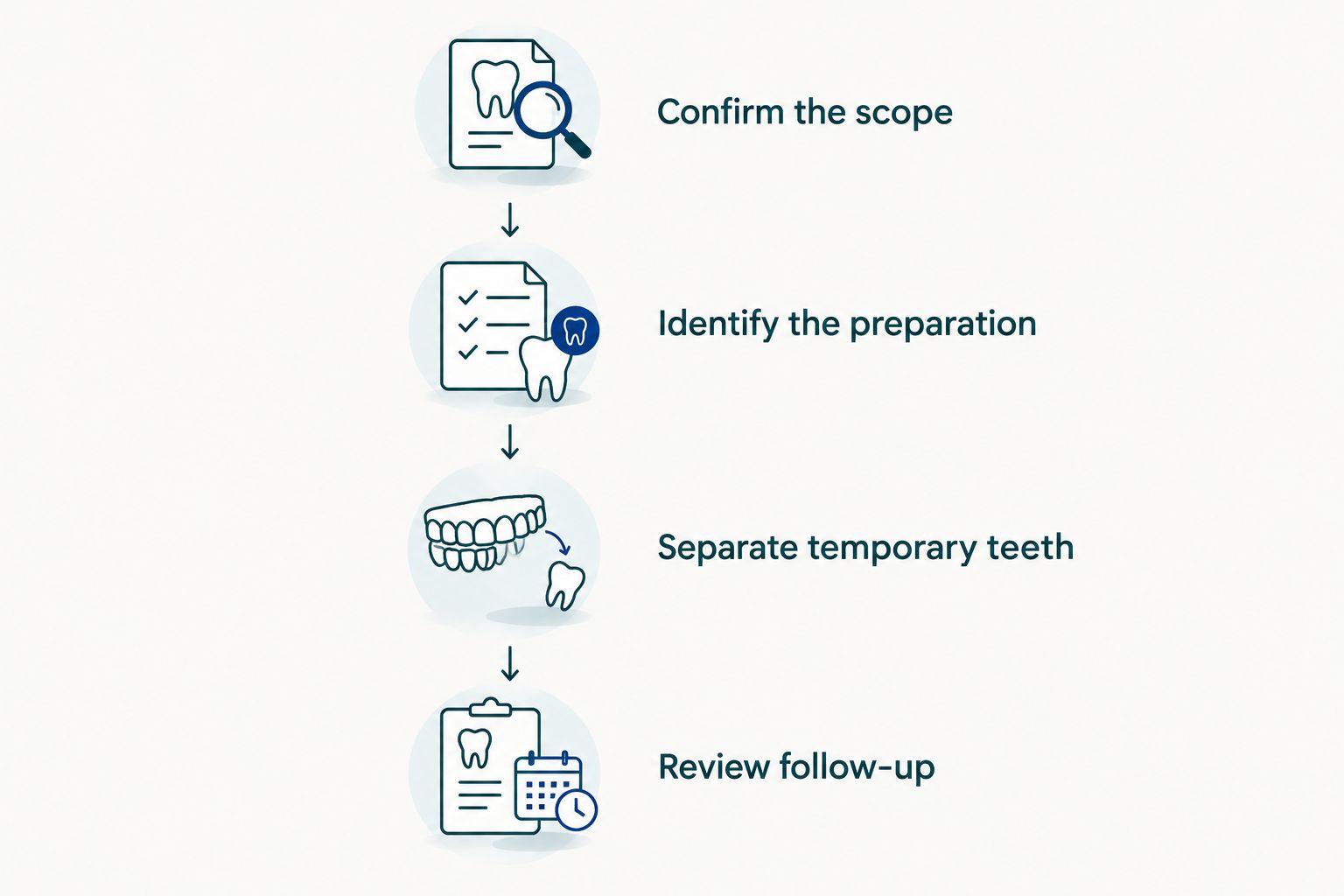
    Four steps for reviewing a full-arch implant estimate, from treatment scope to follow-up care.
    Compare the whole treatment sequence, not just implant placement.

    What should an implant estimate explain before you decide?

    A useful estimate should let you explain the proposed treatment back in your own words. You should know which arch is being treated, whether the teeth are fixed or removable, and what happens between the initial procedures and the final restoration.

    Ask about pain control and sedation if those subjects concern you. Do not assume that a particular approach is included or necessary. Your medical history and the planned procedures belong in that conversation, and any separate arrangements should be clear before you agree to treatment.

    It also helps to ask what would change the plan. Healing, examination findings, or further imaging can affect clinical decisions. Ask how the office explains a recommended change and provides an updated estimate before additional treatment proceeds.

    At Santa Fe Dental Group, you can request an evaluation to discuss full-arch implant options. Bring your questions and any existing treatment proposal you want help understanding; a consultation request is the start of a conversation, not a commitment to treatment.

    Does treating both arches mean the same plan twice?

    Treating 2 arches does not mean the upper and lower jaws have identical needs. Each arch requires its own assessment of remaining teeth, bone support, bite, and restoration design. Ask for the upper and lower treatment details separately so you can see how the combined plan is built.

    Does All-on-X mean every patient needs the same number of implants?

    All-on-X does not specify a fixed number of implants for every patient. Your dentist determines the support arrangement from your examination and planned replacement teeth, then explains why that implant number and placement suit your treatment.

    Should I compare only the initial treatment estimate?

    Your 2026 estimate should be reviewed alongside the expected maintenance responsibilities. Ask how to clean the restoration, which follow-up visits are recommended, and how adjustments or repairs are handled. An initially smaller treatment total does not answer those questions.

    FAQ

    What are the main full arch dental implants cost factors?

    The main full arch dental implants cost factors are treatment scope, implant support, preparatory care, replacement-tooth design, temporary and final stages, and follow-up care. An examination determines which items apply to your treatment.

    Can I get an accurate full-arch implant estimate without an examination?

    A personalized full-arch implant estimate requires a clinical evaluation. Your remaining teeth, bone support, bite, and proposed restoration affect the treatment plan.

    Does a full-arch implant estimate include the final teeth?

    You need to confirm whether the estimate includes the final teeth. Ask the office to identify implant placement, temporary teeth, and the final restoration separately.

    Are snap-in dentures the same as fixed full-arch teeth?

    Snap-in dentures are removable, while fixed full-arch teeth stay attached during daily use. The designs have different cleaning and maintenance requirements, and suitability depends on an examination.

    Will I definitely need bone grafting before full-arch implants?

    Bone grafting is not required for every full-arch implant patient. Your dentist evaluates the available bone and proposed implant placement before recommending preparatory treatment.

    Does dental insurance cover full-arch implant treatment?

    Coverage depends on your specific insurance plan and the proposed procedures. Ask for a benefits review, and confirm exclusions, limits, and your expected responsibility rather than assuming the full treatment is covered.

    What should I bring to a full-arch implant consultation in Vista?

    Bring your medication list, relevant medical history, insurance information, and questions about the treatment. If you already have an estimate, bring it so you can discuss its scope and terminology.

    One last thing

    Ask where the estimate ends. Does it stop after implant placement, after temporary teeth, or after the final restoration and planned follow-up? That single question often makes an otherwise confusing document easier to understand.

    You do not need to choose a design before an examination. Call Santa Fe Dental Group or request an appointment to discuss your needs, ask about the treatment stages, and review the proposed plan at a pace that lets you make an informed decision.

    Related guides

  • How much do braces cost in Vista, CA?

    How much do braces cost in Vista, CA?

    Braces cost in Vista, CA, depends on the tooth movement and bite correction you need, the treatment plan, and what the fee includes; an examination and written estimate establish your individual cost in 2026. Before you commit, check whether that estimate includes records, adjustment visits, removal, and retainers—not just the braces themselves.

    TL;DR
    • Braces cost depends on your treatment needs and included care, not just the brackets.
    • Santa Fe Dental Group offers braces care for patients in Vista and nearby North County communities.
    • Ask for a written estimate separating treatment fees, insurance benefits, and your expected responsibility.
    • Compare complete treatment plans, including follow-up and retainers, rather than monthly payments alone.

    For local care, Santa Fe Dental Group offers braces and a patient-centered approach. You can ask questions about treatment and costs before deciding whether to proceed.

    How much do braces cost in Vista, CA?

    Your braces cost is the amount quoted for your individual treatment plan, adjusted for any confirmed insurance benefit and any separately billed care. A general price advertised elsewhere does not establish what your teeth and bite need.

    For a 2026 estimate, ask the office to explain the following categories. This breakdown helps you compare written proposals without assuming that every practice packages care the same way.

    Cost category What to clarify Why it matters
    Examination and records Whether the evaluation, images, and planning records are included These establish the treatment recommendation
    Active treatment Which appliances and planned adjustment visits the fee covers This defines the main scope of care
    Separate dental care Whether any needed fillings, gum treatment, or other procedures are separate Preparing your mouth for braces can involve additional care
    Changes during treatment How repairs, lost components, or changes to the plan are handled An estimate needs clear boundaries
    Removal and retention Whether removing braces, initial retainers, and retention visits are included Treatment planning should address care after braces come off
    Insurance and payment terms The estimated benefit, patient responsibility, and payment conditions A payment schedule is not the same as the total fee

    Not every category becomes a separate charge. The purpose of this checklist is to make the estimate understandable, not to suggest that you need every listed service.

    Why this matters before you choose braces

    Braces are a course of care, not simply a set of brackets. The financial decision should reflect the treatment being proposed, the visits involved, and the plan for keeping your teeth in their new positions.

    Two estimates can look different because they cover different things. An estimate that lists retainers separately is not directly comparable with one that includes them until you account for that difference.

    Compare the same scope of care before comparing the bottom line. You deserve an explanation you can understand without needing to know dental terminology.

    Why braces cost varies

    The following factors explain why your treatment estimate can differ from another patient's. None of them establishes your diagnosis or treatment needs without an examination.

    • Tooth movement: The amount and type of movement needed affect the treatment plan. Straightening visible teeth and correcting a more involved alignment problem are not necessarily equivalent tasks.
    • Bite correction: Your dentist assesses how the upper and lower teeth meet, not just whether your smile looks straight. Bite goals help define the work involved.
    • Treatment duration: The expected course of treatment and planned monitoring help determine the scope of care. Ask how the estimate handles treatment that takes longer than expected.
    • Dental health: Cavities or gum disease need attention when they affect treatment readiness. Ask whether any recommended preparatory care is included or billed separately.
    • Included services: Records, adjustment visits, repairs, removal, and retention do not always appear in the same fee category. Written details make comparisons clearer.
    • Insurance benefits: Coverage changes your expected out-of-pocket responsibility, not the clinical treatment you need. Eligibility and plan limitations require confirmation.

    A more detailed treatment plan is not automatically the right plan for you. Ask your dentist to connect each recommendation to a specific finding from your examination.

    What should a written braces estimate include?

    A useful estimate connects the clinical recommendation with the financial terms. You should be able to identify what is planned, what is included, and what remains your responsibility.

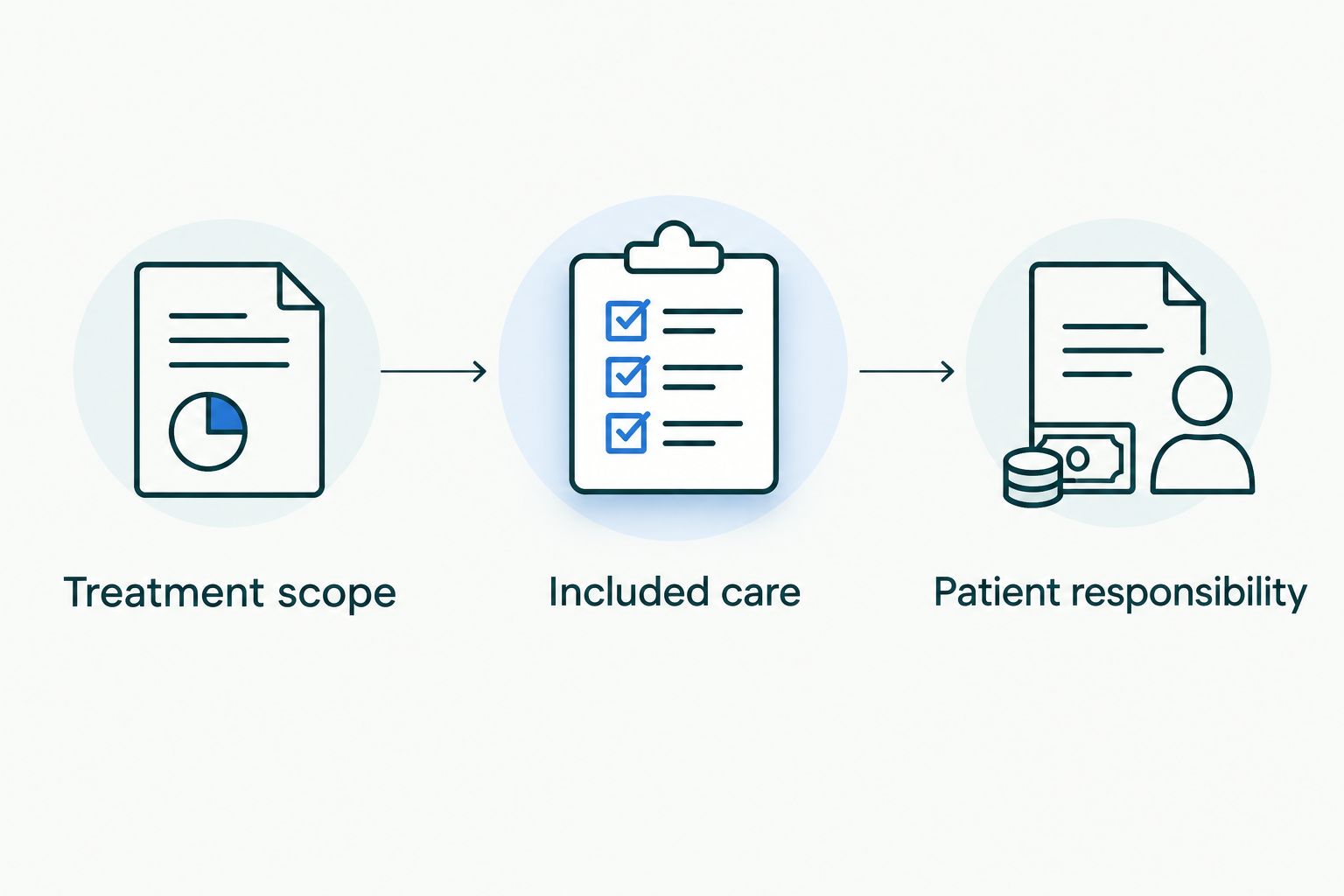
    Use this sequence when reviewing your 2026 braces estimate:

    1. Treatment scope: Ask what alignment or bite problems the plan addresses. Have the office explain unfamiliar terms in everyday language.
    2. Included care: Confirm the appliances, planned visits, records, removal, and retention services covered by the quoted fee. Ask which services would be billed separately.
    3. Patient responsibility: Review the estimated insurance contribution, your expected balance, and the payment terms. Ask what happens if the insurer pays less than estimated.

    These steps separate the treatment decision from the payment decision. Both deserve attention before you agree to start.

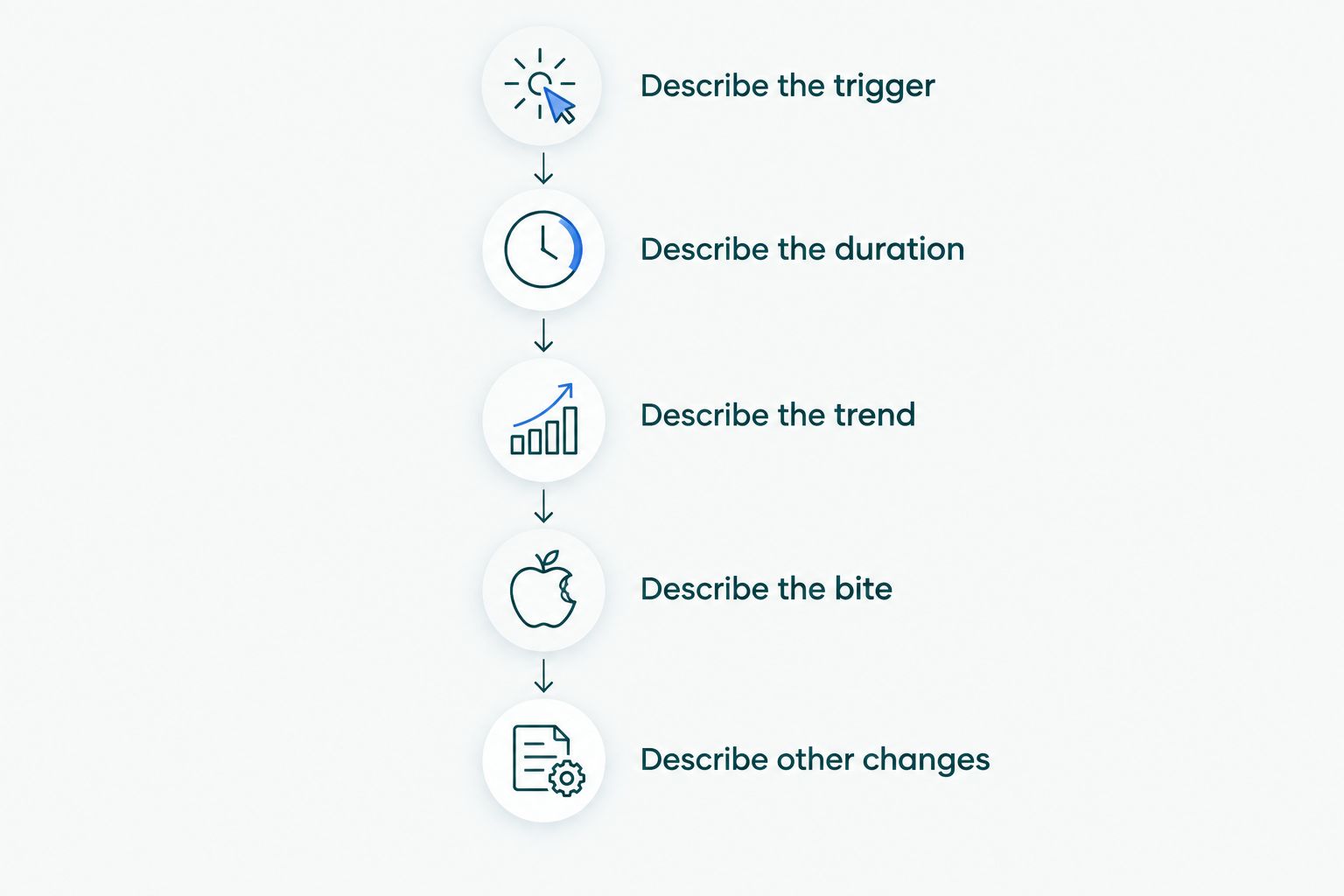
    Three steps for reviewing a braces estimate: treatment scope, included care, and patient responsibility.
    Understand the treatment and included care before comparing payment terms.

    Keep a copy of the estimate and any benefit information you receive. If the treatment plan changes, ask for an updated explanation of both the clinical recommendation and the financial effect.

    Does dental insurance cover braces for adults?

    Dental insurance covers adult braces only when your specific plan includes an applicable orthodontic benefit. Having dental insurance does not, by itself, confirm that braces are covered.

    Ask the office and insurer to check the benefit details before you rely on an estimated contribution. Useful questions include:

    • Does the plan cover orthodontic treatment for adults?
    • Does an age limit apply?
    • Is there a waiting period before benefits apply?
    • Is there a lifetime orthodontic maximum, and has any of it already been used?
    • Does the treating provider's network status affect the benefit?
    • How are benefits paid during treatment, and what happens if coverage ends?

    An estimated insurance benefit is not a guarantee of payment. Ask how your responsibility changes if you switch plans, lose coverage, or receive a different benefit determination.

    For a 2026 coverage check, use your current plan documents rather than an older summary. Your employer's dental plan and another person's plan can have different orthodontic terms even when the insurer's name is the same.

    Does a longer braces treatment always cost more?

    A longer braces treatment does not, by itself, tell you what your final fee will be. The answer depends on the treatment agreement and which visits or changes it covers.

    Ask whether the quoted fee covers the expected course of treatment or whether particular circumstances create additional charges. Examples to clarify include appliance repairs, missed-appointment policies, and changes to the original treatment plan.

    You should also understand what the estimated treatment length means. It is a clinical estimate, not a promise that braces will come off on a particular date.

    Following care instructions and attending planned visits supports treatment progress. If a visit needs to be rescheduled, contact the office rather than assuming you should wait until the next planned adjustment.

    Are retainers included in braces cost?

    Retainers are included in braces cost only when the written estimate says they are. Ask about the initial retainers, follow-up instructions, and charges for replacements or additional retention visits.

    Retainers help maintain tooth positions after active orthodontic treatment. That makes retention part of the planning conversation, even when it appears separately on the financial agreement.

    Before starting, clarify what happens after braces removal. You do not need to choose every future detail immediately, but you should understand the planned transition and any costs excluded from the estimate.

    How can you compare braces estimates fairly?

    Put the written plans side by side and compare their scope before comparing payments. A monthly amount alone cannot tell you whether the treatment, included services, and financial conditions match.

    Ask each office to explain:

    • The treatment goal: What specific alignment or bite issue does the proposed care address?
    • The included visits: Which appointments fall within the quoted fee?
    • The exclusions: What situations or services would generate a separate charge?
    • The retention plan: What happens after the braces are removed?
    • The payment conditions: What is the total patient responsibility, and what terms apply to any payment arrangement?

    If financing is discussed, ask about interest, fees, repayment obligations, and approval requirements. Do not assume that financing is available or that a particular arrangement applies until the office confirms it.

    A clear estimate has an advantage: you can see what you are agreeing to. Its limitation is equally important—an estimate still depends on the stated treatment plan, benefit assumptions, and financial terms.

    What should you ask at a Vista braces appointment?

    Bring your main concerns, current insurance details, and any written estimate you want explained. You do not need to arrive knowing which treatment is right for you.

    Santa Fe Dental Group offers braces care for Vista patients seeking clear, patient-centered explanations. The examination is the opportunity to discuss your goals and understand the recommendation, not a requirement to decide immediately.

    Consider asking these questions in your own words:

    • What did you find about my teeth and bite?
    • What would braces aim to change in my case?
    • What dental care would I need before starting?
    • What is included in the written estimate?
    • What circumstances would change my responsibility?
    • What should I expect after braces removal?

    If dental appointments make you anxious, say so when you request the visit. Ask the team to explain each part of the appointment before it happens and pause when you need clarification.

    For your 2026 planning, call or request an appointment to discuss braces and an individual estimate. An appointment request is not a confirmed booking; confirm the date and time with the office.

    FAQ

    How do I find out what braces will cost me in Vista?

    An examination and written treatment estimate establish your individual braces cost in Vista. Ask for the treatment scope, included services, estimated insurance benefit, and expected patient responsibility.

    Can I get an exact braces estimate without an examination?

    An exact individual braces estimate requires an assessment of your teeth, bite, and treatment needs. General information does not establish which care is appropriate for you.

    Does adult dental insurance automatically cover braces?

    Adult dental insurance does not automatically cover braces. Check whether your plan includes adult orthodontic benefits and whether age limits, waiting periods, or lifetime maximums apply.

    Are adjustment appointments included in the braces fee?

    Adjustment appointments are included only to the extent described in your treatment agreement. Ask which planned visits are covered and how additional visits or repairs are handled.

    Will I need to pay separately for retainers?

    Retainers require a separate payment when they are excluded from the quoted treatment fee. Ask about initial retainers, replacements, and retention visits before starting treatment.

    Should I choose braces based on the monthly payment?

    A monthly payment alone is not enough to compare braces treatment. Review the total patient responsibility, included care, repayment period, and any interest or fees.

    Can I ask about braces at Santa Fe Dental Group?

    Santa Fe Dental Group offers braces care in Vista, California. Call or request an appointment to discuss your goals, an examination, and an individual treatment estimate; confirm the appointment with the office.

    One last thing

    Before accepting a braces estimate, ask: What would change my financial responsibility after treatment begins? This question brings exclusions, insurance assumptions, repairs, and changes to the treatment plan into the conversation before you commit.

    You do not need to make a decision while you still have unanswered questions. A useful next step is a clear explanation and a written estimate you can review at your own pace.

    Related guides

  • How do All-on-4 implants compare with snap-in dentures?

    How do All-on-4 implants compare with snap-in dentures?

    All-on-4 implants support a full arch of teeth that stays attached between dental visits; snap-in dentures attach to implants but come out at home for cleaning. For your 2026 treatment decision, the main difference is fixed versus removable teeth—not whether one option is right for everyone—and both require an examination, daily care, and ongoing maintenance.

    TL;DR
    • All on 4 vs snap in dentures comes down to fixed teeth versus a removable, implant-retained denture.
    • All-on-4 uses four implants per arch; snap-in denture implant needs depend on the treatment plan.
    • Fixed teeth require cleaning underneath; snap-in dentures require removal and attachment care.
    • Santa Fe Dental Group offers dental implant care in Vista; an examination determines which options fit your needs.

    Why this matters

    You are choosing more than how replacement teeth stay in place. You are also choosing a daily cleaning routine, a way to manage repairs, and an appliance you will live with when eating and speaking. Neither design removes the need for follow-up care.

    Santa Fe Dental Group is a dental practice for Vista patients seeking clear explanations of full-arch replacement options. You can request an appointment with Santa Fe Dental Group to discuss your goals without treating that request as a confirmed booking.

    How do All-on-4 implants compare with snap-in dentures?

    Both approaches use implants placed in the jaw, but the replacement teeth connect differently. All-on-4 supports a fixed full-arch bridge, also called a fixed implant-supported denture. A snap-in denture is a removable implant-retained overdenture that uses attachments so you can remove and replace it yourself after instruction. Both are options for full-arch tooth replacement, but they differ in how you clean and maintain them.

    Decision point All-on-4 fixed teeth Snap-in dentures
    Best for Patients who qualify and prefer teeth that stay attached Patients who qualify and prefer a removable implant-retained denture
    Removal A dental professional removes the bridge when needed You remove the denture for cleaning
    Implant arrangement Four implants support one arch in the All-on-4 approach Number and position depend on the jaw and denture design
    Daily cleaning Clean around implants and underneath the bridge Clean the removed denture, mouth, and attachments
    Main advantage No daily removal of the replacement teeth Direct access to the denture and attachments during cleaning
    Main limitation Cleaning beneath the bridge takes technique and suitable tools Attachments wear, and the denture remains removable
    Follow-up needs Implant checks, professional cleaning, and restoration assessment Implant checks, attachment maintenance, and denture-fit assessment

    Choose between the designs only after you understand the cleaning routine and the examination findings. Wanting fixed teeth is a valid preference, but it does not establish that a particular implant arrangement suits your jaw.

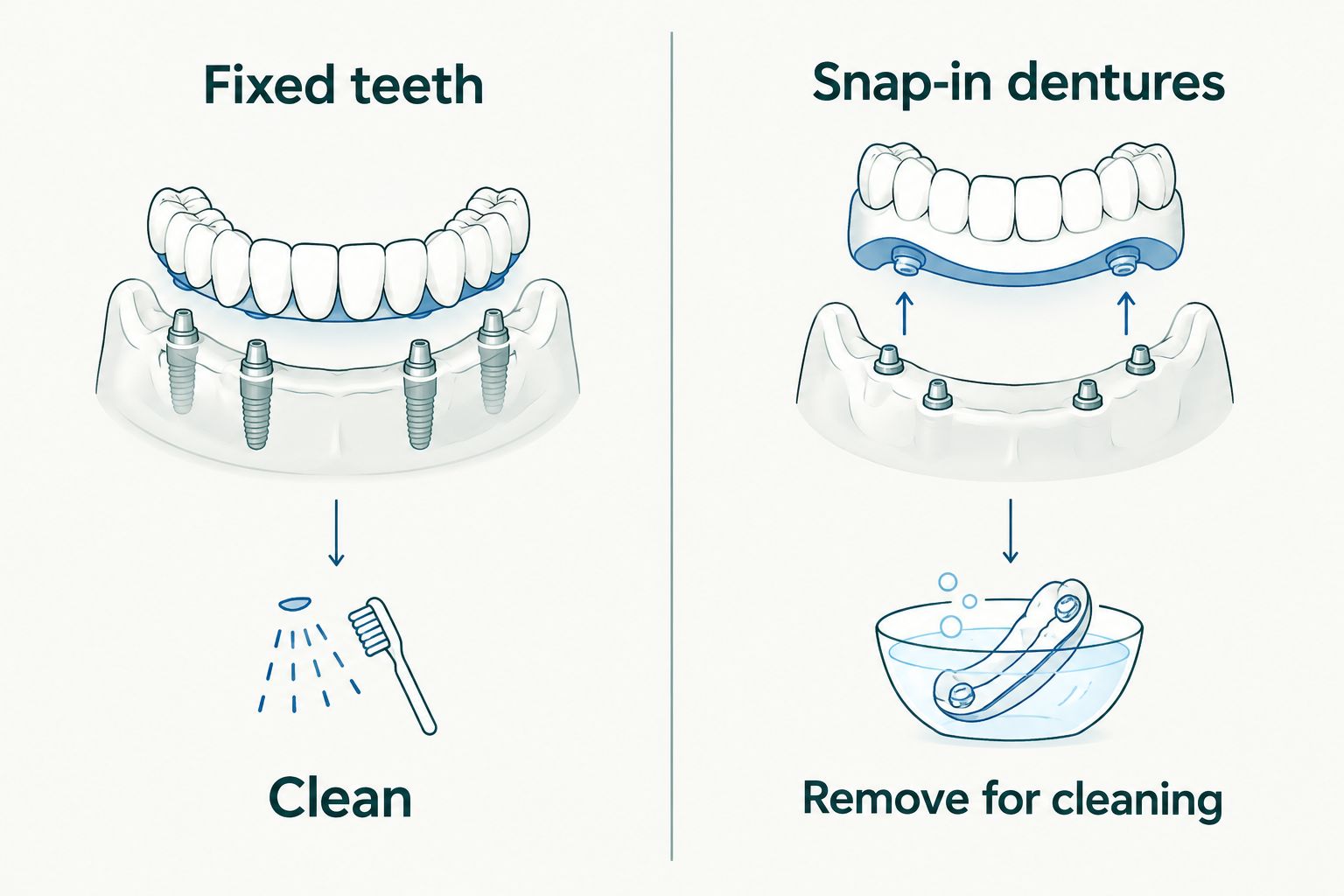
    Fixed teeth need cleaning underneath; snap-in dentures are removed for cleaning.
    Both designs need daily care, but access for cleaning is different.

    All-on-4: four implants supporting one arch

    All-on-4 is a full-arch treatment concept in which four implants support a fixed set of replacement teeth. An arch means the upper or lower row of teeth. A mouth has two arches, so replacing both is a different treatment scope from replacing one.

    What does All-on-X mean?

    All-on-X is a broader term for fixed full-arch teeth supported by a number of implants chosen for your treatment plan. The X represents the number of implants; it does not mean every patient should receive only four. Some patients need more than four implants to provide appropriate support for their replacement teeth.

    Your dentist considers the available jawbone volume and quality, implant distribution, bite forces, and restoration design when recommending the number of implants. All-on-4 is one approach, not a rule for every jaw, and more implants are not automatically better for everyone. Ask why the proposed number and arrangement suit your individual needs.

    The International Team for Implantology's 2018 consensus recommendations on implant number for fixed full-arch teeth emphasize planning around the final restoration, bone anatomy, implant distribution, and access for cleaning. The guidance supports choosing implant number as part of an individual treatment plan rather than assuming the same arrangement fits every patient.

    The bridge stays attached during normal daily use. That is its central appeal if you do not want to remove your teeth at home. Fixed does not mean permanent in the sense of never needing repair, adjustment, or professional removal.

    Best for: patients who prefer fixed teeth and qualify clinically

    All-on-4 deserves discussion when your goal is a fixed full-arch restoration and the examination supports that approach. The dentist evaluates your jaw, implant positions, bite, gum health, and ability to maintain the restoration.

    The trade-off is access. You must clean beneath the bridge and around the implants, not just brush the visible tooth surfaces. Ask to see how the recommended tools reach those areas before accepting a treatment plan.

    For a 2026 consultation, ask whether the proposed restoration is temporary or final at each stage. The All-on-4 name alone does not tell you when you will receive your final teeth or what eating restrictions apply during healing.

    Snap-in dentures: removable teeth retained by implants

    Snap-in dentures connect to implant attachments and come out for cleaning. You might also hear the terms implant-retained overdenture or snap-on denture. Some designs still receive part of their support from the gums, so the exact design matters when discussing denture stability, fit, and chewing comfort.

    Cleveland Clinic's patient guide to implant-supported dentures, medically reviewed in 2022, explains the difference between removable snap-on dentures and fixed implant dentures, including how cleaning access changes with each design.

    Implant retention helps hold the denture in position, but it does not make every removable design behave like a fixed bridge. Ask the dentist to explain how the proposed denture is supported rather than relying on the word snap alone.

    Best for: patients who prefer removable access for cleaning

    Snap-in dentures deserve consideration when you want implant retention and are comfortable removing an appliance. Taking the denture out gives you direct access to its underside and the attachments in your mouth. That access can be useful, but removal and reinsertion still require the right technique.

    The limitations include attachment wear and changes in fit. Retentive components need assessment over time, and some need replacement. A denture that rests partly on the gums can also need adjustment or a reline as the supporting tissues change.

    Do not force a denture that stops seating normally. Arrange an assessment rather than trying to reshape the attachments or repair the denture yourself.

    Why the right choice varies between patients

    A preference for fixed or removable teeth starts the conversation; it does not finish it. These findings help determine whether either approach is appropriate:

    • Bone and anatomy: The available bone and nearby anatomical structures affect implant placement and whether additional procedures need discussion.
    • Gum and oral health: Infection, inflammation, and the condition of remaining teeth influence planning before implants are placed.
    • Bite and grinding: The way your teeth meet and any grinding habits affect restoration design and maintenance discussions.
    • Cleaning access: Hand movement, vision, and access beneath a bridge affect which daily routine you can manage consistently.
    • Medical history: Health conditions, medications, and tobacco use belong in the implant assessment and healing discussion.
    • Your preferences: Comfort with removal, expectations about appearance, and willingness to attend maintenance visits matter alongside clinical findings.

    No single factor decides every case. A scan adds information about anatomy, while the clinical examination and your health history provide information that a scan alone cannot supply.

    What changes in everyday care?

    With fixed teeth, you clean the visible surfaces and the spaces beneath the restoration. With snap-in dentures, you remove the appliance and clean both the denture and the tissues and components beneath it. Neither routine should be reduced to a quick rinse.

    Plan for twice-daily cleaning, then follow the specific instructions for your restoration and attachments. Ask which brush, interdental tools, or other aids fit your design. More force is not a substitute for reaching the right areas.

    Daily task Fixed full-arch bridge Snap-in denture
    Cleaning access Work beneath the attached bridge Remove the denture to reach its underside
    Areas needing attention Bridge surfaces, implant areas, and spaces underneath Denture surfaces, attachments, gums, and any remaining teeth
    What to report Bleeding, persistent soreness, movement, or difficulty cleaning Soreness, changing retention, difficult seating, or movement
    What not to do Try to unscrew the bridge yourself Force attachments or alter the denture at home

    Ask for a hands-on demonstration rather than leaving with instructions you cannot picture. If you have arthritis, reduced grip, or limited vision, say so during planning. The proposed cleaning routine needs to work in your hands, not just on a diagram.

    Does either option mean immediate final teeth?

    Neither All-on-4 nor snap-in dentures automatically means you receive final teeth immediately. Implant stability, the treatment plan, extractions, and healing needs determine the sequence. Temporary teeth and final teeth serve different stages of care.

    For treatment planned in 2026, request a written explanation of what you will wear during healing. Ask when removal is allowed, what foods are appropriate, and who to contact if the restoration feels loose or uncomfortable.

    Avoid comparing plans by their headline promise alone. A useful plan explains the surgical stage, temporary restoration if applicable, final restoration, and follow-up responsibilities without presenting healing as identical for everyone.

    What should you compare in a written treatment plan?

    Compare the work included, not just the name of the treatment. Plans described as full-arch implants can differ in the restoration, preparatory procedures, and maintenance arrangements. Ask for a written estimate and an explanation of what is included before deciding.

    Use these questions during your 2026 appointment:

    1. Which arch is included? Confirm whether the plan covers your upper teeth, lower teeth, or both.
    2. What happens to remaining teeth? Ask which teeth can be retained and why extraction is recommended for any others.
    3. What will I wear during healing? Clarify whether a temporary restoration is included and how you will care for it.
    4. What is the final restoration? Confirm whether it is fixed or removable and how it connects to the implants.
    5. What maintenance should I expect? Ask about cleaning visits, attachment checks, repairs, and any protective appliance recommended for your bite.

    Santa Fe Dental Group offers dental implant and denture care in Vista. Bring your current denture, relevant treatment records, and a medication list to your consultation so the discussion addresses your situation rather than a generic comparison.

    Can I switch from snap-in dentures to fixed teeth later?

    Switching is not automatic. Implant positions, the implant system, available space, bone, and the planned restoration all affect whether existing implants can support a different design.

    If fixed teeth are your longer-term goal, discuss that before implant placement. Do not assume that a removable plan is an interchangeable first stage of a fixed plan; ask what future changes would require.

    Will fixed teeth feel exactly like natural teeth?

    Fixed implant teeth are replacement teeth, not natural teeth. They stay attached during daily use, but their shape, cleaning needs, and sensation differ from the teeth they replace.

    Ask how the proposed restoration affects speech, lip support, and access for cleaning. If your current denture feels bulky or unstable, describe the specific problem so the dentist can explain what a different design can and cannot address.

    FAQ

    What’s the main difference between All-on-4 and snap-in dentures?

    All-on-4 teeth stay attached between dental visits, while snap-in dentures come out at home. Both use implants, but their cleaning routines and maintenance needs differ.

    Are All-on-4 implants better than snap-in dentures?

    Neither option is better for every patient. All-on-4 suits a preference for fixed teeth when clinically appropriate; snap-in dentures suit a preference for a removable implant-retained design.

    How many implants do I need for snap-in dentures?

    The implant number for snap-in dentures depends on the jaw, anatomy, and proposed design. A dental examination and imaging help determine the arrangement rather than a standard number for everyone.

    Do snap-in dentures still need a reline?

    Some snap-in dentures need relining as the supporting gums and bone change. The need depends on how the denture is supported and what the dentist finds during a fit assessment.

    Can I remove All-on-4 teeth myself?

    You should not remove an All-on-4 bridge yourself. A dental professional handles removal when needed; your home routine focuses on cleaning around and beneath the attached restoration.

    Can I eat normally right after getting implant teeth?

    You need to follow the eating instructions for your healing stage rather than assume an unrestricted diet. Temporary teeth and newly placed implants require care even when the restoration feels secure.

    What should I do if my snap-in denture becomes loose?

    Arrange a dental assessment if your snap-in denture becomes loose. Attachment wear, fit changes, or another problem needs examination; do not force or modify the components yourself.

    How do I start comparing full-arch options in Vista?

    Request an examination at Santa Fe Dental Group and explain whether fixed teeth or removable cleaning access matters most to you. Appointment requests require confirmation, and treatment recommendations follow the examination.

    One last thing

    Ask to see the cleaning routine before choosing the teeth. Being able to picture tomorrow morning's care is more useful than choosing by a treatment name alone. For your 2026 decision, a clear explanation of daily maintenance belongs beside the examination findings and written treatment plan.

    Related guides

  • Can a dentist reattach a chipped tooth fragment?

    Can a dentist reattach a chipped tooth fragment?

    Yes, a dentist can sometimes reattach a chipped tooth fragment when the piece fits and the remaining tooth can support the repair. Keep the fragment moist, bring it to your dental evaluation, and remember that reattachment is only one option—the dentist must also check for deeper damage before recommending treatment.

    TL;DR
    • For chipped tooth repair, tooth fragment fit matters, but the remaining tooth needs an examination too.
    • Keep the fragment moist in milk or your saliva, and bring it to the dentist.
    • Thevistadentist offers dental evaluations for patients in Vista and nearby North County San Diego communities.
    • Never glue the fragment back yourself; dental adhesives require professional assessment and placement.

    Why this matters

    Saving the broken piece gives your dentist another repair option. It does not mean the tooth is ready to be bonded back together: a small-looking chip can involve dentin, the sensitive layer under enamel, or damage deeper inside the tooth.

    Thevistadentist is an option for Vista patients seeking a patient-centered chipped tooth evaluation. If you need help in 2026, contact Thevistadentist and describe what happened, your symptoms, and whether you found the fragment. An appointment request is not a confirmed booking.

    Can a dentist reattach a chipped tooth fragment?

    A dentist can reattach some tooth fragments using dental adhesive and tooth-colored restorative material. This approach uses the original piece rather than recreating the entire missing area, but it requires a suitable fragment and a tooth that can be restored safely.

    The decision depends on more than appearance. Your dentist checks the fracture, the fragment's fit, the amount of healthy tooth remaining, and how your teeth meet when you bite.

    Repair option Best suited to Main benefit Main limitation
    Fragment reattachment A usable fragment that fits a restorable tooth Retains the original fragment's shape and surface The fragment can detach or break again; not every fracture is suitable
    Tooth-colored bonding or filling Missing tooth structure that can be rebuilt directly Does not require finding the original piece The repair can chip, stain, or need maintenance
    Crown A tooth that needs more coverage and support Covers and protects the remaining tooth structure Requires preparation of the tooth and is not necessary for every chip

    These are possibilities, not a treatment plan. An exposed or injured tooth nerve, decay, or a fracture extending beneath the gum can change the recommendation.

    What should you do with the broken tooth fragment?

    Keep the fragment moist and bring it with you, even if you are unsure whether it is usable. Do not test the fit by repeatedly pressing it against the tooth.

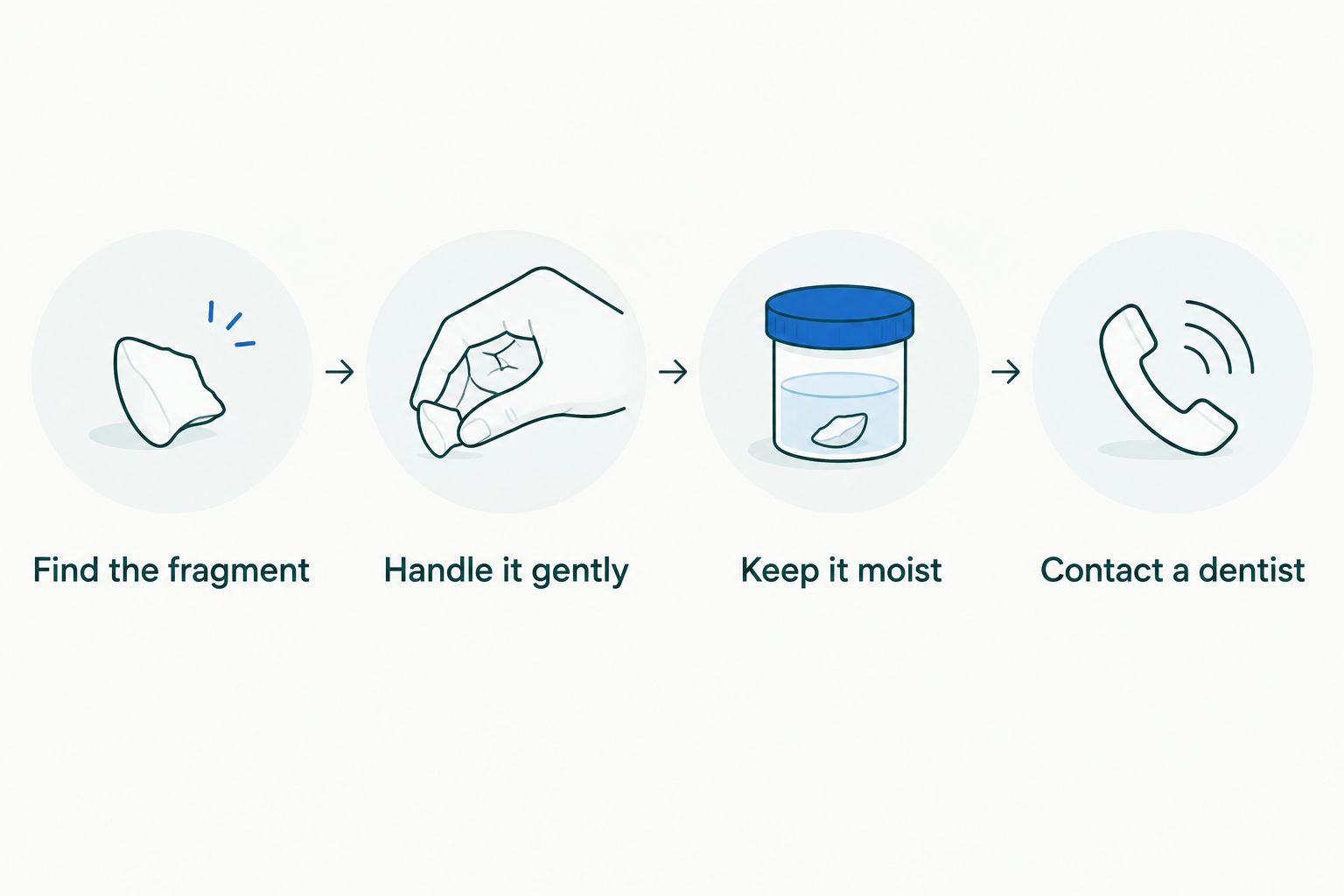
    1. Find the fragment. Look for the piece if you can do so safely. Do not delay getting help for a significant injury while searching.
    2. Handle it gently. Avoid scrubbing, scraping, or trying to reshape the broken surface. If it is dirty, rinse it gently without using disinfectants.
    3. Keep it moist. Place it in a clean container with milk or your saliva. Do not carry a loose fragment inside your mouth, where you could swallow or inhale it.
    4. Contact a dentist. Explain when the tooth broke, whether you have pain or swelling, and whether the tooth feels loose or your bite has changed.

    If you cannot find the fragment, you can still have the tooth evaluated and discuss other repairs. Finding the piece is helpful, not a requirement for receiving care.

    Steps for finding, protecting, moistening, and bringing a chipped tooth fragment to a dentist
    Protecting the fragment preserves an option; an examination determines whether reattachment is appropriate.

    While you wait for instructions, avoid biting on the injured tooth. Choose foods that do not require forceful chewing, and avoid temperatures that trigger sensitivity. Do not use household glue, nail adhesive, or a home repair kit to attach the piece.

    Fragment reattachment: when the original piece is usable

    Fragment reattachment is considered when the piece fits the broken tooth and the dentist can prepare and bond the surfaces appropriately. Keeping the original fragment can help preserve its natural contours, texture, and color.

    The limitation is strength and durability. A reattached fragment is still a repair, and another impact, hard biting, or grinding can damage it. Your dentist should explain what the repair can reasonably do and what would happen if it failed.

    Ask whether the fragment alone can restore the tooth or whether additional restorative material is needed. A piece that looks complete in your hand does not establish how much support remains inside the tooth.

    Bonding or a filling: when the fragment cannot be used

    Tooth-colored composite material can replace missing tooth structure when the original piece is lost, damaged, or unsuitable for reattachment. The dentist shapes the material to rebuild the tooth and checks the bite after placement.

    This option does not depend on finding the fragment. Its limitations include wear, staining, and possible chipping, especially where the tooth takes substantial biting forces.

    A missing fragment does not automatically mean you need a crown. The size and location of the break, the remaining tooth structure, and the condition of the tooth determine whether a direct repair is appropriate.

    A crown: when the remaining tooth needs more support

    A crown covers the prepared tooth rather than simply replacing the chipped edge. A dentist considers it when the remaining structure needs protection that a smaller repair cannot provide.

    The trade-off is that preparing a crown involves removing some tooth structure. A crown is therefore not the default response to every broken tooth, and it does not treat an injured or infected nerve by itself.

    If the nerve inside the tooth needs treatment, your dentist will explain that separately. Reattaching a fragment, placing a filling, and treating the inside of a tooth address different problems.

    Why tooth fragment reattachment varies

    Two chips that look alike can require different care. These factors help explain why a dentist cannot confirm reattachment from a description alone:

    • Fragment condition: An intact piece is different from one that is crushed, incomplete, or damaged along the fracture surface.
    • Fit: The dentist checks whether the fragment matches the remaining tooth and whether the edges can be joined appropriately.
    • Fracture depth: A break limited to enamel differs from one involving dentin, the nerve space, or the root.
    • Healthy tooth remaining: Decay, large existing restorations, or missing support can affect the repair choice.
    • Moisture control: Bonding requires a working area that the dentist can isolate from saliva and bleeding.
    • Biting forces: Tooth position, grinding, and the way your teeth contact each other affect stress on a repair.

    Do not judge suitability by pain alone. A tooth without pain still needs assessment after a fracture, particularly following a fall or impact.

    What happens at a chipped tooth evaluation in Vista?

    A dental evaluation looks beyond the missing corner. Your dentist asks how the injury happened, examines the tooth and nearby tissues, and checks whether the tooth is loose or your bite has changed.

    Depending on the injury, the examination can include dental X-rays and tests of the tooth's response. These checks help identify concerns that are not visible on the surface. For a fuller explanation, read what happens at a chipped tooth dental evaluation.

    For your 2026 appointment, bring the fragment in its container and explain any changes since the injury. Mention pain when biting, sensitivity, bleeding, swelling, or a different tooth color. If you struck your face, tell the dentist even when the chip looks small.

    At Thevistadentist, same-day emergency evaluations are usually available during normal office hours, subject to availability. That does not guarantee same-day treatment or after-hours care. The examination determines the next step.

    Request a chipped tooth evaluation

    Describe your symptoms and ask about an evaluation during normal office hours. Availability varies.

    When should you seek urgent help?

    Contact a dentist promptly after breaking a tooth, especially if you have worsening pain, swelling, bleeding, a loose tooth, or a changed bite. Tell the office about these symptoms when requesting care rather than describing the problem only as a cosmetic chip.

    Difficulty breathing or swallowing, heavy bleeding that will not stop, or a serious facial injury requires emergency medical attention. Do not wait for a routine dental appointment in those circumstances.

    A fragment is not the same as a whole tooth that has been knocked out. If the entire tooth is out of its socket, say so immediately when seeking help; the handling and urgency are different. Do not attempt to push a broken fragment into the gum.

    Will a reattached fragment look like the original tooth?

    A reattached fragment retains its original shape and surface, which can help it blend with the remaining tooth. The final appearance depends on the fracture, the fragment's condition, and the materials needed to join or rebuild the area.

    A visible join, a color difference, or a need for additional finishing is possible. Ask your dentist what appearance is realistic before deciding, particularly if the chip is on a front tooth.

    Can a reattached fragment break off again?

    A reattached fragment can break or detach again, especially with another injury or heavy biting pressure. No examination can promise that a repair will last indefinitely.

    After a repair in 2026, follow the dentist's instructions about eating, cleaning, and follow-up. Ask whether grinding or sports exposure needs attention. If the repair loosens or breaks, save any pieces and contact the practice rather than gluing them back.

    What if you feel anxious about the appointment?

    Tell the team what worries you: discomfort, the sound of instruments, an unexpected treatment recommendation, or uncertainty about the visit. You can ask the dentist to explain each step before beginning and to agree on a signal for a pause.

    An evaluation is an opportunity to understand the injury and discuss choices. You do not need to arrive knowing which repair to request. Thevistadentist emphasizes clear explanations and a reassuring approach so you can ask questions without feeling rushed.

    FAQ

    Can a dentist use my broken tooth piece to repair the chip?

    Yes, a dentist can sometimes reattach the original fragment if it fits and the remaining tooth can support the repair. Bring the piece in a clean container with milk or your saliva so the dentist can assess it.

    Should I put a chipped tooth fragment in water or milk?

    Milk is a suitable way to keep a chipped tooth fragment moist while you arrange dental care. Your saliva in a clean container is another option; do not carry the loose piece inside your mouth.

    Can I glue a tooth fragment back on myself?

    No, do not glue a tooth fragment back yourself. Household adhesives are not intended for dental repair, and placing the piece yourself can interfere with assessment and safe treatment.

    Is it too late if my tooth fragment dried out?

    A dried fragment still deserves a dentist’s assessment; dryness alone does not let you decide whether reattachment is possible. Keep the piece moist now and bring it to the evaluation.

    Does a chipped tooth need an appointment if it does not hurt?

    Yes, a chipped tooth needs a dental evaluation even without pain. The dentist checks the depth of the fracture, the remaining tooth structure, and any signs of injury beyond the visible chip.

    Can I get same-day chipped tooth repair in Vista in 2026?

    Same-day emergency evaluations are usually available at the Vista practice during normal office hours, subject to availability. Same-day treatment is not guaranteed; contact the office to discuss your symptoms and confirm an appointment.

    What if I swallowed the broken tooth fragment?

    You can still have the chipped tooth evaluated if you swallowed the fragment. Breathing difficulty or suspected inhalation requires emergency medical attention; tell the dentist that the piece is missing.

    What should I ask before agreeing to fragment reattachment in 2026?

    Ask why the fragment is suitable, what other repairs are reasonable, and what limitations the dentist expects. Also ask about care instructions, follow-up, and what to do if the fragment detaches.

    One last thing

    Bring the fragment even if you think it is too small to matter. It gives the dentist something useful to examine, but finding it should never delay care for a more serious injury. For a chipped tooth in Vista in 2026, the practical next step is an evaluation—not deciding on bonding, a crown, or reattachment before the tooth has been examined.

    Related guides

  • Can you get a chipped tooth repaired during pregnancy?

    Can you get a chipped tooth repaired during pregnancy?

    Yes, you can usually have a chipped tooth repaired during pregnancy, and necessary dental treatment should not be postponed solely because you are pregnant. Tell your dentist about your pregnancy, medications, and any pregnancy-related complications so the examination, local anesthetic, and treatment plan fit your needs.

    TL;DR
    • Chipped tooth repair pregnancy: necessary treatment generally does not need to wait until after delivery.
    • The American Dental Association supports necessary dental treatment, local anesthesia, and clinically indicated dental X-rays during pregnancy.
    • Pain, swelling, or a deep fracture needs prompt assessment rather than a cosmetic-only appointment.
    • Thevistadentist offers chipped-tooth evaluations for patients in Vista; treatment depends on the examination.

    Why this matters

    A chipped tooth can leave a rough edge, expose sensitive tooth structure, or involve a deeper fracture. Pregnancy does not tell you which situation you have, and the size of the visible chip does not establish the diagnosis.

    For your 2026 care planning, separate necessary repair from optional cosmetic changes. A dentist can explain what needs attention now, what can wait, and whether your prenatal care team should help plan treatment. The guide to what happens at a chipped-tooth dental evaluation explains the assessment before any repair decision.

    Can you get a chipped tooth repaired during pregnancy?

    Yes. Pregnancy alone is not a reason to delay necessary chipped-tooth care. The American Dental Association and the American College of Obstetricians and Gynecologists support necessary dental care during pregnancy, including local anesthesia and clinically indicated dental radiographs.

    These recommendations concern dental care during pregnancy generally, not a diagnosis of your particular tooth. Your dentist still needs to check the damage, symptoms, bite, and surrounding tissues before recommending a repair.

    The usual decision process is:

    1. Assess the damage. Your dentist examines the tooth and checks for sharp edges, exposed inner tooth structure, decay, and signs of deeper injury.
    2. Explain the findings. Ask whether the concern is appearance, tooth protection, pain, infection, or a combination.
    3. Choose appropriate treatment. The plan depends on the tooth and your medical history, not pregnancy alone.
    4. Coordinate when needed. Your dentist can consult your prenatal clinician about complications, medications, or restrictions relevant to care.

    An inquiry is not a confirmed appointment, and an emergency evaluation does not guarantee that the final repair will happen during that visit.

    Which chipped-tooth treatments are considered during pregnancy?

    A small enamel chip and a deep fracture need different care. Your dentist should explain both the benefit and the limitation of each suitable option rather than choose a treatment before examining you.

    Option Best suited to, after examination Main benefit Limitation or trade-off
    Smoothing or polishing A minor enamel irregularity Removes a rough or sharp edge Does not replace a larger missing portion of tooth
    Bonding or a filling A repairable chip with enough sound tooth remaining Replaces missing structure with restorative material Suitability depends on the fracture, bite, and remaining tooth
    A crown A more weakened tooth that needs broader coverage Covers and protects remaining tooth structure Requires more tooth preparation than a small bonded repair
    Root canal treatment with restoration Damage involving an inflamed or infected tooth pulp Treats the affected tissue inside a tooth that can be retained Is not needed for every chip and requires a separate diagnosis

    A veneer is generally a cosmetic restoration, not the default answer to a newly broken tooth. If your concern is appearance alone, discuss whether to postpone elective changes until after pregnancy.

    The treatment name does not establish urgency. For example, a filling can address a relatively limited defect, while a small-looking fracture can still require further investigation if symptoms suggest deeper injury.

    Does your trimester change the treatment plan?

    Early pregnancy: disclose it before treatment

    Tell the dental team if you are pregnant or think you might be pregnant. You do not need to wait until a later trimester to ask for an examination of a painful or broken tooth.

    Nausea and fatigue can make visits harder. Explain your triggers and ask about pauses or appointment timing rather than deciding that dental care is off limits.

    Mid-pregnancy: comfort can make scheduling easier

    The middle part of pregnancy is often more comfortable for planned dental visits, but it is not the only acceptable treatment window. Necessary care can be provided throughout pregnancy.

    For a planned repair in 2026, choose timing with your dentist based on symptoms, clinical need, and how you feel. A comfortable appointment date should not take priority over assessing infection or worsening pain.

    Later pregnancy: discuss positioning and breaks

    Later in pregnancy, reclining for an extended period can cause discomfort or lightheadedness. Tell the team immediately if you feel unwell so they can adjust your position and pause treatment.

    Do not assume that being close to delivery means every broken tooth should wait. Your dentist can distinguish an optional cosmetic change from treatment needed to protect your health.

    Why the repair plan varies during pregnancy

    Pregnancy is part of the medical history, not a diagnosis for the tooth. These factors help determine the next step:

    • Depth of damage: An enamel-only chip differs from a fracture that exposes deeper tooth structure or involves the pulp.
    • Symptoms: Persistent pain, sensitivity, swelling, and changes when biting need to be described clearly.
    • Remaining tooth structure: The amount and condition of sound tooth affect whether bonding, a filling, or broader coverage is suitable.
    • Pregnancy-related health concerns: Complications or restrictions from your prenatal clinician can affect coordination and planning.
    • Medication history: Prescription medicines, over-the-counter products, supplements, and allergies matter when selecting care.
    • Comfort during treatment: Nausea, reflux, anxiety, and difficulty reclining can affect how a visit is arranged.

    Bring your questions even if they feel small. Understanding why a dentist recommends a particular repair is part of making an informed decision.

    Can you have dental X-rays and numbing while pregnant?

    Clinically indicated dental X-rays and local anesthesia can be used during pregnancy. ADA and ACOG guidance supports their use when needed for dental care; pregnancy does not automatically rule them out.

    An X-ray is not required for every visible chip. Your dentist decides whether imaging is necessary to investigate a fracture, assess the roots, or look for another problem that the examination cannot resolve.

    Local anesthetic numbs the treatment area. It is different from sedation, which needs its own discussion about the medicine, your pregnancy, and whether it is necessary.

    For a 2026 appointment, ask which anesthetic is planned and why imaging is recommended. Do not assume that approval for local numbing also covers nitrous oxide, oral sedatives, or intravenous sedation.

    Should you wait until after delivery if the chip does not hurt?

    No pain does not prove that a chipped tooth can safely wait. A dentist needs to check the damage before advising whether observation or repair is appropriate.

    A minor cosmetic irregularity might be reasonable to leave until later. A fracture that affects the tooth's strength or exposes vulnerable structure needs a different discussion, even when you are comfortable.

    If the tooth is painless, explain when the chip happened, whether it has changed, and whether food catches around it. Those details help the dental team arrange an appropriate evaluation without treating every chip as the same problem.

    When does a chipped tooth need urgent help?

    Contact a dentist promptly if you have increasing pain, swelling, a loose or displaced tooth, pain when biting, or a fracture after an injury. Report fever, drainage, or a bad taste along with the tooth symptoms.

    Trouble breathing or swallowing, or rapidly spreading facial or neck swelling, needs emergency medical attention. Do not wait for a routine dental appointment when those symptoms occur.

    Thevistadentist offers chipped-tooth evaluations in Vista. Same-day emergency evaluations are usually available during normal office hours, subject to availability; that does not guarantee same-day treatment or after-hours care.

    When you call, describe both the dental symptoms and your pregnancy. Clear information helps the team assess the request, but the diagnosis still requires an examination.

    What should you do before your dental evaluation?

    You do not have to choose a repair yourself. Focus on protecting the area, explaining your symptoms, and giving the dentist the information needed to plan care.

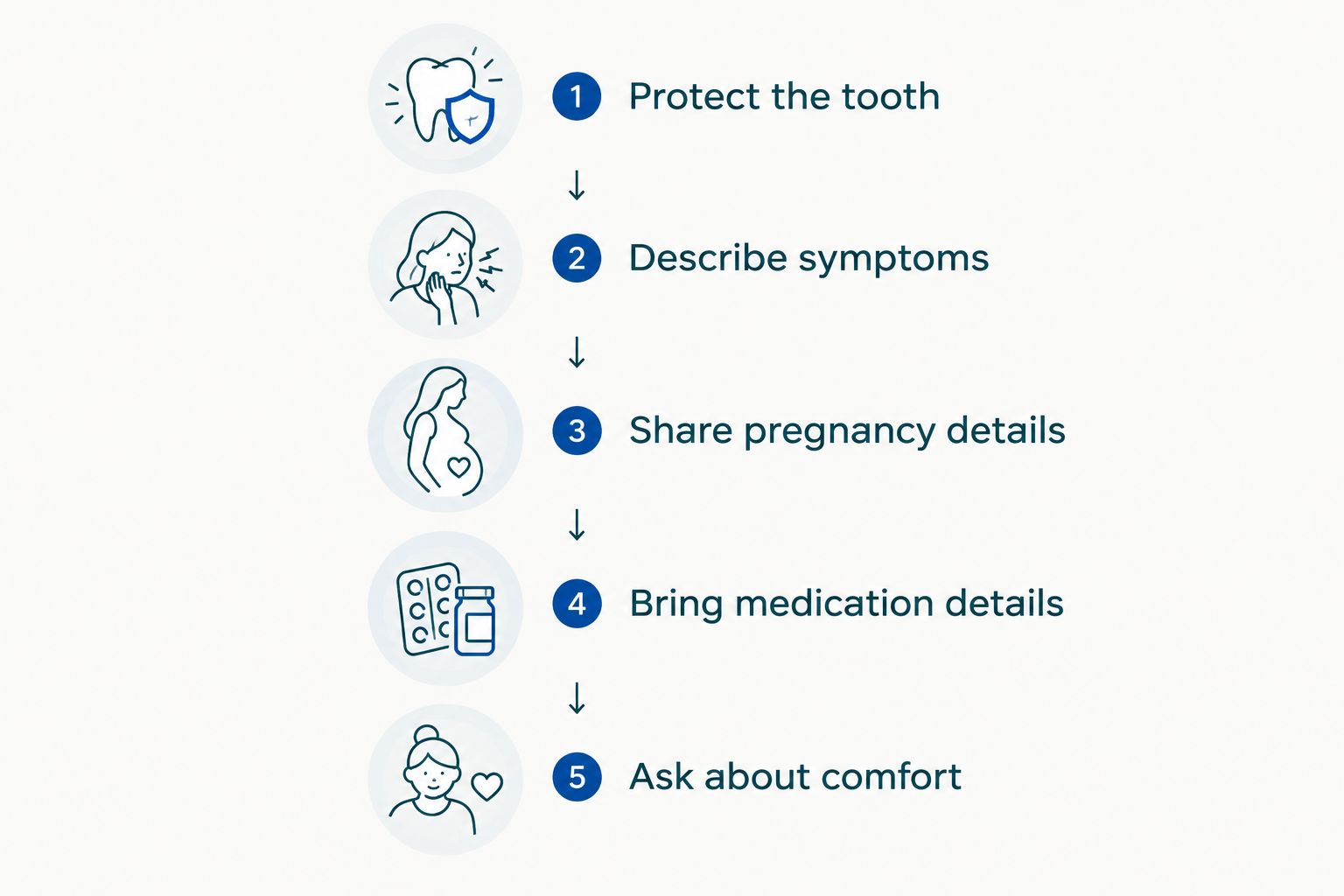
    1. Protect the tooth. Avoid biting hard foods with the damaged tooth, and do not test the edge repeatedly with your tongue.
    2. Describe symptoms. Note pain, temperature sensitivity, swelling, bleeding, or changes in how your teeth meet.
    3. Share pregnancy details. Tell the team how far along you are and about complications or advice from your prenatal clinician.
    4. Bring medication details. Include prescriptions, supplements, allergies, and anything taken for dental pain.
    5. Ask about comfort. Explain nausea, dental anxiety, or difficulty reclining before treatment begins.
    Preparation steps for a chipped-tooth dental evaluation during pregnancy
    Share pregnancy and medication details before the dentist plans treatment.

    Do not file the tooth yourself or use household glue to attach a broken piece. If you have the fragment, keep it and bring it to the appointment; the dentist can assess whether it is useful.

    For pain medicine, ask your prenatal clinician, dentist, or pharmacist what is appropriate for your pregnancy and medical history. Do not assume that an over-the-counter medicine or a product applied to the gum is suitable simply because it is sold without a prescription.

    Arranging care in Vista without pressure

    Thevistadentist is a local option for pregnant patients in Vista who need a chipped-tooth evaluation. The practice provides emergency, general, and restorative dental care, with a patient-centered approach and clear explanations.

    An examination is still necessary before the team can determine the repair, appointment needs, or whether coordination with your prenatal clinician is appropriate. Ask what needs attention now and what can reasonably wait.

    For a 2026 appointment request, use Thevistadentist to find the practice's contact options. Call or request an appointment, explain that you are pregnant, and wait for confirmation of the appointment details.

    Request a chipped-tooth evaluation

    Tell the team about your pregnancy, symptoms, and comfort needs when requesting an appointment.

    How do you care for the tooth while waiting?

    Keep cleaning your teeth gently rather than avoiding the damaged area entirely. Brush for 2 minutes, 2 times a day, with fluoride toothpaste, and clean between your teeth 1 time a day unless your dental team gives you different instructions for a specific injury.

    Choose foods that do not put pressure on the damaged tooth. Avoid chewing ice or other hard objects, and stop using the tooth to bite anything that triggers discomfort.

    After repair, ask when you can chew normally and what symptoms should prompt another call. Instructions depend on the treatment and anesthetic used; a general article cannot replace your dentist's directions.

    FAQ

    Is chipped tooth repair safe during pregnancy?

    Necessary chipped-tooth repair can generally be provided during pregnancy. Your dentist needs to examine the tooth and review your pregnancy, medications, and medical history before choosing treatment.

    Can I get a chipped tooth bonded while pregnant?

    Dental bonding can be considered during pregnancy when it is an appropriate repair. The dentist must first check the chip, remaining tooth structure, and bite; bonding is not suitable for every fracture.

    Do I need to wait until the second trimester for a dental repair?

    You do not need to wait until the second trimester for necessary dental care. Timing depends on the tooth’s condition, your symptoms, and pregnancy-related health considerations.

    Can a dentist numb my tooth while I am pregnant?

    Local anesthesia can be used for necessary dental treatment during pregnancy. Tell your dentist about pregnancy complications, medications, and allergies, and discuss sedation separately if it is proposed.

    Can I have a dental X-ray for a broken tooth during pregnancy?

    A clinically indicated dental X-ray can be taken during pregnancy. Your dentist should explain why the image is needed and how it will help assess the tooth or guide treatment.

    What if my chipped tooth does not hurt while I am pregnant?

    A painless chipped tooth still needs an evaluation before you decide to delay repair. The examination helps distinguish a minor cosmetic defect from damage that needs protection or treatment.

    Can I request a same-day chipped-tooth appointment in Vista?

    You can request an emergency evaluation at the Vista practice. Same-day emergency evaluations are usually available during normal office hours, subject to availability; an inquiry does not confirm an appointment or guarantee same-day treatment.

    One last thing

    Ask your dentist to separate the immediate health need from the cosmetic goal. Protecting a damaged tooth and changing its appearance are not always the same decision. That distinction can help you understand what to address during pregnancy without feeling pressured to complete optional treatment.

    Related guides

  • How can teeth grinding affect chipped tooth repair?

    How can teeth grinding affect chipped tooth repair?

    Teeth grinding can put repeated pressure on a chipped tooth repair, increasing the risk of wear, another chip, or damage to the remaining tooth. Your dentist needs to assess both the broken area and your bite, because repairing the chip does not stop the grinding that can stress it.

    TL;DR
    • Chipped tooth repair: grinding can stress bonding, crowns, and the remaining natural tooth.
    • Santa Fe Dental Group offers chipped tooth evaluations for patients in Vista and nearby communities.
    • A night guard can help protect teeth and repairs, but it does not necessarily stop grinding.
    • The right repair depends on the damage, remaining tooth structure, and how your teeth meet.

    Why this matters

    A chipped edge is the part you can see. Grinding or clenching can also place stress on the tooth when you sleep or concentrate, without you noticing the habit. A repair that looks natural still needs to work comfortably when you bite and move your jaw.

    For your 2026 appointment, ask about both repairing the tooth and protecting it afterward. Understanding what happens at a chipped tooth evaluation can help you explain your concerns and know what questions to ask. You do not need to prove that you grind before bringing it up.

    How can teeth grinding affect chipped tooth repair?

    Grinding can wear a repair, chip its edges, or contribute to fractures in the tooth around it. Clenching also matters: holding your teeth together under pressure can stress a restoration even without obvious grinding movements. Neither habit means a repair will definitely fail.

    Your dentist considers the following when planning care:

    1. Examine the chip. The dentist checks the size and location of the damage, the remaining tooth, and whether there are signs of decay or a deeper crack. X-rays are used when clinically appropriate; not every crack is visible on an X-ray.
    2. Check your bite. The dentist assesses how your teeth meet and whether the damaged area takes pressure during biting or side-to-side movement. Where the force lands matters as well as how much tooth is missing.
    3. Look for wear. Flattened biting surfaces, repeated chips, or damage to existing restorations can prompt questions about grinding. These findings need interpretation alongside your history, rather than serving as a diagnosis by themselves.
    4. Discuss protection. The repair plan can include reviewing your bite, discussing a night guard, and arranging follow-up. Protection supports the repair; it does not replace treatment for the damaged tooth.

    Tell your dentist if an earlier repair broke in the same place. That history helps identify whether the problem involves the repair, the underlying tooth, the bite, or several factors together.

    Why grinding-related repair needs vary

    Grinding does not automatically mean you need a crown or cannot have bonding. These factors help explain why different teeth need different approaches:

    • Chip location: A chip on a biting edge faces different contact forces from a chip away from the bite.
    • Depth of damage: An enamel chip differs from damage that exposes deeper tooth layers or reaches the pulp, the tissue inside the tooth.
    • Remaining tooth structure: A tooth with a large existing filling has a different starting point from a mostly intact tooth.
    • Bite contact: A repair that meets an opposing tooth during jaw movement needs careful assessment.
    • Grinding and clenching history: Repeated breakage, reported nighttime grinding, and daytime clenching all belong in the discussion.
    • Condition of the tooth: Decay, cracks, gum health, and symptoms can change the treatment plan.

    You cannot reliably judge these factors from a mirror or photograph. A small-looking chip does not establish that the rest of the tooth is healthy, and a painless tooth still deserves assessment.

    Comparing chipped tooth repair options in 2026

    The table below describes possible approaches, not a treatment recommendation for your tooth. The best option is the one that addresses the damage while preserving suitable healthy tooth structure. Grinding is part of that decision, not the only deciding factor.

    Option Best suited to Potential benefit Limitation when grinding is present
    Bonding or a tooth-colored filling Selected smaller defects with enough sound tooth remaining Can replace missing tooth structure without full crown coverage The material can wear or chip under repeated loading
    Crown Teeth needing broader protection because of substantial damage or weakness Covers and supports the prepared tooth Requires tooth preparation and does not eliminate grinding forces
    Veneer Selected front-tooth defects where appearance and tooth condition support its use Can change the visible front surface and edge Is not a universal solution for heavy bite contact or deeper damage

    A night guard is not included as a repair option because it does not replace missing tooth structure. It serves a different purpose: helping protect teeth and restorations from direct contact during grinding.

    When is bonding or a filling suitable?

    Bonding or a filling is best suited to selected smaller chips when the tooth and bite support it. Your dentist can shape tooth-colored material to restore the damaged area, then check how it contacts the opposing teeth. The amount of sound tooth available to support the material matters.

    The advantage is that this approach can preserve more natural tooth than full coverage. The limitation is that the material remains exposed to biting forces and can need repair or replacement. A history of grinding makes the bite check and protection discussion especially relevant.

    Read about whether a filling can repair a chipped tooth if you want to understand that distinction before your visit. An examination determines whether the damaged area is suitable for this approach.

    When does a crown enter the discussion?

    A crown is best suited to teeth that need broader coverage because of their condition, not simply because you grind. A dentist considers how much tooth remains, the position of existing fillings, and whether there are cracks or weakened areas. A crown cannot make every damaged tooth restorable.

    Its benefit is coverage of the prepared tooth. Its trade-off is that placing it requires removal of tooth structure, and it remains subject to wear, fracture, and problems affecting the tooth underneath. You still need daily care and follow-up after crown treatment.

    Ask your dentist to explain why coverage is being recommended and what a more conservative option would leave unaddressed. That conversation should connect the recommendation to findings in your tooth.

    Can a veneer solve a grinding-related chip?

    A veneer is best suited to selected front-tooth concerns after the dentist checks the bite and tooth condition. It can address the appearance of the visible tooth surface, but it is not a substitute for assessing deeper damage. Grinding can place stress on a veneer as well as on natural enamel.

    The benefit is a change to the tooth's visible surface and shape. Limitations include tooth preparation when required, the possibility of chipping or debonding, and suitability restrictions related to the bite. Do not choose a veneer based only on how the chipped edge looks.

    What a night guard can and cannot do

    A night guard creates a barrier between the upper and lower teeth. Your dentist can discuss whether an appliance is appropriate for your grinding pattern, existing restorations, and bite. A night guard can help protect a repair, but it does not guarantee that the repair will never chip.

    It also does not necessarily stop the muscle activity responsible for grinding. That distinction matters: protection and treatment of contributing factors are separate conversations. Tell your dentist about jaw discomfort, headaches on waking, sleep concerns, and any appliance you already wear.

    Before choosing a guard in 2026, separate these parts of the plan:

    • Repair: Restore the damaged tooth with an approach suited to the examination findings.
    • Protection: Discuss whether a guard is appropriate and how it should fit around your teeth and restorations.
    • Follow-up: Check comfort, wear, and any changes in the tooth or appliance over time.
    Repair, protection, and follow-up as separate parts of caring for a chipped tooth.

    The conversation about night guards for teeth grinding should include fit, comfort, and changes after dental treatment—not just whether you own a guard. An appliance made before a repair might no longer fit correctly, so bring it to the appointment rather than forcing it over the repaired tooth.

    Do not keep wearing an appliance that causes new pain or no longer seats properly without asking your dentist. Bring up practical difficulties, too: an appliance cannot help protect your teeth while it sits unused because it feels uncomfortable.

    What should you tell the dentist before repair?

    You do not need a detailed sleep history to have a useful conversation. Describe what you have noticed and what someone else has observed, keeping those separate. For example, morning jaw tiredness is your symptom; hearing you grind at night is someone else's observation.

    For your 2026 visit, bring these details:

    • When you first noticed the chip and whether it followed an injury or biting something hard.
    • Whether the tooth hurts with biting, temperature changes, or without an obvious trigger.
    • Whether a filling, crown, or previous repair has broken in that area.
    • Whether you catch yourself clenching during the day or someone has heard nighttime grinding.
    • Any night guard, retainer, or other removable dental appliance you use.

    If dental visits make you anxious, say so when requesting the appointment. You can ask the dentist to explain the findings before discussing treatment and to agree on a signal for a pause. Clear explanations help you participate without having to make a decision before you understand the options.

    Should you wait if the chipped tooth does not hurt?

    No pain does not confirm that a chipped tooth is safe to leave untreated. Some chips cause little discomfort, while others involve damage that needs closer assessment. Grinding adds a reason to examine how the tooth handles pressure, even when you can chew normally.

    Until the tooth is assessed, avoid chewing hard foods on that area and do not file or glue the tooth yourself. Keep the area clean with gentle brushing. Contact a dentist promptly for worsening pain, swelling, a loose tooth, or a repair that feels unstable.

    Seek urgent medical care for trouble breathing or swallowing, or rapidly spreading swelling. Those symptoms need a different level of attention from a routine chipped-edge appointment.

    What if the repaired tooth feels high when you bite?

    A repair that feels high needs a dental review rather than repeated testing by biting hard. A change in bite contact can make the tooth feel as though it touches before the others. Tell the practice when it started and whether you also have pain or sensitivity.

    Do not try to wear the material down yourself. The dentist needs to check whether the issue is bite contact, sensitivity after treatment, a crack, or another cause. A high-feeling bite and ongoing grinding can occur together, but one symptom does not establish the diagnosis.

    Planning care in Vista in 2026

    Santa Fe Dental Group is suited to Vista patients seeking a chipped tooth evaluation with clear explanations and a reassuring approach. The practice offers emergency, general, restorative, and cosmetic dental care. An examination is still necessary before the dentist can recommend a particular repair.

    Same-day emergency evaluations are usually available during normal office hours, subject to availability. That does not mean same-day treatment is guaranteed or that after-hours care is offered. Call or request an appointment, describe the chip and any symptoms, and wait for the practice to confirm arrangements.

    When you contact Santa Fe Dental Group about chipped tooth repair, mention grinding or clenching even if it has never been formally assessed. You can also ask what to bring and whether an existing guard should come with you.

    FAQ

    Can teeth grinding break a repaired chipped tooth?

    Teeth grinding can contribute to another chip or damage to a repair through repeated pressure. The risk depends on the tooth, repair, bite, and grinding pattern; failure is not inevitable.

    Is bonding a bad choice if I grind my teeth?

    Bonding is not automatically unsuitable when you grind your teeth. Your dentist needs to assess the chip, remaining tooth structure, and bite before recommending it.

    Will a crown stop me from grinding my teeth?

    A crown does not stop teeth grinding. It restores or covers a tooth when appropriate, while grinding and protection require a separate discussion.

    Do I need a night guard after chipped tooth repair?

    A night guard is appropriate for some patients after chipped tooth repair, but not everyone needs the same approach. Your dentist can assess grinding signs, appliance fit, and the condition of your teeth.

    Can I wear my old night guard after a tooth repair?

    Have your dentist check your old night guard after a repair because the tooth’s shape may have changed. Do not force an appliance that no longer seats comfortably.

    Can Santa Fe Dental Group see a chipped tooth the same day?

    Santa Fe Dental Group usually has same-day emergency evaluations during normal office hours, subject to availability. Contact the practice to request care; an inquiry does not confirm an appointment or guarantee same-day treatment.

    One last thing

    Bring your existing night guard to the repair appointment, even if you rarely wear it. The dentist can assess its fit and look for wear that contributes to the discussion about your bite. Do not adjust the appliance yourself before the visit.

    For a chipped tooth repair planned in 2026, leave knowing more than the name of the restoration. Ask what the examination showed, how grinding affects the plan, and which changes should prompt you to call.

    Related guides

  • What should parents know about chipped baby tooth repair?

    What should parents know about chipped baby tooth repair?

    A chipped baby tooth needs a dental assessment, but not every chip needs a filling or other repair. A dentist checks the depth of the break, tooth movement, pain, and signs of injury beneath the gum before recommending monitoring, smoothing, a restoration, or another treatment. This 2026 guide explains what to do next without assuming your child needs a particular procedure.

    TL;DR
    • Searching chipped tooth repair baby tooth? A dental examination determines whether monitoring or treatment is appropriate.
    • Never put a knocked-out baby tooth back into its socket.
    • Thevistadentist offers emergency dental care in Vista; ask whether the practice can evaluate your child’s injury.
    • Trouble breathing, major facial injury, or uncontrolled bleeding needs emergency medical attention.

    What should parents know about chipped baby tooth repair?

    The size of the visible chip does not tell you the full extent of the injury. A small break can accompany a loosened tooth, gum injury, or damage that needs follow-up. A larger break can expose sensitive inner tissue even when your child struggles to describe the discomfort.

    Call a dentist after the injury and explain what happened. Mention your child's age, whether the tooth is loose or displaced, and whether a piece is missing. The guide to what happens at a chipped tooth dental evaluation explains the assessment process; for a child, the examination also needs to account for primary teeth and developing permanent teeth.

    A baby tooth is temporary, but that does not make an injury unimportant. The aim is to keep your child comfortable, address infection or instability, and protect the surrounding tissues—not simply make the tooth look unchanged.

    Why this matters

    Primary teeth help children chew and speak, and they help preserve space for permanent teeth. Treatment decisions balance those functions against the condition of the injured tooth and its expected remaining time in the mouth.

    Thevistadentist offers local dental care for Vista patients seeking a chipped tooth evaluation and clear explanations. When calling about a child, ask whether the practice can assess the injury or whether a pediatric dental referral is appropriate.

    For parents arranging care in 2026, the practical priority is a clear plan: how urgently your child needs an examination, what to do while waiting, and which changes require another call.

    What should you check immediately after the injury?

    Start with your child's overall condition rather than the tooth's appearance. A fall can injure more than the mouth, and a frightened child needs a calm adult before a detailed inspection.

    1. Check overall safety. Trouble breathing, loss of consciousness, repeated vomiting after a head injury, or a major facial injury requires emergency medical attention.
    2. Control bleeding. Apply gentle pressure with clean gauze for about 10 minutes if your child can cooperate safely. Get urgent help for heavy bleeding that does not stop.
    3. Look gently. Note whether the tooth is chipped, loose, pushed out of position, or missing. Do not wiggle it to test its stability.
    4. Call the dentist. Describe the injury and symptoms, including any missing fragment. Ask where and how soon your child should be evaluated.
    Four steps for responding to a child's chipped tooth, from checking safety to calling the dentist.
    Check your child’s overall condition before focusing on the tooth.

    If you find a tooth fragment, save it in a clean container and bring it to the appointment. Tell the dentist if you cannot find the fragment, especially if your child has coughing or breathing symptoms. Do not reach blindly into the mouth or throat.

    Which treatments can a chipped baby tooth need?

    There is no single repair for every primary tooth injury. The dentist considers the fracture, the tooth's stability, your child's symptoms, and whether the tooth can be restored safely.

    The following comparison explains possible approaches, not a treatment recommendation for your child. An examination comes first.

    Approach Best suited to Main benefit Limitation or trade-off
    Monitoring Selected minor injuries without findings that require immediate repair Avoids unnecessary treatment Needs follow-up and attention to new symptoms
    Smoothing A small, sharp enamel edge when smoothing is appropriate Removes an irritating edge Does not replace missing tooth structure
    Filling or bonding A restorable chip needing replacement of lost structure Restores shape and covers the damaged area Requires suitable remaining tooth structure and cooperation
    Crown Selected primary teeth needing more extensive coverage Covers more of the damaged tooth Involves more treatment than smoothing or a small filling
    Pulp treatment or extraction Selected deep injuries, infection, or teeth that cannot be retained safely Addresses damage beyond the outer tooth layers Requires a separate discussion of benefits, risks, and follow-up

    Monitoring or smoothing for a small chip

    A minor enamel chip does not automatically need a filling. If the tooth is stable and the examination shows no reason for more treatment, the dentist can recommend observation or smoothing a sharp edge.

    The advantage is avoiding a procedure that offers little benefit. The limitation is that observation still requires a plan: what to watch for, when to return, and whether further assessment is needed.

    Filling or bonding to replace missing structure

    A filling or bonding material can replace part of a chipped tooth when the remaining tooth supports a repair. The dentist checks the bite and the damaged surface before deciding whether this approach fits.

    A restoration can improve shape and comfort, but it does not make an injured tooth immune to future problems. It can chip or loosen, and deeper injury can still become apparent later.

    A crown when broader coverage is needed

    A crown covers more tooth structure than a small filling. It is an option for selected damaged primary teeth, not an automatic response to a visible chip.

    The benefit is broader coverage where a smaller restoration is unsuitable. The trade-off is a more involved procedure; ask why coverage is needed and how the dentist will help your child manage treatment.

    Pulp treatment or extraction for deeper injury

    The pulp is the tissue inside a tooth containing nerves and blood vessels. A deep fracture or infection can require treatment beyond replacing the missing corner.

    In selected cases, a dentist can treat the pulp and restore the tooth. In others, removing the tooth is appropriate. Ask what each approach would address, what follow-up involves, and whether early tooth loss affects space for the permanent tooth.

    Why does chipped baby tooth treatment vary?

    Treatment depends on the injury, not on a standard repair chosen from a photograph. These factors explain why children with similar-looking chips can receive different recommendations:

    • Depth of the break: Enamel-only damage differs from a fracture reaching sensitive dentin or pulp.
    • Tooth position and movement: A displaced or unusually loose tooth needs assessment beyond the chipped surface.
    • Symptoms and tissue health: Pain, swelling, tenderness, or signs of infection influence the plan.
    • Remaining tooth structure: A repair needs enough suitable tooth structure to support it.
    • Stage of dental development: The dentist considers the primary tooth and the developing permanent tooth beneath it.
    • Your child's ability to manage care: Age, anxiety, and cooperation help shape how treatment is delivered or whether referral is needed.

    For a 2026 appointment, bring a clear account of the accident and your child's medical information. Photos taken soon after the injury can help show changes, but they do not replace the examination.

    How can you keep your child comfortable while waiting?

    Offer soft foods and discourage biting with the injured tooth. Avoid foods or drinks that trigger discomfort, and do not let your child repeatedly touch the sharp edge with a finger or tongue.

    Use a cold compress against the outside of the cheek for comfort, with a cloth between the cold source and skin. If your child needs pain relief, ask a dentist, pediatrician, or pharmacist about an appropriate medicine and dose for your child's age and weight. Never put aspirin directly on the tooth or gum.

    With first aid for children's dental emergencies, the goal is to protect the injured area and recognize urgent symptoms—not to complete a repair at home. Do not file the tooth, use household glue, or attach a fragment yourself.

    Keep the mouth clean gently. Routine brushing guidance is 2 minutes, twice a day, but avoid scrubbing an injured area or forcing brushing that causes bleeding or pain. Ask the dentist how to clean around the injury until it is assessed.

    What should you tell the Vista dental office when you call?

    Start with the injury, not a request for a particular treatment. Say that your child chipped a baby tooth, explain when and how it happened, and describe bleeding, discomfort, tooth movement, or swelling.

    Tell the team if your child is anxious, has difficulty tolerating dental care, or has medical needs that affect treatment. You can ask for plain-language explanations and time to discuss the plan before agreeing to a procedure.

    Thevistadentist usually has same-day emergency evaluations during normal office hours, subject to availability. Ask whether the practice can evaluate your child's injury; an inquiry is not a confirmed booking, and an evaluation does not guarantee same-day treatment or after-hours care.

    Before your 2026 visit, ask how payment and insurance questions will be handled. Understanding whether insurance covers chipped tooth repair starts with your plan's benefits and the treatment recommended after examination, not an assumption that every dental injury has the same coverage.

    Does a chipped baby tooth need care if it does not hurt?

    A chipped baby tooth still needs dental advice even when it does not hurt. Pain alone does not show whether the tooth is stable or whether the surrounding tissues were injured. Call for guidance rather than waiting for discomfort to decide when to act.

    Should you put a knocked-out baby tooth back in?

    Never put a knocked-out baby tooth back into its socket. Replanting it can harm the developing permanent tooth. If you are unsure whether the missing tooth is primary or permanent, seek immediate dental guidance because the recommended response differs.

    What if the baby tooth changes color afterward?

    A color change after injury needs dental follow-up, but color alone does not determine treatment. Tell the dentist when the change appeared and whether your child has pain, swelling, increased looseness, or a gum bump. Do not assume a darker tooth automatically needs extraction.

    FAQ

    Can a chipped baby tooth heal on its own?

    Missing enamel does not grow back. A dentist can still recommend monitoring a minor chip when the examination shows that a restoration is unnecessary.

    Is a chipped baby tooth always a dental emergency?

    Not every chip requires immediate treatment, but every injury deserves dental advice. Significant pain, displacement, swelling, or persistent bleeding makes prompt assessment especially important.

    Can a dentist put a filling in a baby tooth?

    Yes, a dentist can restore a baby tooth with a filling when the tooth and injury are suitable. The examination determines whether a filling, another treatment, or monitoring fits.

    What if my child swallowed the chipped piece?

    Tell the dentist that the fragment is missing or was swallowed. Trouble breathing or choking requires emergency medical care; do not assume a missing fragment was swallowed if breathing symptoms are present.

    Will a chipped baby tooth damage the adult tooth?

    A chipped baby tooth does not automatically mean the permanent tooth is damaged. The type and force of the injury matter, and the dentist assesses whether follow-up of the developing tooth is needed.

    Can I wait until the baby tooth falls out?

    Do not decide to wait for the tooth to fall out without dental advice. Symptoms, stability, infection risk, and dental development determine whether observation is appropriate.

    Can I request a same-day evaluation in Vista in 2026?

    You can ask Thevistadentist about a same-day emergency evaluation during normal office hours, subject to availability. Explain your child’s age and injury so the team can advise whether the practice can assess the problem; treatment is not guaranteed that day.

    One last thing

    Before leaving the appointment, ask for a follow-up plan—not just a repair plan. An injured tooth can change after the first visit, even when the chip looks minor. Know which symptoms require a call and whether the dentist wants another examination.

    For your child's 2026 care, keep the instructions somewhere easy to find and tell other caregivers what to watch for. A calm explanation and a clear next step are more useful than repeatedly checking the tooth yourself.

    Related guides

  • How is a child’s chipped permanent tooth assessed?

    How is a child’s chipped permanent tooth assessed?

    A dentist assesses a child’s chipped permanent tooth by checking how deeply the tooth broke, whether it moved, how the bite fits, and whether nearby teeth or soft tissues were injured. The dentist may take X-rays and test the tooth’s response to temperature or gentle touch. A small-looking chip and the absence of pain do not rule out a deeper injury, so arrange a dental evaluation rather than choosing a repair from appearance alone.

    TL;DR
    • For chipped tooth repair, a permanent tooth in a child needs assessment of fracture depth, root development, and associated injuries.
    • Save the broken fragment in milk or saliva and bring it to the dental visit.
    • Thevistadentist offers chipped tooth evaluations in Vista; ask whether the practice can assess your child’s injury.
    • Repair options depend on examination findings, not just the chip’s size or whether the tooth hurts.

    Why this matters

    A permanent tooth needs care that accounts for its stage of development. A newly erupted tooth can still have an unfinished root, making preservation of its living inner tissue especially important.

    For a dental injury in Vista in 2026, contact Thevistadentist and explain your child’s age, the injury, and current symptoms. Same-day emergency evaluations are usually available during normal office hours, subject to availability. Ask whether the practice can assess your child or whether specialist care is appropriate; an appointment request is not a confirmed booking.

    How is a child’s chipped permanent tooth assessed?

    The assessment looks beyond the missing piece. A dentist checks the injured tooth, neighboring teeth, gums, lips, bite, and supporting tissues before recommending treatment.

    Start with the injury history

    Explain when and how the injury happened. A fall, sports collision, or bite on something hard gives the dentist different clues about associated injuries.

    Tell the dentist about bleeding, sensitivity, pain when biting, looseness, or a tooth that looks longer, shorter, or out of position. Mention any previous injury to the same tooth, even if that tooth seemed to recover.

    Examine the tooth and surrounding tissues

    The dentist looks for exposed enamel, dentin, or pulp. Enamel is the hard outer covering; dentin lies beneath it; pulp is the living tissue containing nerves and blood vessels.

    The examination also checks for cracks, movement, gum injury, and changes in how the teeth meet. If a fragment is missing and a lip is cut, the dentist considers whether a piece became embedded in the soft tissue.

    Use X-rays when the findings call for them

    Dental X-rays can help assess root development, root fractures, and injury around the tooth. Different views sometimes provide information that a photograph or surface examination cannot show.

    An X-ray does not answer every question about a tooth’s recovery. Your dentist combines imaging with the examination and follow-up findings rather than treating a single image as the whole diagnosis.

    Establish a baseline for follow-up

    The dentist may check how the tooth responds to cold or another sensitivity test. A recently injured tooth can temporarily respond differently, so an early result does not, by itself, establish whether the pulp will recover.

    The broader guide to what happens at a chipped tooth evaluation explains the examination process. For children, the dentist also considers root maturity and whether the child can comfortably cooperate with the assessment.

    Assessment sequence covering injury history, tooth examination, X-rays, and a baseline for follow-up
    The examination combines the injury history with findings from the tooth and surrounding tissues.

    What the depth of the chip changes

    The visible size of a chip does not establish the treatment. A narrow fracture can reach sensitive tissue, while a wider, shallow chip can remain limited to the outer surface.

    The following comparison describes general approaches, not a treatment plan for your child.

    Finding Approach the dentist considers Best for Limitation
    Enamel-only chip Smoothing or a conservative bonded repair A superficial defect or sharp edge Does not address an unrecognized deeper injury
    Enamel and dentin fracture Covering exposed dentin, fragment reattachment, or a bonded restoration Protecting exposed dentin and restoring shape The tooth still needs assessment for associated trauma
    Pulp exposure Treatment to protect or preserve living pulp when appropriate Selected teeth where pulp preservation is feasible Suitability depends on the injury and clinical findings
    Extensive fracture or associated displacement A more involved restoration, stabilization, or specialist care Injuries beyond a simple surface chip Treatment and monitoring are more complex

    Enamel-only chips

    A shallow chip can leave an edge that catches the tongue or lip. The dentist checks that the fracture is limited to enamel before discussing smoothing or adding tooth-colored material.

    The advantage is conserving tooth structure. The limitation is that correcting the edge alone does not address any separate injury to the root or supporting tissues.

    Chips that expose dentin

    Exposed dentin can cause sensitivity to cold, air, or touch. Covering that surface helps protect the tooth, while a bonded restoration or suitable recovered fragment can restore its shape.

    The dentist checks how much sound tooth remains and whether the tooth meets opposing teeth safely. A repair restores the broken area, but it does not remove the need to monitor an injured tooth.

    Chips that expose the pulp

    A pink or red area within the broken surface can indicate exposed pulp. Do not probe it or try to decide its depth at home.

    For a young permanent tooth, preserving healthy pulp can support continued root development. The dentist assesses whether pulp-preserving treatment is appropriate or whether another treatment or referral is needed; pulp exposure does not automatically mean the same treatment for every child.

    Why the assessment and repair plan vary

    A plan for a child’s permanent tooth depends on more than the missing corner. These factors guide the examination and the discussion with your family:

    • Fracture depth: Enamel, dentin, and pulp injuries need different protection and treatment.
    • Root development: An immature permanent tooth has different treatment priorities from a fully developed tooth.
    • Associated injury: Looseness, displacement, bite changes, or root damage can change the plan.
    • Time and symptoms: The injury history and changes since the accident help guide assessment.
    • Remaining tooth structure: The amount and position of sound tooth affect repair choices.
    • Your child’s comfort: Anxiety and ability to tolerate care influence how the team approaches the visit.

    Bring previous dental records if readily available, but do not delay contacting a dentist to gather paperwork. For your child’s 2026 visit, a short written timeline of the injury and subsequent symptoms is more useful than trying to name the fracture yourself.

    What should you do before the dental visit?

    Contact a dentist promptly after a permanent tooth breaks. Describe any movement, bleeding, bite change, or visible pink or red area so the team can advise you about urgency.

    1. Rinse gently. Use water to clear the mouth without scrubbing the broken surface.
    2. Save the fragment. If you find it, keep it moist in milk or saliva in a clean container and bring it along. Do not keep it loose in a child’s mouth.
    3. Protect the tooth. Choose soft foods and avoid biting with the injured tooth until you receive advice.
    4. Use a cold compress. Apply it outside the face if there is swelling or soreness.
    5. Avoid home repairs. Do not file the tooth, use household glue, or place aspirin against the tooth or gum.

    If your child needs pain relief, ask a dentist or pharmacist about an age-appropriate medicine and follow its label. Do not use a medication dose intended for an adult.

    Breathing or swallowing difficulty, uncontrolled bleeding, or signs of a significant head injury need emergency medical attention. If the whole permanent tooth came out, tell the dental team immediately: a knocked-out tooth requires different urgent instructions from a chipped tooth.

    Does a chipped permanent tooth need assessment if it does not hurt?

    A chipped permanent tooth needs assessment even when it does not hurt. Pain alone cannot show how deeply the tooth fractured or whether the supporting tissues were injured.

    Tell the dentist if the tooth later darkens, becomes sensitive, develops swelling, or hurts when biting. Do not wait for those changes before making the initial call.

    Can the dentist reattach the broken piece?

    A dentist can sometimes reattach a recovered tooth fragment if its condition, fit, and the injury allow it. Keeping the fragment moist gives the dentist an opportunity to consider that option.

    Reattachment preserves the tooth’s original shape, but it is not appropriate for every fracture. If the fragment cannot be used, the dentist can explain other ways to protect the tooth and rebuild the missing area.

    Will my child need a root canal?

    A chipped permanent tooth does not automatically need root canal treatment. The dentist assesses the pulp, root maturity, fracture, and associated injuries before discussing treatment.

    Some injured teeth need care that preserves living pulp, while others need different treatment. Ask what the examination shows, what remains uncertain, and what follow-up will help clarify recovery.

    Planning a calm dental visit in Vista

    Tell the team if your child is frightened, sensitive to sounds, or worried that an examination will hurt. Ask for explanations in plain language and a chance for your child to signal when they need a pause.

    Thevistadentist is a local option for Vista patients seeking a chipped tooth repair evaluation rather than choosing treatment online. When you call, confirm that the practice can assess your child’s age and injury. Explain any symptoms before asking about appointment timing.

    For appointment planning in 2026, distinguish the evaluation from the repair. The first visit establishes what happened and what care is appropriate; it does not guarantee that definitive treatment will be completed that day.

    Request a dental evaluation

    Describe your child’s injury and ask about an appropriate evaluation during normal office hours.

    FAQ

    How does a dentist check whether my child’s chipped tooth is permanent?

    A dentist identifies the tooth using its position, appearance, eruption history, and X-rays when needed. Tell the team if you are unsure whether it is a baby tooth or a permanent tooth.

    Can I send a photo instead of bringing my child in?

    A photo does not replace an examination of a chipped permanent tooth. It can help you describe the injury, but it cannot reliably assess the root, tooth movement, bite, or pulp condition.

    What if my child’s chipped tooth is loose too?

    Looseness after an injury needs prompt dental assessment because the tissues supporting the tooth may also be injured. Avoid wiggling it and tell the dental team about any change in position or bite.

    Does no response to a cold test mean the tooth has died?

    No response to a cold test immediately after trauma does not, by itself, prove that the pulp has died. The dentist considers other findings and repeats testing when appropriate.

    Can a young permanent tooth keep developing after a chip?

    A young permanent tooth can continue developing when its living pulp remains healthy or is successfully preserved. Whether that is possible depends on the injury and the examination findings.

    Should I book a cosmetic repair first?

    Book an injury assessment before choosing a cosmetic repair. The dentist needs to check the tooth’s health and supporting tissues before discussing how to restore its appearance.

    Are same-day appointments available in Vista in 2026?

    Same-day emergency evaluations at Thevistadentist are usually available during normal office hours, subject to availability. Call to explain your child’s injury and confirm whether an appropriate appointment can be offered; an inquiry does not confirm a booking.

    One last thing

    A tooth can look repaired before its recovery is fully understood. Keep the follow-up appointments your dentist recommends, even if your child feels comfortable and the repair looks normal.

    Before leaving a 2026 evaluation, ask for clear instructions on eating, cleaning, activity, and symptoms that should prompt another call. Those instructions should reflect your child’s actual injury, not just the appearance of the finished repair.

    Related guides

  • Can a chipped tooth be repaired while you wear braces?

    Can a chipped tooth be repaired while you wear braces?

    Yes, a chipped tooth can often be repaired while you wear braces; the dentist needs to check the damage, the bracket position, and your bite before choosing treatment. A bracket or wire sometimes needs adjustment by your orthodontic team, but wearing braces does not automatically mean waiting until orthodontic treatment ends.

    TL;DR
    • Chipped tooth repair braces: repair is often possible during orthodontic treatment, after a dental examination.
    • Bonding can repair suitable chips, but bracket placement and bite contact affect the plan.
    • Thevistadentist offers dental evaluations in Vista; explain that you wear braces when requesting an appointment.
    • In 2026, ask whether the tooth needs immediate protection and whether your orthodontist needs to coordinate care.

    Can a chipped tooth be repaired while you wear braces?

    Yes. A dentist can often repair the damaged part without removing all your braces. The important question is whether the dentist can reach the chip and restore the tooth without interfering with a bracket, wire, or the way your teeth meet.

    Your chipped tooth dental evaluation helps establish whether the damage involves only enamel, extends into the layer beneath it, or affects the tooth more deeply. X-rays are taken when clinically indicated, rather than automatically for every small chip.

    A repair also needs to fit your orthodontic plan. Teeth continue moving during treatment, so the dentist considers both the current bite and any coordination needed with your orthodontist.

    Approach Best for What it can do Limitation while wearing braces
    Smoothing or polishing Selected very small enamel chips Remove a rough edge Does not replace missing tooth structure
    Composite bonding or filling Suitable localized chips Replace missing structure with tooth-colored material The bracket and bite must allow access and a suitable repair shape
    Crown Teeth with substantial structural damage Cover and support a damaged tooth Requires planning around tooth movement, brackets, and the remaining tooth structure
    Temporary protection Teeth needing protection before definitive care Cover or stabilize an area as part of a staged plan Requires follow-up and is not necessarily the final repair

    These are treatment possibilities, not a diagnosis. A deep injury can require treatment beyond the visible chip, and a tooth that looks only slightly damaged can still need further assessment.

    Why this matters

    A chipped tooth and a loose bracket can feel similar with your tongue. Both can create a rough edge, but they require different care. An orthodontic appointment to fix hardware does not replace an examination of injured tooth structure.

    For chipped tooth repair in Vista, Thevistadentist is a local option for patients who want a dental evaluation and clear explanations of treatment choices. Tell the team about your braces and any injury when you request an appointment.

    For your 2026 visit, bring your orthodontist's name and describe what changed. That information helps the dental team understand whether the concern involves the tooth, the appliance, or both.

    Bonding or a filling during braces

    Composite bonding uses tooth-colored material to rebuild an appropriate chipped area. A filling can also restore missing structure, depending on the location and shape of the damage. Your dentist chooses the approach after examining the tooth.

    Braces do not automatically prevent this treatment. A chip at the biting edge can be separate from the bracket, while damage closer to a bracket can make access more difficult.

    The dentist also checks whether the opposite tooth strikes the proposed repair. Adding material without considering bite contact can leave a restoration under unwanted force.

    Ask these questions before treatment:

    • Can you reach the chipped area with the bracket in place?
    • Will the repair change where my teeth touch?
    • Does my orthodontist need to move or replace a bracket?
    • Is this intended as the final repair or protection during treatment?

    The benefit of bonding is that it can replace a suitable missing area without covering the whole tooth. Its limitation is that it is not appropriate for every fracture, especially when too little sound structure remains or the bite places excessive force on the repair.

    A crown during braces

    A crown is considered when the remaining tooth needs more coverage or support than a smaller repair can provide. The decision depends on the damage and the condition of the tooth, not simply whether you wear braces.

    Crown treatment during orthodontics needs coordination. The dental and orthodontic teams must consider bracket attachment, access, tooth movement, and how the crown will meet opposing teeth.

    A crown can protect a structurally compromised tooth, but it requires tooth preparation and more planning than smoothing a small chip. Do not assume that a large-looking chip automatically needs a crown, or that braces rule one out.

    Your dentist can explain whether protection is needed now and whether any part of the final restoration should be timed around orthodontic treatment.

    Temporary protection before a final repair

    Sometimes the immediate goal is to protect the tooth or remove a sharp area while the longer-term plan is arranged. That does not mean the injury is being ignored. It means treatment is being separated into stages for a clinical reason.

    Temporary protection has limits. You still need the recommended follow-up, and you should report a change in pain, swelling, bite, or the condition of the protective material.

    Before leaving, ask what you can chew, how to clean the area, and what should prompt another call. Instructions depend on the actual treatment and your appliance.

    Why chipped tooth repair with braces varies

    The repair plan depends on more than the visible size of the chip:

    • Depth of damage: An enamel chip and an injury reaching the tooth's inner tissues need different assessment and care.
    • Bracket position: A bracket can block access to the damaged surface or sit on tooth structure that needs repair.
    • Bite contact: The dentist checks whether another tooth hits the chipped edge or proposed restoration.
    • Remaining tooth structure: The amount and condition of sound tooth affect which repairs are suitable.
    • Orthodontic movement: Planned changes in tooth position can affect restoration shape and timing.
    • Associated injury: A blow to the mouth can affect the tooth, its supporting tissues, or nearby teeth beyond the visible chip.

    No single factor determines treatment alone. Your dentist combines these findings rather than choosing a repair from a photograph or description.

    What should you do before your appointment?

    Start by protecting the area and arranging an assessment. You do not need to work out the treatment yourself.

    1. Check symptoms. Note pain, sensitivity, swelling, bleeding, looseness, or a changed bite. Seek emergency medical care for trouble breathing or swallowing, a serious facial injury, or uncontrolled bleeding.
    2. Protect the area. Gently rinse your mouth and avoid chewing hard foods on the affected tooth. Orthodontic wax can cover an irritating bracket or wire; it is not a tooth repair.
    3. Contact the dentist. Explain that you have a chipped tooth and braces, describe any injury, and ask how soon you should be assessed. Mention any piece of tooth you have saved.
    4. Coordinate orthodontics. Tell your orthodontist if a bracket is loose, a wire has moved, or the dental team requests appliance adjustment. Do not remove a bracket or cut a wire yourself unless your treating team specifically directs you.

    Keep the distinction clear: home care reduces irritation and further stress while you arrange care. It does not establish how deep the damage goes.

    Steps for checking symptoms, protecting the area, contacting a dentist, and coordinating orthodontic care.
    Arrange a dental assessment and report any loose or displaced orthodontic hardware.

    Can you wait until your braces come off?

    Do not decide to wait solely because the tooth does not hurt. Pain is not a reliable measure of how much tooth structure has been damaged, and a sharp edge or changed bite can need attention even without aching.

    A dentist can explain whether a small chip can be monitored or needs repair. Read more about a chipped tooth that does not hurt if lack of pain is making the decision confusing.

    For a new chip in 2026, request an assessment rather than using your braces removal date as the deadline. After examining the tooth, the dentist can explain which care should happen now and which work, if any, can wait.

    Will the dentist need to remove a bracket?

    Not always. A bracket can remain in place when it does not obstruct examination or the planned repair. If it blocks access or is attached to damaged tooth structure, the dentist and orthodontist can discuss adjustment or removal.

    Ask who will handle the appliance and whether you need a separate orthodontic visit. Do not assume the dental repair appointment includes bracket replacement or orthodontic adjustment.

    The same applies after repair. A restored tooth surface can affect how a bracket is attached, so your teams need a shared plan rather than separate assumptions.

    Requesting care in Vista

    Thevistadentist provides emergency, general, restorative, cosmetic, implant, and orthodontic care in Vista, California. When requesting chipped tooth repair, mention your braces, symptoms, and whether the damage followed an accident.

    Same-day emergency evaluations are usually available during normal office hours, subject to availability. An evaluation request is not a confirmed booking, and a same-day evaluation does not guarantee same-day treatment.

    If dental visits make you anxious, say so when you contact the practice. Ask the dentist to explain the examination findings and proposed steps before treatment begins.

    Request a dental evaluation

    Mention your chipped tooth and braces. The team can confirm appointment options during normal office hours.

    FAQ

    Can a chipped tooth be fixed without taking my braces off?

    A chipped tooth can often be repaired without removing all your braces. A bracket or wire sometimes needs adjustment if it blocks access, and the dentist coordinates that need with your orthodontic team.

    Is bonding better than a crown for a chipped tooth with braces?

    Neither bonding nor a crown is better for every chipped tooth with braces. Bonding suits some localized chips, while a crown is considered when the remaining tooth needs more coverage or support.

    Should I call my dentist or my orthodontist first?

    Contact your dentist for damaged tooth structure and tell your orthodontist about loose brackets or displaced wires. When both are affected, let both teams know so examination and appliance care can be coordinated.

    Can I use glue to fix a chipped tooth around a bracket?

    Do not use household glue to repair a chipped tooth or reattach a bracket. Avoid chewing on the area and contact your dental or orthodontic team for instructions.

    Does a painless chip still need a dental examination?

    A painless chip still needs dental assessment because pain does not establish the depth or extent of damage. The dentist can determine whether monitoring, smoothing, or a restoration is appropriate.

    Can I get a same-day chipped tooth evaluation in Vista in 2026?

    Same-day emergency evaluations at Thevistadentist are usually available during normal office hours, subject to availability. Contact the practice to request an appointment; an inquiry does not confirm a booking or guarantee same-day treatment.

    One last thing

    A small chip can change where your teeth meet, even when it looks like a cosmetic problem. Before your 2026 appointment, notice whether closing gently feels different, but do not repeatedly bite down to test the tooth.

    Tell the dentist about that change. A useful repair plan considers the damaged tooth, your bite, and your braces together.

    Related guides

  • Why might a repaired chipped tooth feel sensitive?

    Why might a repaired chipped tooth feel sensitive?

    A repaired chipped tooth can feel sensitive because the original injury or the repair irritated the tissue inside the tooth, exposed sensitive dentin, or changed how your teeth meet. Brief sensitivity can settle, but pain that lingers, worsens, or happens when you bite needs a dental review rather than an assumption that the repair is healing normally.

    TL;DR
    • For a chipped tooth repair sensitive to cold or biting, the trigger and pain pattern guide the dental evaluation.
    • Thevistadentist offers chipped tooth repair evaluations for Vista patients who want clear explanations and a reassuring approach.
    • Lingering pain, swelling, or a bite that feels uneven deserves prompt attention; sensitivity alone does not identify the cause.

    Why might a repaired chipped tooth feel sensitive?

    Sensitivity after chipped tooth repair has several possible causes. The timing matters, but so do the trigger, how long the discomfort lasts, and whether the tooth feels better or worse between episodes. A dentist needs to assess those details alongside the tooth and its repair.

    The following patterns help you describe the problem. They are clues for an examination, not a way to diagnose yourself.

    What you notice Possible explanation What to discuss with your dentist
    A quick sting with cold that stops after the cold is gone Irritated or exposed sensitive tooth tissue Whether the response is improving and the repair seals the tooth
    Pain when your teeth close together A repair that changes the bite, a crack, or irritation around the tooth Whether the repaired tooth contacts first or hurts under pressure
    Pain that continues after a hot or cold trigger Inflammation of the tissue inside the tooth How long the discomfort continues and whether it happens without a trigger
    Sensitivity beside a rough or damaged repair A problem at the repair edge or another exposed area Whether the restoration needs smoothing, repair, or replacement
    Throbbing with swelling or feeling unwell A possible infection or other urgent problem How quickly you need care and whether emergency medical attention is necessary

    A chipped tooth repair dental evaluation helps separate a bite problem from a concern involving the tooth itself. Tell the dentist whether the sensitivity started before the repair, immediately afterward, or after a period without symptoms.

    Why this matters

    Sensitivity does not automatically mean a repair failed. It also does not prove that the tooth only needs more time. The same trigger, such as cold water, can produce different responses depending on the condition of the tooth.

    For a chipped tooth repair follow-up in 2026, the useful question is not simply whether sensitivity is normal. It is whether your particular symptoms fit the examination findings. That distinction helps you avoid both unnecessary worry and a delay in getting a problem checked.

    Brief cold sensitivity: describe how quickly it stops

    Dentin lies beneath the hard outer enamel and contains microscopic channels connected to the inner part of the tooth. A chip, exposed root surface, or problem around a restoration can allow temperature changes to stimulate this sensitive area.

    Dental treatment can also temporarily irritate the tissue inside a tooth. A brief response that ends when the trigger is removed is different from pain that continues afterward, but the pattern alone cannot confirm that everything is healthy.

    Notice whether the sensitivity is becoming less frequent, staying unchanged, or increasing. You do not need to repeatedly test the tooth with ice or hot drinks. Describe naturally occurring symptoms instead of deliberately provoking pain.

    Pain when biting: have the bite and tooth checked

    A repaired tooth sometimes meets the opposing tooth differently after treatment. If the restoration contacts too early, biting pressure can make the tooth uncomfortable. A dentist can check those contacts and determine whether an adjustment is appropriate.

    However, biting pain is not always a high spot. A crack, inflammation around the tooth, or another problem can also hurt under pressure. Pain when you release a bite is another detail to report rather than a diagnosis you need to make yourself.

    Until the tooth is assessed, avoid chewing hard foods on that side. Do not file, sand, or reshape the restoration at home; that can damage the repair and make the bite harder to assess.

    Lingering or spontaneous pain: contact your dentist promptly

    Pain that continues after a temperature trigger, wakes you, or begins without eating or drinking needs prompt dental attention. These symptoms can occur when the tissue inside the tooth is significantly inflamed. An examination is needed to determine the cause and treatment.

    A small-looking chip does not reveal how much stress the original injury placed on the tooth. Likewise, a repair that looks intact from the outside does not show the condition of the tissue beneath it.

    When arranging a 2026 follow-up, mention these symptoms at the start of the conversation. Do not describe the problem only as routine sensitivity if the pain is persistent, escalating, or interrupting sleep.

    Why sensitivity after chipped tooth repair varies

    Different teeth respond differently because the injury, the remaining tooth structure, and the repair are not identical. These factors help explain why another person's recovery is not a reliable timetable for yours:

    • Depth of the original chip: Damage closer to the inner tissue can produce a different response from a shallow enamel chip.
    • The original impact: A blow can affect the tooth even when the visible missing piece is small.
    • Condition of the repair edge: A damaged or poorly sealed edge can expose sensitive areas to irritation.
    • How your teeth meet: An uneven contact can place extra pressure on the repaired tooth.
    • Cracks or decay: A separate problem can cause symptoms that seem to come from the repair.
    • Clenching or grinding: Repeated pressure can stress both the natural tooth and the restoration.

    These factors overlap. Your dentist checks the tooth rather than choosing a treatment from the symptom description alone.

    What should you tell the dentist before your visit?

    You do not need dental terminology to give a useful account. A short description of what happens during an ordinary meal or drink is often clearer than calling the tooth sensitive without further detail.

    1. Describe the trigger. Explain whether cold, heat, sweetness, brushing, or chewing brings on the discomfort.
    2. Describe the duration. Say whether the sensation ends with the trigger or continues afterward.
    3. Describe the trend. Report whether symptoms are improving, unchanged, or getting worse.
    4. Describe the bite. Mention whether the repaired tooth seems to touch before the surrounding teeth.
    5. Describe other changes. Include swelling, a bad taste, a loose edge, or pain that starts on its own.
    Five details to report about sensitivity after chipped tooth repair
    The trigger, duration, and trend help your dentist understand the symptoms before examining the tooth.

    Bring any instructions you received after the repair and explain what you have already tried. Mention your medicines and relevant health conditions before asking about pain relief. Your appointment request does not confirm a booking; ask the office to confirm the available time and any instructions before arrival.

    When does sensitivity need urgent care?

    Contact a dentist promptly for worsening pain, lingering temperature pain, swelling, or difficulty chewing. A broken or loose restoration also needs assessment, particularly if it leaves a sharp edge or exposes more of the tooth.

    The distinction behind when a toothache becomes an emergency is not pain intensity alone: spreading swelling, fever, difficulty swallowing, and difficulty breathing change the urgency of care. Trouble breathing or swallowing, or rapidly spreading swelling involving the face or neck, requires emergency medical attention rather than waiting for a routine dental appointment.

    For local care in 2026, Thevistadentist usually has same-day emergency evaluations during normal office hours, subject to availability. An evaluation is not a promise of same-day treatment or after-hours care. Explain your symptoms when you call so the office can discuss the next step.

    What can you do while waiting for an evaluation?

    Keep the area clean with gentle brushing and avoid foods or drinks that clearly trigger the discomfort. Choose foods you can chew comfortably, and avoid biting hard objects or testing the repair with your fingernail.

    A toothpaste intended for sensitive teeth can help some forms of exposed-dentin sensitivity. It does not repair a crack, correct an uneven bite, or treat an infection. Ask your dentist whether it fits your situation rather than using it to postpone an examination.

    If you need an over-the-counter pain medicine, follow its label and check with a pharmacist or clinician if you have medical conditions, take other medicines, or are unsure it is safe for you. Never place aspirin directly against the tooth or gum; it can injure the tissue.

    What treatment might a sensitive repaired tooth need?

    Treatment depends on the cause, not simply on whether the tooth feels sensitive. Your dentist should explain what the examination shows, what each option addresses, and what it cannot fix.

    Possible next step Best for, when examination supports it Benefit Limitation
    Monitoring with follow-up Mild symptoms judged suitable for observation Avoids unnecessary treatment while the tooth is reassessed Does not correct a damaged restoration or treat infection
    Bite adjustment An excessively heavy contact on the repaired tooth Removes the identified contact problem Does not treat a crack or inflammation inside the tooth
    Filling repair or replacement A repair edge or restoration that needs correction Restores the affected area when appropriate Requires enough suitable tooth structure and does not resolve every source of pain
    A crown A weakened tooth that needs broader coverage Covers and supports remaining tooth structure Requires tooth preparation and is not necessary for every chip
    Root canal treatment A tooth with a diagnosed problem involving the inner tissue Treats the affected tissue while aiming to retain the tooth Does not replace missing outer tooth structure; restoration is also needed

    No option belongs on your treatment plan solely because it appears in this table. If a recommendation is unclear, ask the dentist to connect the proposed treatment to a specific finding. Understanding that connection is part of making an informed choice.

    Does sensitivity mean the repair failed?

    Sensitivity does not, by itself, establish that a chipped tooth repair failed. A sound-looking restoration and a sensitive tooth can coexist, while a problem at the repair edge can also cause discomfort.

    For your 2026 review, ask whether the concern involves the restoration, the bite, the remaining tooth, or the tissue inside it. These are different problems and do not automatically require the same treatment.

    Can a sensitive repaired tooth still look normal?

    A sensitive repaired tooth can look normal because appearance does not reveal the condition of the inner tissue or every crack. Your dentist can use an examination, bite checks, response tests, and X-rays when indicated to investigate the symptoms.

    A photograph can show a visible chip or damaged edge, but it cannot replace that assessment. Avoid deciding that the tooth is healthy solely because the repair still matches its neighbors.

    How do you choose follow-up care in Vista?

    Thevistadentist is best for Vista patients seeking a chipped tooth repair evaluation with clear explanations and a reassuring approach. Tell the team if dental anxiety makes it difficult to arrange care, and ask what to expect before the examination begins.

    The practice offers emergency, general, restorative, and cosmetic dental care. The limitation remains the same as with any symptom-led inquiry: the right treatment cannot be chosen before a dental examination. Ask how follow-up will work if the initial recommendation is to monitor the tooth.

    FAQ

    Is sensitivity after chipped tooth repair always normal?

    Sensitivity after chipped tooth repair is not always a routine response. Brief discomfort can settle, but persistent, worsening, spontaneous, or biting pain needs a dental review.

    Why does my repaired chipped tooth hurt with cold water?

    Cold water can stimulate sensitive dentin or irritated tissue inside a repaired tooth. Tell your dentist whether the pain stops when the cold is gone or continues afterward.

    Why does my repaired tooth hurt when I bite down?

    Pain when biting can come from an uneven contact, a crack, or inflammation around the tooth. A dentist needs to check the bite and tooth before deciding whether an adjustment or another treatment is appropriate.

    Does a sensitive repaired tooth mean I need a root canal?

    A sensitive repaired tooth does not automatically need root canal treatment. The dentist assesses the symptoms and examination findings to determine whether the inner tissue needs treatment.

    Can I use sensitive toothpaste after chipped tooth repair?

    Sensitive toothpaste can help some causes of exposed-dentin sensitivity, but it cannot correct a damaged repair, an uneven bite, or an infection. Ask your dentist whether it is appropriate for your symptoms.

    Can I request a same-day evaluation in Vista?

    You can request a same-day emergency evaluation at Thevistadentist during normal office hours; these evaluations are usually available, subject to availability. Contact the office to confirm a time, and do not assume an inquiry guarantees a booking or same-day treatment.

    When should I seek emergency help for a sensitive tooth?

    Seek emergency medical attention for trouble breathing or swallowing, or rapidly spreading swelling involving the face or neck. Contact a dentist promptly for worsening dental pain, swelling, fever, or a damaged repair.

    One last thing

    A tooth that looks repaired can still need follow-up for a problem you cannot see. Before your 2026 appointment, note one ordinary episode: what triggered the sensation, whether it stopped, and whether biting felt different. That description is more useful than repeatedly testing the tooth—and gives you a clear place to start the conversation.

    Related guides