

You cannot permanently repair a chipped tooth at home; you can protect the tooth, reduce irritation, and arrange a dental evaluation. In 2026, home care remains a temporary measure—not a way to replace missing enamel, check for deeper damage, or decide which treatment you need.
- Chipped tooth repair at home means temporary protection, not permanent treatment.
- Avoid household glue, nail files, and attempts to attach a broken fragment yourself.
- Severe swelling, breathing difficulty, or uncontrolled bleeding needs urgent medical attention.
- Thevistadentist offers dental care in Vista; request an evaluation to discuss chipped tooth repair options.
Why this matters
A chip that looks small in the mirror does not tell you how deeply the tooth is damaged. Pain, sensitivity, a changed bite, and the circumstances of the injury help a dentist decide what to examine. No pain does not prove that a chipped tooth needs no care.
For Vista patients, the next step is an examination, not choosing a repair from a photograph. Thevistadentist is a local option for patients who need an in-person dental evaluation for a chipped tooth. You can explain any dental anxiety when requesting the appointment and ask the team to talk through the examination before it begins.
Can you repair a chipped tooth at home?
You can protect a chipped tooth at home, but you cannot restore the missing tooth structure yourself. Household materials cannot provide a safe, lasting replacement for dental enamel. Even a temporary dental product does not establish whether a crack, decay, or nerve injury is present.
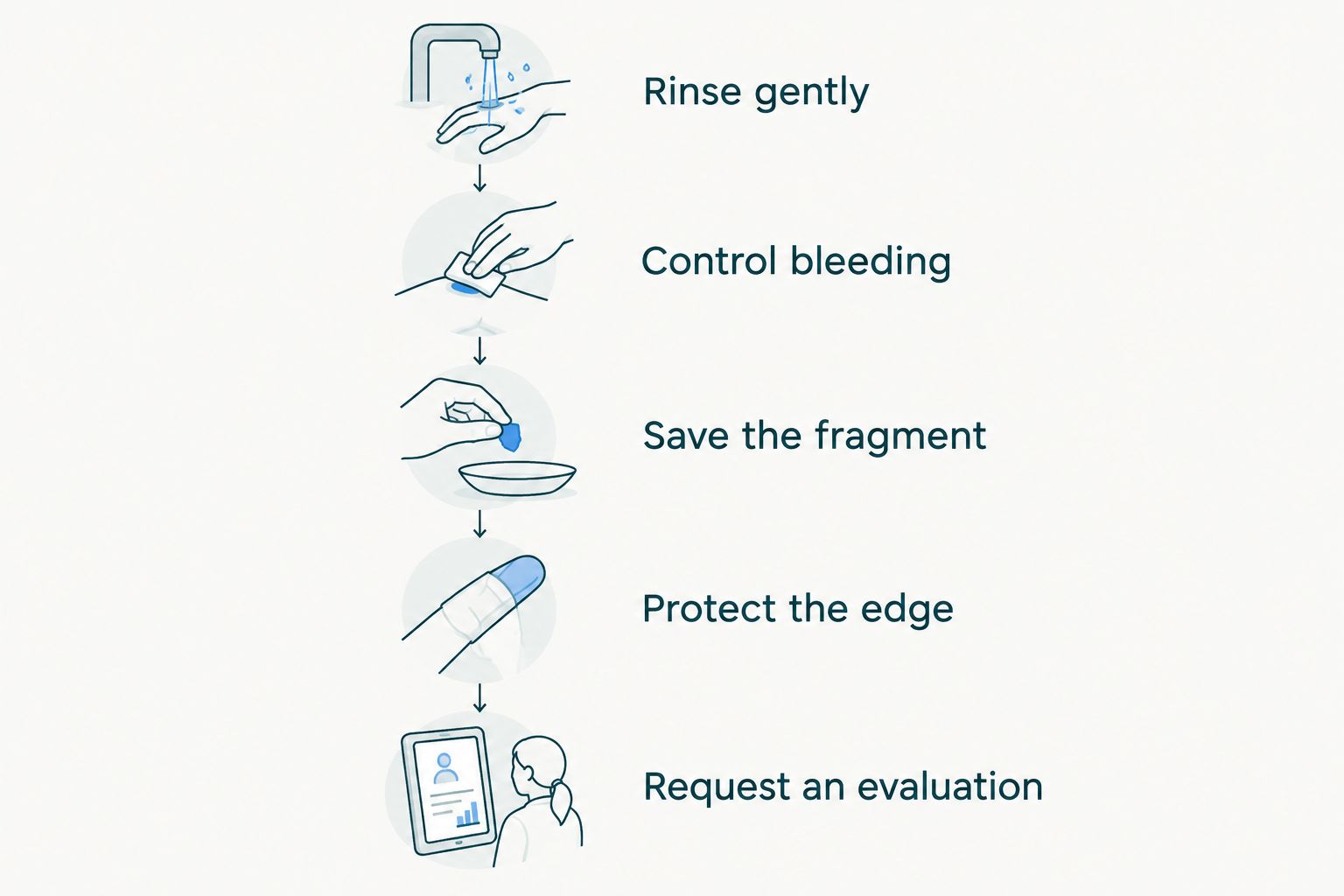
Use these steps while arranging professional care:
- Rinse gently. Rinse your mouth with warm water to clear loose debris. Avoid vigorous rinsing if the surrounding tissues are bleeding.
- Control bleeding. Hold clean gauze against bleeding gum or lip tissue with steady pressure. Seek urgent care if bleeding remains uncontrolled.
- Save the fragment. If you find a broken piece, place it in a clean container with milk and bring it to the dentist. Do not try to glue it back into place.
- Protect the edge. Orthodontic wax can temporarily cover a sharp edge that rubs your tongue or cheek. Follow the package directions and do not push material into a deep break.
- Avoid pressure. Choose soft foods and chew away from the damaged tooth. Avoid biting hard foods with it, even if doing so does not hurt.
- Request an evaluation. Describe the injury, symptoms, swelling, and whether the tooth feels loose or your bite has changed. Ask how soon the tooth should be examined.
These steps are first aid, not a treatment plan. If a tooth has been completely knocked out rather than chipped, tell the dental team immediately: a knocked-out permanent tooth needs different, time-sensitive care.
What should you avoid putting on a chipped tooth?
Do not use household glue, file the tooth, or attempt to drill or reshape it. Those actions can injure surrounding tissue, remove healthy tooth structure, or make the eventual repair more difficult.
Avoid these common home-repair mistakes:
- Household adhesives: Superglue and craft glue are not dental restorations. Do not use them to attach a fragment or fill a gap.
- Nail files and abrasive tools: Smoothing a tooth yourself removes material without showing where the damage ends.
- Aspirin against the gum: Placing aspirin directly on oral tissue can cause a chemical burn. Use medicines only as directed.
- Repeated bite testing: Biting down to check whether the tooth still hurts puts more force on an injured area.
- Unsupervised cosmetic fixes: Covering the appearance of a chip does not assess the tooth underneath.
A pharmacy temporary filling or cement product is not interchangeable with chipped-tooth treatment. Some products are intended for particular situations, such as a lost filling or loose crown. Ask a dental professional whether a product fits your situation before applying it, and follow its directions exactly.
When does a chipped tooth need urgent attention?
Contact a dentist promptly after a tooth injury, especially if you have worsening pain, temperature sensitivity, swelling, a loose tooth, or a bite that no longer feels normal. Mention a visible pink or red area inside the break. These signs help the dental team assess urgency; they do not establish a diagnosis on their own.
Difficulty breathing or swallowing, rapidly spreading facial or neck swelling, and uncontrolled bleeding need emergency medical attention. A significant facial injury also needs urgent assessment rather than a home repair attempt.
For dental concerns in Vista in 2026, Thevistadentist usually has same-day emergency evaluations available during normal office hours, subject to availability. Call or request an appointment to ask about the next available evaluation. An inquiry is not a confirmed booking, and an evaluation does not guarantee same-day treatment or after-hours care.
If you are uncertain whether your symptoms require emergency care, describe them clearly when you call. Do not minimize swelling or difficulty swallowing because the broken area looks small.
What can a dentist do for a chipped tooth?
Treatment depends on the examination, not just the size of the missing piece. A dentist checks the tooth, surrounding tissues, and bite; dental X-rays are used when clinically indicated. The aim is to understand the injury before deciding how to protect or restore the tooth.
The options below remain examination-dependent in 2026. A visible chip does not automatically mean you need a crown, and a small-looking break does not automatically mean bonding is enough.
| Option | Best for | What it does | Limitation |
|---|---|---|---|
| Professional smoothing | Selected very small, shallow chips | Rounds an uneven edge | Does not replace missing tooth structure |
| Dental bonding | Suitable chips with enough healthy tooth remaining | Uses tooth-colored resin to rebuild the missing area | Can chip or stain and needs ongoing care |
| Dental crown | Teeth needing broader coverage after significant damage | Covers and protects the remaining tooth | Requires preparation of the tooth and is not necessary for every chip |
| Root canal treatment with restoration | Teeth whose pulp requires treatment after injury | Treats damaged or infected tissue inside the tooth before restoration | Is not required simply because a tooth is chipped |
These are possible approaches, not recommendations for your tooth. Ask what the examination shows, why a particular option is being recommended, and what alternatives are clinically suitable.
Can the dentist use the broken piece?
A dentist can sometimes reattach a tooth fragment when its condition and the injury make that appropriate. Bring the fragment even if you are unsure whether it is useful. Keeping it does not guarantee reattachment, and losing it does not mean the tooth cannot be repaired.
Does bonding last forever?
Dental bonding is not permanent in the sense of lasting indefinitely without maintenance. Resin can wear, stain, or chip, and a dentist needs to monitor it. Avoid using a bonded tooth to open packages or bite hard objects, and keep recommended follow-up appointments.
Why chipped tooth treatment varies
The right repair addresses both the missing piece and the condition of the remaining tooth. These factors explain why two people with similar-looking chips can receive different recommendations:
- Depth of the break: An enamel-only chip differs from damage that reaches dentin or the pulp inside the tooth.
- Remaining tooth structure: The amount and condition of healthy tooth affect how a restoration can be supported.
- Position of the damage: A chip on a biting edge faces different forces from damage elsewhere on the tooth.
- Cracks or decay: A visible chip can occur alongside problems that need attention before a restoration is placed.
- Bite and grinding habits: Clenching, grinding, or an uneven bite can affect how much force the repaired area receives.
- Nerve and supporting-tissue health: Injury can involve the inside of the tooth or the tissues that hold it in place.
You do not need to work out these factors at home. Tell the dentist how the injury happened and what has changed since then. That history is more useful than trying to label the fracture yourself.
What should you tell a Vista dentist when you call?
Start with the problem: you have a chipped or broken tooth and need advice about an evaluation. Explain when it happened, whether it followed a fall or blow, and whether you have pain, bleeding, swelling, looseness, or difficulty eating. Say whether you found the fragment.
For your 2026 appointment request, also mention any temporary material you have applied and any medicine you have taken. If you are anxious, ask for explanations before each part of the examination. You can request a pause or clarification without committing to a treatment decision.
Useful questions include:
- Does my description suggest that I need an urgent evaluation?
- What should I avoid eating or doing before the visit?
- What will the examination involve?
- Will you explain the findings and treatment alternatives before starting?
- How will I receive an estimate for the recommended care?
Choose clear explanations over a treatment promise made before anyone examines the tooth. Thevistadentist provides emergency, general, restorative, and cosmetic dental care in Vista; which service fits your injury is decided after evaluation. The benefit of local assessment is a plan based on your tooth, while the practical limit is that neither the treatment nor its timing can be confirmed from an online description alone.
Request a chipped tooth evaluation
Ask about the next available evaluation in Vista. Your request is not a confirmed appointment.
FAQ
Can I fix a small chipped tooth myself if it does not hurt?
No. A painless chip still needs dental assessment because pain alone does not show how deeply a tooth is damaged. Protect the edge, avoid biting on it, and request an evaluation.
Can I use superglue to repair a chipped tooth?
No. Household superglue is not a dental repair material and should not be used to attach a fragment or fill a tooth. Save any fragment and bring it to the dentist instead.
What can I put over a sharp chipped tooth?
Orthodontic wax can temporarily cover an edge that irritates your tongue or cheek. Follow the package directions, and remember that covering the edge does not repair the tooth.
Should I save a piece of my broken tooth?
Yes. Place the fragment in a clean container with milk and bring it to the dental evaluation. A dentist can assess whether reattachment is appropriate, but it is not guaranteed.
Can I wait until a chipped tooth starts hurting?
Do not use pain as the signal to arrange care. Contact a dentist after the injury and describe your symptoms so the team can advise you about urgency.
Can I get a same-day chipped tooth appointment in Vista in 2026?
Same-day emergency evaluations are usually available during normal office hours at the Vista practice, subject to availability. Call or request an appointment to confirm an evaluation; same-day treatment and after-hours care are not guaranteed.
Will every chipped tooth need a crown or root canal?
No. Selected small chips can be smoothed or restored with bonding, while more extensive damage needs a different approach. A crown or root canal is recommended only when the examination supports it.
One last thing
A tooth that feels better has not necessarily repaired itself. Sensitivity can change, and a sharp edge can become less noticeable, without the missing tooth structure growing back. Keep the evaluation even if the tooth stops bothering you, and bring the fragment if you have it.
Related guides
- How much does chipped tooth repair cost?
- How is a chipped front tooth repaired?
- Chipped tooth repair: what happens at a dental evaluation?
- Cosmetic options for a chipped front tooth in Vista, CA