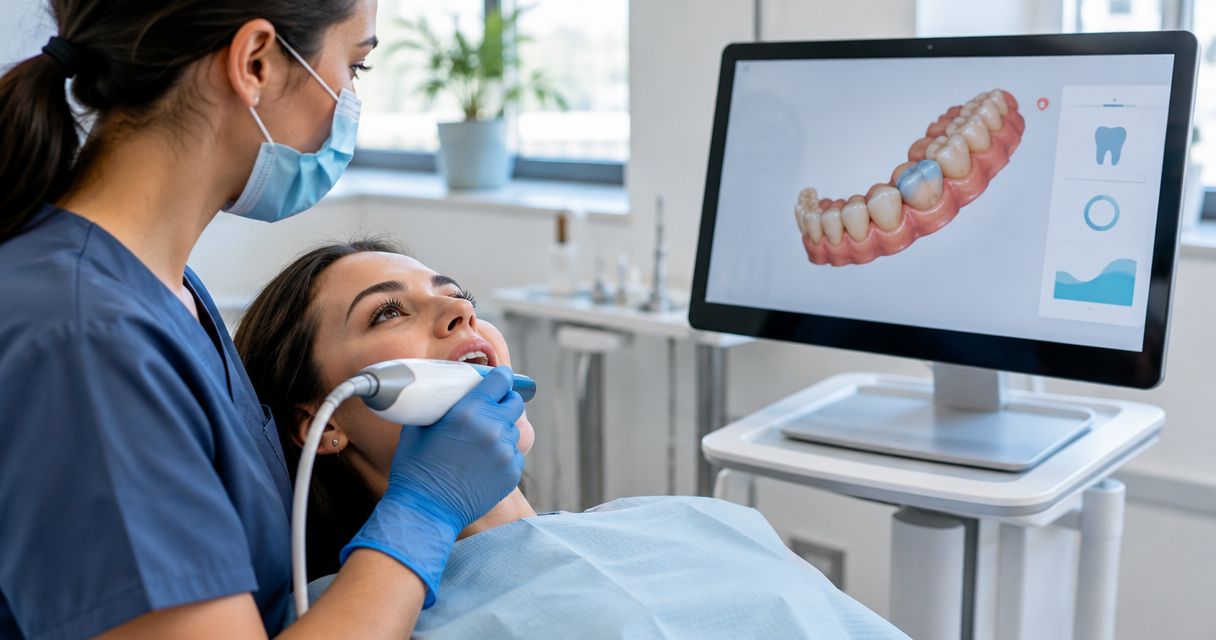
Digital scans for dental crowns replace a tray of impression material with a handheld scanner that records the shape of your teeth and bite. They change how your dentist captures the information used to make a crown—not whether you need tooth preparation, numbing, or a separate fitting appointment. A digital impression does not, by itself, mean you will receive a same-day crown.
- Digital scans for dental crowns capture tooth shape without a conventional impression tray.
- Santa Fe Dental Group uses digital impressions for crowns, bridges, and dentures in Vista.
- Digital impressions do not replace an examination, necessary X-rays, tooth preparation, or final bite checks.
- Ask separately about scanning, temporary crowns, and the appointment for your finished restoration.
Why this matters
Knowing which part of a crown appointment changes can make the visit feel more predictable. A scanner changes the impression step; it does not remove the care needed to prepare your tooth or check the finished crown.
Santa Fe Dental Group is a fit for Vista patients seeking dental crowns with digital impressions and clear explanations. You can learn about Santa Fe Dental Group before requesting an evaluation, then ask how the crown process applies to your tooth.
For a crown appointment in 2026, the useful question is not simply whether the office scans teeth. Ask what the scan replaces, what you will feel, and when the finished crown will be fitted.
How do digital scans change a dental crown appointment?
Digital scans change the way your dentist records the prepared tooth, nearby teeth, and how your upper and lower teeth meet. Instead of holding impression material around those teeth while it sets, the dental team moves a scanner through your mouth to build a digital surface model.
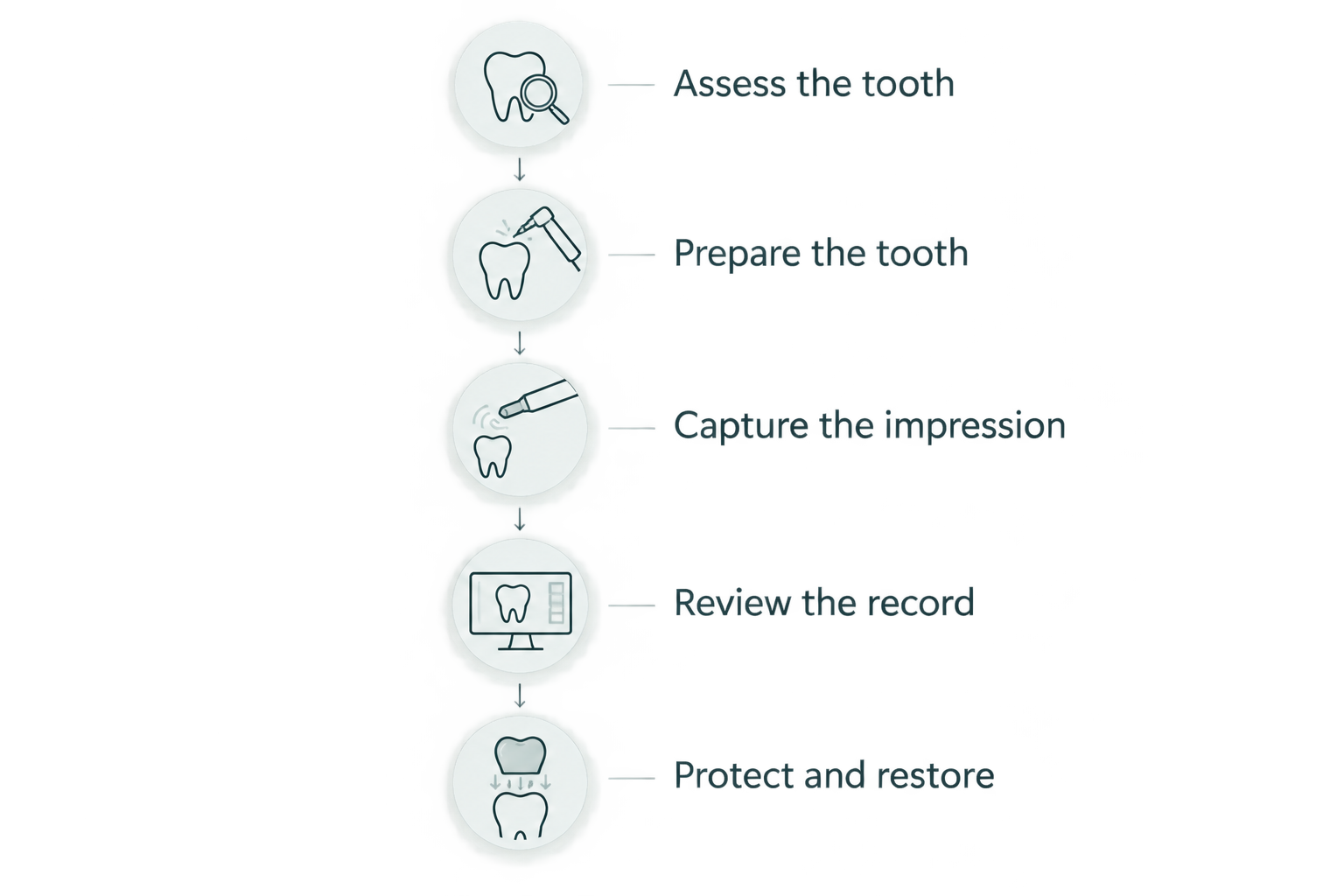
The overall process still includes these steps, with the exact sequence determined by your treatment:
- Assess the tooth. Your dentist examines the tooth and uses any necessary diagnostic images to decide whether a crown is appropriate.
- Prepare the tooth. Your dentist numbs the area as needed, treats the tooth, and shapes it to accommodate the crown.
- Capture the impression. The scanner records the prepared tooth and other information needed to design the restoration.
- Review the record. Your dental team checks whether the scan shows the necessary surfaces clearly.
- Protect and restore the tooth. Your dentist explains any temporary crown, the fabrication process, and the appointment for fitting the finished crown.
Some records can be taken before preparation as well. Your dentist chooses the sequence based on the condition of your tooth and the information needed—not a fixed scanning routine for everyone.
What changes compared with a conventional impression?
A digital impression creates a computer model from images of tooth surfaces. A conventional impression creates a physical record using material held in a tray. Both are ways to provide the shape information needed for a restoration.
The practical benefit of scanning is avoiding the conventional impression tray during that step. The limitation is that the scanner still needs a clear view, enough access, and your cooperation while the dental team captures the required surfaces.
| Impression method | What happens | Main benefit | Main limitation | Best for |
|---|---|---|---|---|
| Digital impression | A handheld scanner records tooth surfaces | Avoids a conventional impression tray | Requires clear visibility and access to the necessary surfaces | Patients whose crown case can be recorded digitally, especially those concerned about impression material |
| Conventional impression | A tray holds impression material while it sets | Provides a physical impression when the dentist selects that technique | Requires holding the tray and material in the mouth | Cases where the dentist determines a physical impression is appropriate |
Neither method replaces the dentist's judgment. A clear digital record is useful, but crown fit also depends on tooth preparation, design, fabrication, and the final clinical checks.
If you have had an uncomfortable impression before, describe what bothered you. A gagging sensation, difficulty breathing through your nose, and jaw fatigue call for different kinds of support.
What will you feel during a digital crown scan?
During the scan, you will keep your mouth open while the scanner tip moves near your teeth. The team can ask you to change your opening or bite position so the scanner captures different surfaces and how your teeth meet.
You can still feel cheek or tongue movement, air used to dry the area, or the effort of holding your mouth open. A digital scan avoids impression material, but it does not promise a sensation-free appointment.
If dental visits make you anxious, agree on a stop signal before treatment begins. Tell the team if you need a pause, have a sensitive gag reflex, or find it difficult to keep your jaw open.
The scan itself is separate from tooth preparation. If you are worried about pain, ask your dentist to explain which parts require numbing and what sensations to report during those steps.
Why the digital scanning experience varies
Your crown appointment in 2026 should be planned around your mouth and the tooth being treated, rather than a promised scan time. The same device does not make every appointment identical.
Several clinical factors affect how the impression step proceeds:
- Tooth location. Reaching a back tooth involves different scanner positioning than recording a front tooth.
- Gum condition. Blood or inflamed tissue can interfere with a clear view of the edge of the prepared tooth.
- Moisture control. Saliva needs to be managed while the team records the tooth surfaces.
- Mouth opening. Limited opening or jaw fatigue affects access and the need for breaks.
- The prepared edge. The dentist needs a clear record of where the crown will meet the tooth.
- The bite record. The scan must include enough information about opposing teeth and how they meet.
An additional scan of an area is not, by itself, a sign that something has gone wrong. It can be part of checking and completing the record before the crown is made.
Does a digital scan mean I can get a same-day crown?
A digital scan does not mean a same-day crown. Scanning records information; fabricating the crown is a separate step that depends on the office's process and your treatment plan.
Ask whether your crown will be made by a dental laboratory and whether you will wear a temporary crown. Do not assume that a screen showing your tooth means the finished restoration is being made during that visit.
For your 2026 appointment, confirm the expected sequence before arranging time away from work or help with transportation. Ask about the preparation visit, any temporary restoration, and the fitting visit separately.
Santa Fe Dental Group uses digital impressions for crown care. That describes how the impression is taken, not a promise of same-day crown fabrication.
Do I still need X-rays and tooth preparation?
Digital scans do not replace necessary X-rays or tooth preparation. An optical scan records visible surfaces; it does not show the inside of a tooth, its roots, or the surrounding bone in the way dental X-rays can.
Your dentist decides which diagnostic records are necessary after evaluating your tooth. The scanner cannot determine on its own whether a tooth needs a crown or whether another problem needs attention first.
A crown also needs room to fit over the tooth. When preparation is required, the dentist still shapes the tooth and addresses the underlying condition before recording the final impression.
This distinction matters if your main concern is avoiding drilling or numbing. Ask about the treatment itself, not only the impression method, so you understand what your appointment involves.
What stays the same when the finished crown is fitted?
Your dentist still needs to evaluate the finished crown in your mouth. A digital design does not remove the need to check the edges, contact with neighboring teeth, and your bite before completing treatment.
Tell your dentist how the crown feels when you close and move your teeth together. A restoration that feels comfortable while your mouth is open can feel different when you bite.
You also still need instructions for cleaning around the crown and caring for the supporting tooth. A crown covers tooth structure, but the tooth and surrounding gums continue to need daily care and dental follow-up.
If you receive a temporary crown, follow the instructions provided for that temporary restoration. Contact the dental office if it loosens or you develop symptoms rather than waiting for the fitting visit without advice.
What should I ask before scheduling a crown appointment?
For a crown consultation in 2026, bring questions about comfort and appointment sequence—not just the scanner. Your answers should help you understand what is planned without requiring you to choose treatment before an examination.
Start with these questions:
- Will a digital scan be suitable for the tooth being evaluated?
- Which parts of the appointment involve numbing or tooth preparation?
- Can the team pause if my jaw becomes tired or I feel anxious?
- Will I need a temporary crown?
- What happens between the impression and the finished crown fitting?
- Who should I contact if the temporary crown feels loose or my bite feels uncomfortable?
Bring a current medication list and explain any past difficulty with dental treatment. If you have limited opening, a strong gag reflex, or sensitivity, mention it before the appointment rather than trying to manage it silently.
You can contact the office to request an evaluation and explain your concerns. A request is not a confirmed appointment; ask the team to confirm the date, time, and purpose of the visit.
FAQ
Do digital scans for dental crowns hurt?
Digital scanning records tooth surfaces without cutting the tooth, but holding your mouth open or moving the scanner around sensitive areas can feel uncomfortable. Tooth preparation is a separate step, and your dentist can explain the numbing planned for it.
Can I get a digital crown scan if I gag with impression trays?
Digital scanning avoids the tray and setting material used for conventional impressions, which can help if those trigger your gag reflex. It does not guarantee that you will not gag, so explain your triggers and agree on a stop signal.
Does a digital scan use the same radiation as an X-ray?
An optical dental impression scanner does not use ionizing radiation like a dental X-ray. It records visible surfaces, so your dentist can still recommend X-rays when needed to assess the tooth and surrounding structures.
Will I still need a temporary crown after a digital scan?
You can still need a temporary crown after a digital scan if the finished crown will be fitted at a later visit. Ask your dentist how the prepared tooth will be protected between appointments.
Are digital impressions always better than conventional impressions?
Digital impressions are not the right choice for every clinical situation. They avoid conventional impression material, but the dentist still needs clear access and a complete record to plan the crown.
What should I confirm about my crown appointment in 2026?
For a crown appointment in 2026, confirm which visit includes preparation, whether a temporary crown is planned, and when the finished crown will be fitted. Digital scanning alone does not establish the treatment schedule.
Does Santa Fe Dental Group use digital impressions for crowns?
Santa Fe Dental Group uses digital impressions for crowns, bridges, and dentures. Request an evaluation to discuss whether a digital impression is appropriate for your crown treatment and what the appointment will involve.
One last thing
Ask your dentist to explain the difference between the scan and the finished crown. Seeing your tooth on a screen can make the process easier to understand, but the model is a treatment record—not confirmation that the crown is complete or ready to fit.
Before you leave, make sure you know what happens next and whom to contact with questions. That clear handoff matters whether your impression is digital or conventional.
Related guides