

Bonding is an option for chipped tooth repair when the damaged area can be rebuilt with tooth-colored resin and enough healthy tooth remains to support it. A dentist must first check the chip, your bite, and the health of the tooth; a small-looking break can need more than a cosmetic repair. Bonding restores shape, but it does not treat an infected tooth or make every cracked tooth safe to use.
- Chipped tooth repair bonding suits selected chips when healthy tooth structure can support tooth-colored resin.
- A dental examination checks for decay, deeper cracks, and bite pressure before treatment is chosen.
- Bonding preserves tooth structure, but the resin can stain, wear, or chip.
- Thevistadentist offers dental evaluations in Vista; request an appointment before assuming bonding is the right repair.
Why this matters
A chipped tooth can feel much larger to your tongue than it looks in the mirror. The visible size alone does not tell you whether bonding is appropriate, particularly if the tooth hurts when you bite or reacts to temperature.
For a chipped tooth in 2026, the useful first step is still an examination—not choosing a material from a photograph. This guide to what happens at a dental evaluation for chipped tooth repair explains that appointment in more detail.
When is bonding an option for chipped tooth repair?
Bonding is often considered for a limited chip when the dentist can attach resin to sound tooth structure, recreate a useful shape, and keep the repair from taking excessive biting pressure. It can also help restore the appearance of an uneven front tooth. Suitability depends on the condition of the whole tooth, not simply whether the missing piece looks small.
The main repair options address different problems. These are possibilities to discuss after an examination, not treatments you need to choose yourself.
| Option | Best for | Main benefit | Main limitation |
|---|---|---|---|
| Smoothing or polishing | A very small, superficial irregular edge | Removes a rough area without adding a restoration | Does not replace a substantial missing piece |
| Dental bonding | A chip that healthy tooth structure can support | Rebuilds shape with tooth-colored resin | Resin can stain, wear, or chip under pressure |
| Veneer | Selected front teeth needing a broader surface change | Changes the visible front surface and shape | Often requires enamel removal and is not a solution for every damaged tooth |
| Crown | A tooth needing more extensive coverage and protection | Covers more of the remaining tooth | Requires more tooth preparation than a limited bonded repair |
Choose the repair that fits the damage, rather than the repair that sounds simplest. If the examination finds an injury to the tooth's inner tissue, the dentist will explain whether treatment beyond a surface restoration is needed.
Bonding for a small edge chip
A limited chip at the edge of a tooth is a common reason to consider bonding. The dentist adds resin, shapes the replacement edge, and checks how it meets the opposing teeth. The goal is a comfortable shape that fits your bite as well as your smile.
Bonding is especially useful when adding material makes more sense than removing additional healthy tooth. However, a thin edge that repeatedly meets heavy biting force can be vulnerable to another break. Tell the dentist if the tooth has chipped before or if you bite your nails, chew pens, or clench your teeth.
A tiny rough spot does not automatically need bonding. If smoothing would address the problem without changing the tooth unfavorably, the dentist can explain that option too.
Bonding for a visible front-tooth chip
For a front tooth, appearance and function need equal attention. Resin can be selected to blend with the surrounding tooth, then shaped and polished to restore the missing contour. A natural-looking result depends on more than matching a basic shade: the edge shape and surface texture matter too.
Bonding has limits. Resin can discolor over time, and a repair does not whiten in the same way as natural enamel. If you are considering whitening in 2026, discuss the sequence before choosing the final bonding shade.
You do not need to decide between bonding and a veneer before your appointment. Explain what bothers you—an uneven edge, a visible gap left by the chip, or a change in shape—and ask which approach addresses it while preserving healthy tooth.
When bonding alone is not enough
A large missing portion, decay around the break, or a crack extending farther into the tooth can change the treatment plan. Bonding a visible corner does not resolve damage underneath it. A dentist needs to determine whether the remaining structure can support a restoration safely.
Pain also changes the conversation. Lingering temperature sensitivity, pain when biting, or spontaneous aching deserves assessment rather than an assumption that a cosmetic patch will solve it. These symptoms do not establish a diagnosis on their own.
If a crown or another treatment is recommended, ask the dentist to show you the finding that supports it. A clear explanation should connect the proposed treatment to the tooth's condition, not just to its appearance.
Why bonding suitability varies
The same-looking chip can require different care in different mouths. These factors help explain why an examination matters:
- Remaining tooth: Bonding needs sound structure to support the repair. Missing or weakened tooth changes what is practical.
- Depth of damage: A surface chip is different from a break involving deeper tissue or an associated crack.
- Bite pressure: The way your teeth meet affects the force placed on a repaired edge.
- Decay or existing restorations: A chip beside a filling needs assessment of the surrounding tooth and restoration.
- Appearance goals: Replacing an isolated corner is different from changing the color or shape of the whole front surface.
- Clenching and habits: Repeated pressure or biting hard objects can damage resin and natural teeth alike.
For treatment planning in 2026, ask which of these factors affects your tooth. That question is more useful than asking whether bonding is generally a good treatment.
What happens before and during dental bonding?
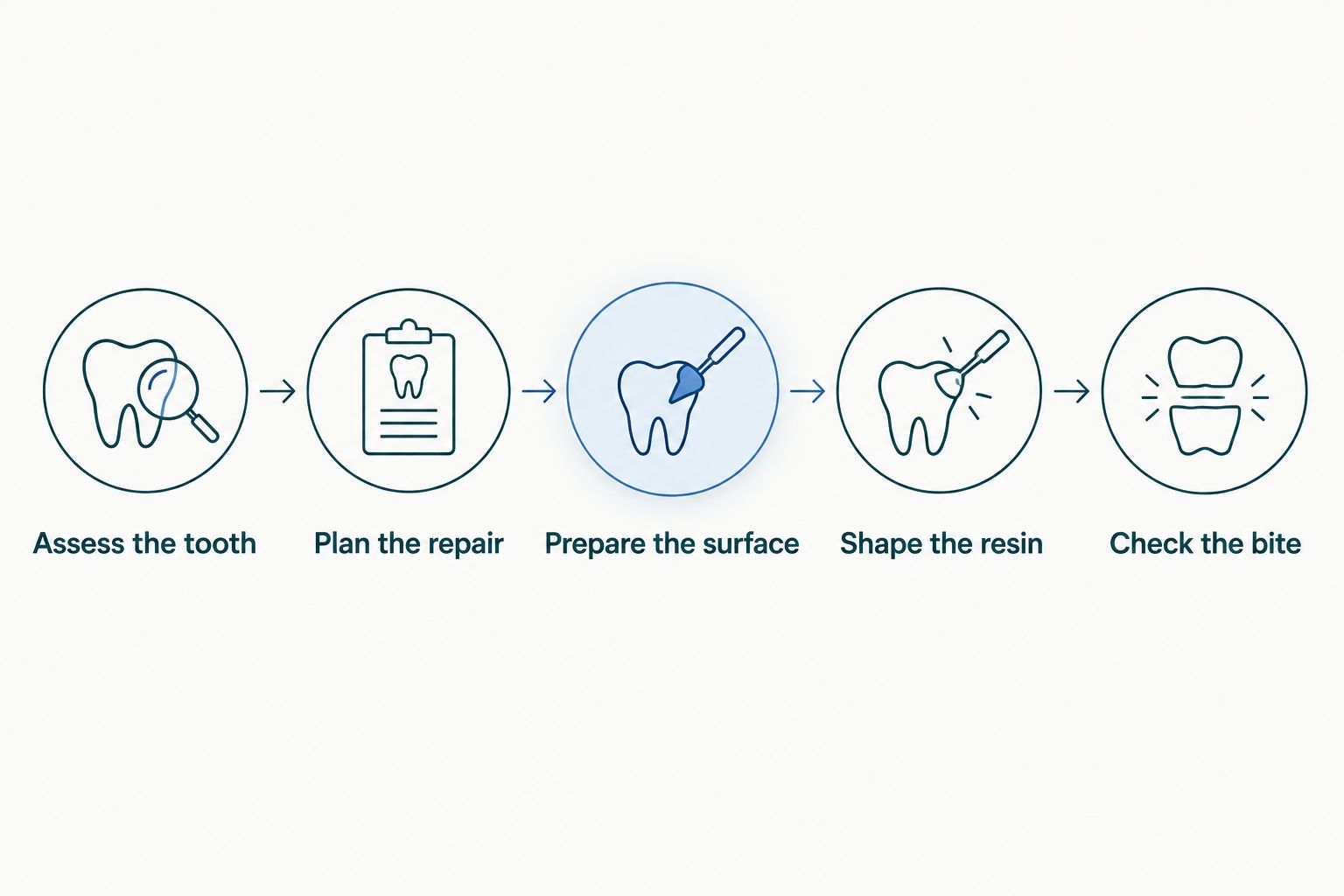
The exact visit depends on your examination and the repair required. A typical bonding process follows this sequence:
- Assess the tooth. The dentist reviews the injury, symptoms, remaining structure, and bite. X-rays are taken when clinically indicated.
- Plan the repair. You discuss whether bonding suits the damage, what it can change, and its limitations.
- Prepare the surface. The dentist prepares the tooth so the resin can attach. The amount of preparation depends on the tooth's condition.
- Shape the resin. Tooth-colored material is placed, shaped, and hardened with a curing light.
- Check the bite. The dentist adjusts and polishes the repair, then checks how the teeth meet.
Tell the dentist if you feel anxious about treatment. You can ask for an explanation before each step and discuss comfort measures before work begins. Whether numbing is needed depends on the damage and the treatment involved; bonding is not automatically a no-anesthetic procedure.
What should you do while waiting for an evaluation?
Protect the tooth rather than testing how strong it feels. Avoid biting hard foods with the damaged area, keep the area clean, and do not try to file the edge yourself. Household glue is not a dental repair material.
If you find the broken fragment, keep it and bring it to your appointment. A dentist can determine whether it is useful; finding it does not mean reattachment will be appropriate.
Contact a dentist promptly if the tooth hurts, the edge injures your tongue, or the break followed a blow to the mouth. Trouble breathing or swallowing, or significant facial swelling, needs urgent medical attention. A tooth knocked completely out requires a different, time-sensitive response from a simple chip.
Can a chipped tooth be bonded if it does not hurt?
A painless chipped tooth can be suitable for bonding, but the absence of pain does not establish that the damage is superficial. The dentist still needs to check the tooth and determine whether smoothing, bonding, or another approach fits.
Can a bonded tooth chip again?
A bonded tooth can chip again because both the resin and the remaining natural tooth remain vulnerable to damage. Avoid chewing hard objects and ask whether bite pressure or clenching contributed to the original break.
Is bonding always better than a crown for a chip?
Bonding is not always better than a crown; each addresses a different level of damage. Bonding can preserve more tooth when a limited repair is appropriate, while a crown can be considered when the tooth needs more extensive coverage.
Choosing a chipped-tooth evaluation in Vista
Thevistadentist is best for Vista patients seeking a local dental evaluation before deciding on chipped-tooth bonding. The practice offers general, restorative, cosmetic, and emergency dental care. The appropriate service depends on what the examination finds.
Same-day emergency evaluations are usually available during normal office hours, subject to availability. Requesting an appointment does not confirm a booking, and an emergency evaluation does not guarantee same-day treatment. Ask the office to confirm the appointment and explain what to expect.
You can request an evaluation through Thevistadentist. Mention when the chip happened, whether you have pain or swelling, and whether the tooth has been repaired before. Those details help the team understand your concern without deciding treatment before examining you.
Request a chipped-tooth evaluation
Ask about an evaluation in Vista. Appointment timing and treatment depend on availability and your examination.
Caring for a bonded repair
Brush with fluoride toothpaste, clean between your teeth, and attend the follow-up visits your dentist recommends. A bonded repair still needs daily care, and the natural tooth around it can develop decay.
Avoid using the repaired tooth to open packaging or bite hard objects. If you clench or grind, ask whether a protective appliance is appropriate rather than choosing one without guidance.
Contact the practice if the repair feels high when you bite, becomes rough, loosens, or develops new sensitivity. Do not assume that discomfort is something you must simply get used to. An adjustment or examination can identify what needs attention.
FAQ
Is chipped tooth repair bonding a good option in 2026?
Chipped tooth repair bonding is a good option when healthy tooth structure can support resin and the repair fits your bite. A dental examination determines whether bonding addresses the damage or whether another treatment is needed.
Does getting a chipped tooth bonded hurt?
Your comfort needs depend on the chip and the work required. Ask the dentist whether numbing is recommended and explain any dental anxiety before treatment begins.
Can bonding fix a chipped front tooth?
Bonding can restore a chipped front tooth when the remaining structure and bite support the repair. The dentist shapes and polishes tooth-colored resin to replace the missing contour.
How long will bonding last on my chipped tooth?
There is no fixed lifespan for an individual bonded repair. Its condition depends on the size and location of the repair, bite forces, habits, and ongoing care.
Can I whiten my teeth after bonding in 2026?
Whitening does not lighten bonded resin in the same way it lightens natural teeth. Discuss whitening plans before bonding so the dentist can explain shade matching and treatment order.
Can I get a same-day chipped-tooth appointment in Vista?
Same-day emergency evaluations at Thevistadentist are usually available during normal office hours, subject to availability. Contact the office to request and confirm an appointment; same-day treatment is not guaranteed.
Should I wait until a chipped tooth hurts before seeing a dentist?
Do not use pain as the only reason to arrange an evaluation. A painless chip still needs assessment to establish its depth, the condition of the remaining tooth, and the appropriate repair.
One last thing
Before leaving your appointment, ask: What should feel normal when I bite, and what should prompt a call? A repair can look right in the mirror while still needing a bite adjustment. Knowing what to watch for makes aftercare clearer and gives you a practical reason to contact the practice if something feels wrong.
Related guides
- How is a chipped front tooth repaired?
- Cosmetic options for a chipped front tooth in Vista, CA
- What affects chipped tooth repair costs?